• Fri frakt över 249 kr
  • •
  • Snabba leveranser
  • •
  • Billiga böcker
Kundservice

Du är på sajten för privatpersoner.

Företag, bibliotek eller offentlig verksamhet?

Du handlar på classic.bokus.com, där alla dina funktioner finns intakta.
Till classic.bokus.com
Bokus logotyp. Gå till startsidan.
  • Erbjudanden
  • Nyheter
  • Student
  • Topplistor
  • Barn & ungdom
  • Bokus Play
  • E-böcker
  • Pocketböcker
  • Spel & pussel

10% rabatt på allt med kod: NYSTART10 →

Sidfot

Mina sidor

    Hjälp

    • Kundservice
    • Vanliga frågor och svar
    • Frakt och leverans
    • Retur vid ångerrätt
    • Reklamera vara
    • Betalning
    • Köpvillkor
    • Allmänna villkor
    • Information om webbplatsens tillgänglighet

    Om Bokus

    • Om oss
    • Pressrum
    • För studenter
    • För företag
    • För bibliotek och offentlig verksamhet
    • För leverantörer
    • Hållbarhet

    Populärt

    • Aktuella erbjudanden
    • Presentkort
    • Studentlitteratur
    • Nya böcker
    • Topplistor
    • Signerade böcker
    • Engelska böcker

    Inspiration

    • Boktips
    • BookTok
    • Populära bokserier
    • Barnbokskaraktärer
    • Populära författare
    Logotyp för Bokus
    Följ oss på Facebook (extern länk)Följ oss på Instagram (extern länk)Följ oss på YouTube (extern länk)Följ oss på TikTok (extern länk)
    bokus @ CookiesAnpassa cookiesIntegritetspolicyKöpvillkor
    Till Citymail hemsida (extern länk)Till Budbee hemsida (extern länk)Till Postnord hemsida (extern länk)Till Schenker hemsida (extern länk)Till Early Bird hemsida (extern länk)Till Walleys hemsida (extern länk)
    1. Naturvetenskap och teknik
    2. Teknik och industri
    3. Tillverkningsteknik

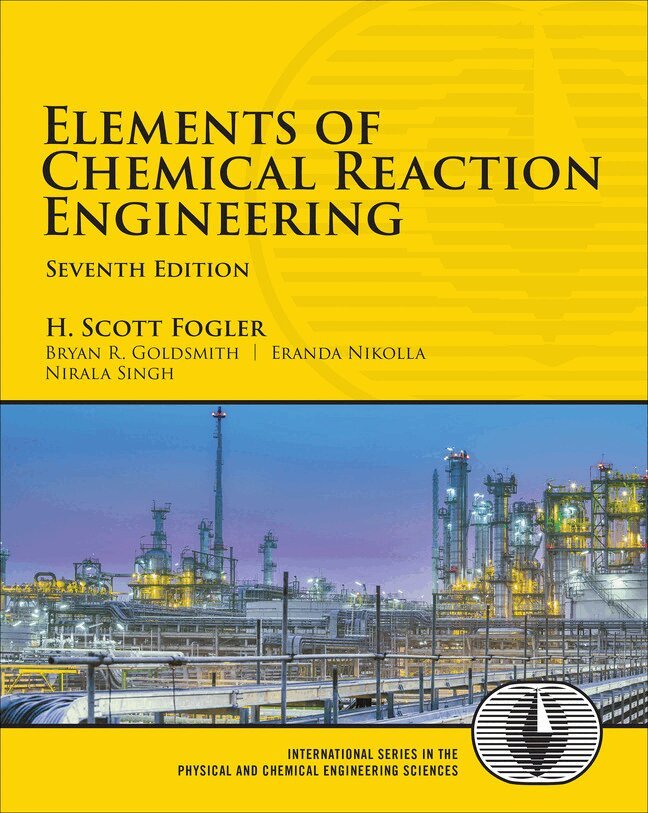
    Elements of Chemical Reaction Engineering

    AvH. Fogler,Bryan Goldsmith

    Häftad, Engelska, 2025

    Del i serien International Series in the Physical and Chemical Engineering Sciences

    1 143 kr

    Beställningsvara. Skickas inom 7-10 vardagar. Fri frakt över 249 kr.

    Fler format och utgåvor

    Häftad

    2 457 kr

    Beskrivning

    The Essential Textbook for Mastering Chemical Reaction Engineering--Now Fully Updated with Expanded Coverage of Electrochemical Reactors

    H. Scott Fogler's Elements of Chemical Reaction Engineering, now in its seventh edition, continues to set the standard as the leading textbook in chemical reaction engineering. This edition, coauthored by Bryan R. Goldsmith, Eranda Nikolla, and Nirala Singh, still offers Fogler's engaging and active learning experience, with updated content and expanded coverage of electrochemical reactors.

    Reflecting current theories and practices, and with a continuing emphasis on safety and sustainability, this edition includes expanded sections on molecular simulation methods, analysis of experimental reactor data, and catalytic reactions.

    Leveraging the power of Wolfram, Python, POLYMATH, and MATLAB, students can explore the intricacies of reactions and reactors through realistic simulation experiments. This hands-on approach allows students to clearly understand the practical applications of theoretical concepts.

    This book prepares undergraduate students to apply chemical reaction kinetics and physics to the design of chemical reactors. Advanced chapters cover graduate-level topics, including diffusion and reaction models, residence time distribution, and tools to model non-ideal reactors.

    The seventh edition includes

    • An expanded section on molecular simulation methods and potential energy surfaces
    • Updated examples of experimental reactor data and its analysis
    • Detailed discussion of definitions in catalysis and examples of catalytic reactions
    • Additional examples and an expanded section on surface reaction mechanisms and microkinetic modeling
    • A new chapter on electrochemical reactors with example problems, reflecting the growing importance of this field in renewable energy and industrial processes

    About the Companion Web Site (umich.edu/~elements/7e/index.html)

    • Comprehensive PowerPoint slides for lecture notes for chemical reaction engineering classes
    • Links to additional software, including POLYMATHTM, MATLABTM, Python, Wolfram MathematicaTM, AspenTechTM, and COMSOLTM
    • Interactive learning resources linked to each chapter, including Learning Objectives, Summary Notes, Web Modules, Interactive Computer Games, Solved Problems, FAQs, additional homework problems, and links to LearnChemE and other resources
    • Living Example Problems provide interactive simulations, allowing students to explore the examples and ask "what-if" questions
    • Professional Reference Shelf, which includes advanced content on reactors, weighted least squares, experimental planning, pharmacokinetics, detailed explanations of key derivations, and more
    • Redesigned Web site to increase accessibility

    Register your book for convenient access to downloads, updates, and/or corrections as they become available. See inside book for details.

    Produktinformation

    • Utgivningsdatum:2025-04-16
    • Mått:204 x 255 x 39 mm
    • Vikt:1 989 g
    • Format:Häftad
    • Språk:Engelska
    • Serie:International Series in the Physical and Chemical Engineering Sciences
    • Antal sidor:1 136
    • Upplaga:7
    • Förlag:Pearson Education
    • ISBN:9780135337554

    Utforska kategorier

    • Tillverkningsteknik inom Naturvetenskap och teknik

    Mer om författaren

    H. Scott Fogler was the Ame and Catherine Vennema Professor of Chemical Engineering and the Arthur F. Thurnau Professor at the University of Michigan. He was 2009 President of the American Institute of Chemical Engineers. Fogler chaired ASEE's Chemical Engineering Division, served as director of the American Institute of Chemical Engineers, and earned the Warren K. Lewis Award from AIChE for contributions to chemical engineering education. He received the Chemical Manufacturers Association's National Catalyst Award and the 2010 Malcolm E. Pruitt Award from the Council for Chemical Research.Bryan R. Goldsmith is the Dow Corning Assistant Professor of Chemical Engineering at the University of Michigan, Ann Arbor. He joined Michigan in 2017 after completing a Humboldt Postdoctoral Fellowship at the Fritz Haber Institute of the Max Planck Society in Berlin, Germany. He received his PhD in chemical engineering from the University of California Santa Barbara in 2015. His research lab specializes in atomistic modeling and machine learning to understand and design catalysts for chemical conversion, pollution reduction, and energy generation and storage. He was a recipient of the AIChE 35 under 35 Award and the ACS OpenEye Outstanding Junior Faculty Award.Eranda Nikolla is a professor in the Department of Chemical Engineering at the University of Michigan and is Materials Science Editor of the Journal of Catalysis. She received MS and PhD degrees from the University of Michigan and was a postdoctoral scholar in chemical engineering at the California Institute of Technology from 2009-2011. Her research lab focuses on studying issues related to thermocatalysis and electrocatalysis for energy and chemical conversion and storage.Nirala Singh is an assistant professor of chemical engineering at the University of Michigan. He received a BSE in chemical engineering from the University of Michigan in 2009 and a PhD in chemical engineering from the University of California Santa Barbara in 2015.

    Innehållsförteckning

    • Introduction xviiAbout the Authors xxxiChapter 1: Mole Balances 11.1 The Rate of Reaction, –r_A 41.2 The General Mole Balance Equation (GMBE) 81.3 Batch Reactors (BRs) 111.4 Continuous-Flow Reactors 131.5 Industrial Reactors 241.6 And Now . . . A Word from Our Sponsor--Safety 1 (AWFOS-S1 Safety) 25Chapter 2: Conversion and Reactor Sizing 372.1 Definition of Conversion 382.2 Batch Reactor Design Equations 382.3 Design Equations for Flow Reactors 412.4 Sizing Continuous-Flow Reactors 442.5 Reactors in Series 532.6 Some Further Definitions 642.7 And Now . . . A Word from Our Sponsor--Safety 2 (AWFOS-S2 The NFPA Diamond) 68Chapter 3: Rate Laws 773.1 Basic Definitions 783.2 The Rate Law 803.3 The Reaction-Rate Constant 903.4 Molecular Simulations 1023.5 Present Status of Our Approach to Reactor Sizing and Design 1093.6 And Now . . . A Word from Our Sponsor--Safety 3 (AWFOS-S3 The GHS Diamond) 110Chapter 4: Stoichiometry 1234.1 Batch Reactors (BRs) 1254.2 Flow Systems 1314.3 Reversible Reactions and Equilibrium Conversion 1444.4 And Now . . . A Word from Our Sponsor--Safety 4 (AWFOS-S4 The Swiss Cheese Model) 149Chapter 5: Isothermal Reactor Design: Conversion 1615.1 Design Structure for Isothermal Reactors 1625.2 Batch Reactors (BRs) 1665.3 Continuous-Stirred Tank Reactors (CSTRs) 1745.4 Tubular Reactors 1845.5 Pressure Drop in Reactors 1915.6 Synthesizing the Design of a Chemical Plant 2145.7 And Now . . . A Word from Our Sponsor--Safety 5 (AWFOS-S5 A Safety Analysis of the Incident Algorithm) 216Chapter 6: Isothermal Reactor Design: Moles and Molar Flow Rates 2356.1 The Moles and Molar Flow Rate Balance Algorithms 2366.2 Mole Balances on CSTRs, PFRs, PBRs, and Batch Reactors 2366.3 Application of the PFR Molar Flow Rate Algorithm to a Microreactor 2406.4 Membrane Reactors 2456.5 Unsteady-State Operation of Stirred Reactors 2546.6 Semibatch Reactors 2556.7 And Now . . . A Word from Our Sponsor--Safety 6 (AWFOS-S6 The BowTie Diagram) 262Chapter 7: Collection and Analysis of Rate Data 2757.1 The Algorithm for Data Analysis 2767.2 Determining the Reaction Order for Each of Two Reactants Using the Method of Excess 2787.3 Integral Method 2797.4 Differential Method of Analysis 2837.5 Nonlinear Regression 2907.6 Reaction-Rate Data from Differential Reactors 2957.7 Experimental Planning 3047.8 And Now . . . A Word from Our Sponsor--Safety 7 (AWFOS-S7 Laboratory Safety) 304Chapter 8: Multiple Reactions 3158.1 Definitions 3168.2 Algorithm for Multiple Reactions 3198.3 Parallel Reactions 3228.4 Reactions in Series 3318.5 Complex Reactions 3418.6 Membrane Reactors to Improve Selectivity in Multiple Reactions 3498.7 Sorting It All Out 3548.8 The Fun Part 3548.9 And Now . . . A Word from Our Sponsor--Safety 8 (AWFOS-S8 The Fire Triangle) 355Chapter 9: Reaction Mechanisms, Pathways, Bioreactions, and Bioreactors 3739.1 Active Intermediates and Nonelementary Rate Laws 3749.2 Enzymatic Reaction Fundamentals 3839.3 Inhibition of Enzyme Reactions 3979.4 Bioreactors and Biosynthesis 4059.5 And Now . . . A Word from Our Sponsor--Safety 9 (AWFOS-S9 Process Safety Triangle) 427Chapter 10: Catalysis and Catalytic Reactors 44710.1 Catalysts 44710.2 Steps in a Catalytic Reaction 45310.3 Synthesizing a Rate Law, Mechanism, and Rate-Limiting Step 46910.4 Heterogeneous Data Analysis for Reactor Design 48610.5 Reaction Engineering in Microelectronic Fabrication 49710.6 Model Discrimination 50010.7 Catalyst Deactivation 50310.8 Reactors That Can Be Used to Help Offset Catalyst Decay 51410.9 And Now . . . A Word from Our Sponsor--Safety 10 (AWFOS-S10 Exxon Mobil Torrance Refinery Explosion Involving a Straight-Through Transport Reactor [STTR]) 526Chapter 11: Nonisothermal Reactor Design: The Steady-State Energy Balance and Adiabatic PFR Applications 54711.1 Rationale 54811.2 The Energy Balance 54911.3 The User-Friendly Energy Balance Equations 55711.4 Adiabatic Operation 56311.5 Adiabatic Equilibrium Conversion 57211.6 Reactor Staging with Interstage Cooling or Heating 57711.7 Optimum Feed Temperature 58111.8 And Now . . . A Word from Our Sponsor--Safety 11 (AWFOS-S11 Acronyms) 585Chapter 12: Steady-State Nonisothermal Reactor Design: Flow Reactors with Heat Exchange 59712.1 Steady-State Tubular Reactor with Heat Exchange 59812.2 Balance on the Heat-Transfer Fluid 60112.3 Examples of the Algorithm for PFR/PBR Design with Heat Effects 60412.4 CSTR with Heat Effects 62512.5 Multiple Steady States (MSS) 63612.6 Nonisothermal Multiple Chemical Reactions 64312.7 Radial and Axial Temperature Variations in a Tubular Reactor 65812.8 And Now . . . A Word from Our Sponsor--Safety 12 (AWFOS-S12 Safety Statistics) 658Chapter 13: Unsteady-State Nonisothermal Reactor Design 68713.1 The Unsteady-State Energy Balance 68813.2 Energy Balance on Batch Reactors (BRs) 69013.3 Batch and Semibatch Reactors with a Heat Exchanger 70613.4 Nonisothermal Multiple Reactions 71713.5 And Now . . . A Word from Our Sponsor--Safety 13 (AWFOS-S13 Safety Analysis of the T2 Laboratories Incident) 729Chapter 14: Mass Transfer Limitations in Reacting Systems 74514A Mass Transfer Fundamentals 74614.1 Diffusion Fundamentals 74614.2 Binary Diffusion 75014.3 Modeling Diffusion with Chemical Reaction 75414.4 The Mass Transfer Coefficient 75614B Applications 75814.5 Mass Transfer to a Single Particle 75814.6 The Shrinking Core Model 76414C Packed-Bed Applications 76914.7 Mass Transfer Limited Reactions in Packed Beds 76914.8 Robert the Worrier 77214.9 What If . . . ? (Parameter Sensitivity) 77614.10 And Now . . . A Word from Our Sponsor--Safety 14 (AWFOS-S14 Sugar Dust Explosion) 784Chapter 15: Diffusion and Reaction 79715.1 Diffusion and Reactions in Homogeneous Systems 79815.2 Diffusion and Reactions in Spherical Catalyst Pellets 79915.3 The Internal Effectiveness Factor 80815.4 Falsified Kinetics 81515.5 Overall Effectiveness Factor 81715.6 Estimation of Diffusion- and Reaction-Limited Regimes 82215.6.1 Mears Criterion for External Diffusion Limitations 82215.7 Mass Transfer and Reaction in a Packed Bed 82315.8 Determination of Limiting Situations from Reaction-Rate Data 82915.9 Multiphase Reactors in the Professional Reference Shelf 83015.10 Fluidized Bed Reactors 83215.11 Chemical Vapor Deposition (CVD) 83215.12 And Now . . . A Word from Our Sponsor--Safety 15 (AWFOS-S15 Critical Thinking Questions Applied to Safety) 832Chapter 16: Residence Time Distributions of Chemical Reactors 84916.1 General Considerations 85016.2 Measurement of the RTD 85216.3 Characteristics of the RTD 85916.4 RTD in Ideal Reactors 86616.5 PFR / CSTR Series RTD 87216.6 Diagnostics and Troubleshooting 87516.7 And Now . . . A Word from Our Sponsor--Safety 16 (AWFOS-S16 Critical Thinking Actions) 882Chapter 17: Predicting Conversion Directly from the Residence Time Distribution 89317.1 Modeling Nonideal Reactors Using the RTD 89417.2 Zero Adjustable Parameter Models 89617.3 Using Software Packages Such as Polymath to Find Maximum Mixedness Conversion 91317.4 Tanks-in-Series One Parameter Model, n 91617.5 RTD and Multiple Reactions 91817.6 And Now . . . A Word from Our Sponsor--Safety 17 (AWFOS-S17 Brief Case History on an Air Preheater) 923Chapter 18: Models for Nonideal Reactors 93518.1 Some Guidelines for Developing Models 93618.2 Flow and Axial Dispersion of Inert Tracers in Isothermal Reactors 93918.3 Flow, Reaction, and Axial Dispersion 94318.4 Flow, Reaction, and Axial Dispersion in Isothermal Laminar Flow Reactors and Finding Meno 94718.5 Tanks-in-Series Model versus Dispersion Model 95718.6 Numerical Solutions to Flows with Dispersion and Reaction 95818.7 Nonisothermal Flow with Radial and Axial Variations in a Tubular Reactor 96218.8 Two-Parameter Models—Modeling Real Reactors with Combinations of Ideal Reactors 97018.9 And Now . . . A Word from Our Sponsor--Safety 18 (AWFOS-S18 An Algorithm for Management of Change (MoC)) 980Chapter 19: Electrochemical Reactor Design 99519.1 Uses of Electrochemical Reactions 99519.2 Basic Definitions for Electrochemical Reactors 99719.3 Modeling Isothermal Electrochemical Reactors 101819.4 Modeling Heat Effects in Electrochemical Reactors 102519.5 And Now . . . A Word from Our Sponsor--Safety 19 (Example of Lithium-Ion Battery Overheating) 1031Appendix A: Numerical Techniques 1041A.1 Useful Integrals in Chemical Reactor Design 1041A.2 Equal-Area Graphical Differentiation 1042A.3 Solutions to Differential Equations 1044A.4 Numerical Evaluation of Integrals 1045A.5 Semi-Log Graphs 1047A.6 Software Packages 1047Appendix B: Ideal Gas Constant and Conversion Factors 1049Appendix C: Thermodynamic Relationships Involving the Equilibrium Constant 1053Appendix D: Software Packages 1059D.1 Polymath 1059D.2 Wolfram 1060D.3 Python 1061D.4 MATLAB 1061D.5 Excel 1061D.6 COMSOL 1062D.7 Aspen 1063D.8 Visual Encyclopedia of Equipment-Reactors Section 1063D.9 Reactor Lab 1063Appendix E: Rate-Law Data 1065Appendix F: Nomenclature 1067Appendix G: Open-Ended Problems 1071G.1 ChemE Car 1071G.2 Effective Lubricant Design 1071G.3 Peach Bottom Nuclear Reactor 1071G.4 Underground Wet Oxidation 1072G.5 Hydrodesulfurization Reactor Design 1072G.6 Continuous Bioprocessing 1072G.7 Methanol Synthesis 1072G.8 Cajun Seafood Gumbo 1072G.9 Alcohol Metabolism 1073G.10 Methanol Poisoning 1074G.11 Safety 1074Appendix H: Use of Computational Chemistry Software Packages 1075H.1 Computational Chemical Reaction Engineering 1075Appendix I: How to Use the CRE Web Resources 1077I.1 CRE Web Resources Components 1077Appendix J: General Derivations 1079J.1 Logarithmic mean temperature difference for CSTR heat transfer 1079Index 1081