• Fri frakt över 249 kr
  • •
  • Snabba leveranser
  • •
  • Billiga böcker
Kundservice

Du är på sajten för privatpersoner.

Företag, bibliotek eller offentlig verksamhet?

Du handlar på classic.bokus.com, där alla dina funktioner finns intakta.
Till classic.bokus.com
Bokus logotyp. Gå till startsidan.
  • Erbjudanden
  • Nyheter
  • Student
  • Topplistor
  • Barn & ungdom
  • Bokus Play
  • E-böcker
  • Pocketböcker
  • Spel & pussel

10% rabatt på allt med kod: NYSTART10 →

Sidfot

Mina sidor

    Hjälp

    • Kundservice
    • Vanliga frågor och svar
    • Frakt och leverans
    • Retur vid ångerrätt
    • Reklamera vara
    • Betalning
    • Köpvillkor
    • Allmänna villkor
    • Information om webbplatsens tillgänglighet

    Om Bokus

    • Om oss
    • Pressrum
    • För studenter
    • För företag
    • För bibliotek och offentlig verksamhet
    • För leverantörer
    • Hållbarhet

    Populärt

    • Aktuella erbjudanden
    • Presentkort
    • Studentlitteratur
    • Nya böcker
    • Topplistor
    • Signerade böcker
    • Engelska böcker

    Inspiration

    • Boktips
    • BookTok
    • Populära bokserier
    • Barnbokskaraktärer
    • Populära författare
    Logotyp för Bokus
    Följ oss på Facebook (extern länk)Följ oss på Instagram (extern länk)Följ oss på YouTube (extern länk)Följ oss på TikTok (extern länk)
    bokus @ CookiesAnpassa cookiesIntegritetspolicyKöpvillkor
    Till Citymail hemsida (extern länk)Till Budbee hemsida (extern länk)Till Postnord hemsida (extern länk)Till Schenker hemsida (extern länk)Till Early Bird hemsida (extern länk)Till Walleys hemsida (extern länk)
    1. Naturvetenskap och teknik
    2. Teknik och industri
    3. Tillverkningsteknik

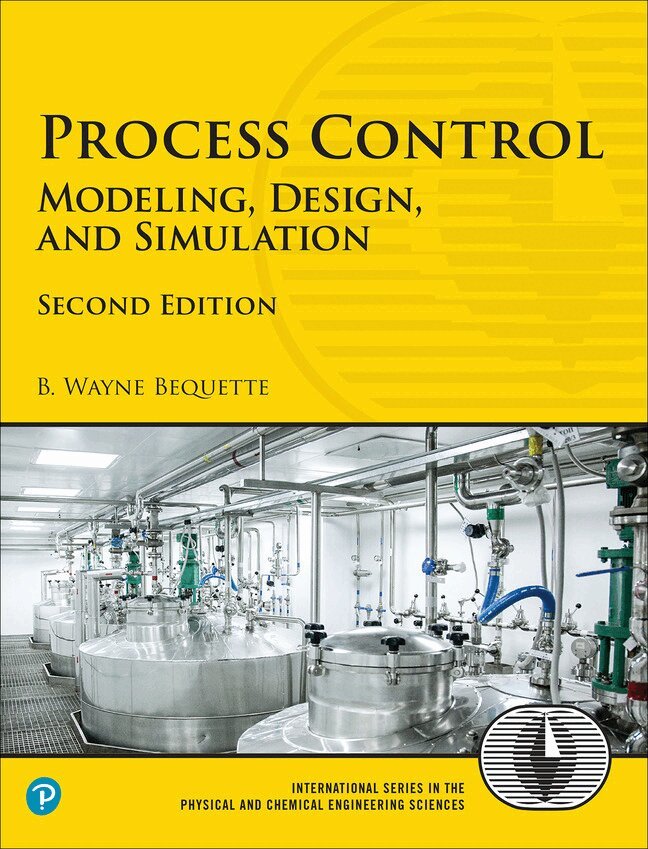
    Process Control

    Modeling, Design, and Simulation

    AvB. Bequette

    Häftad, Engelska, 2024

    Del i serien International Series in the Physical and Chemical Engineering Sciences

    1 134 kr

    Beställningsvara. Skickas inom 7-10 vardagar. Fri frakt över 249 kr.

    Fler format och utgåvor

    Inbunden

    2 432 kr

    Beskrivning

    Master Process Control Hands On, through Updated Practical Examples and MATLAB® Simulations

    Process Control: Modeling, Design, and Simulation, Second Edition, is a complete introduction to process control and has been fully updated, integrating current software tools to enable professionals and students to master critical techniques hands on through simulations based on modern versions of MATLAB. This revised edition teaches the field's most important techniques, behaviors, and control problems with even more practical examples and exercises. Wide-ranging enhancements include safety considerations, an expanded discussion of digital control, additional process examples, and updates throughout for newer versions of MATLAB and SIMULINK.

    • Fundamentals of process control and instrumentation, including objectives, variables, block diagrams, and process flowsheets
    • Methodologies for developing dynamic models of chemical processes, including compartmental models
    • Dynamic behavior of linear systems: state-space models, transfer function-based models (including conversion to state space), and more
    • Empirical and discrete-time models, including relationships among types of discrete models
    • Feedback control; proportional, integral, and derivative (PID) controllers; and closed-loop stability analysis
    • Frequency response analysis techniques for evaluating the robustness of control systems
    • Improving control loop performance: internal model control (IMC), automatic tuning, gain scheduling, and enhanced disturbance rejection
    • Split-range, selective, and override strategies for switching among inputs or outputs
    • Control loop interactions and multivariable controllers
    • An introduction to model predictive control (MPC), with a new discrete state-space model derivation exercise

    Bequette walks step by step through developing control instrumentation diagrams for an entire chemical process, reviewing common control strategies for individual unit operations, then discussing strategies for integrated systems. This edition also includes 16 learning modules demonstrating how to use MATLAB and SIMULINK to solve many key control problems, including new modules on process monitoring and safety, as well as a detailed new study of artificial pancreas systems for Type 1 diabetes.

    Register your book for convenient access to downloads, updates, and/or corrections as they become available. See inside book for details.

    Produktinformation

    • Utgivningsdatum:2024-04-07
    • Mått:230 x 10 x 180 mm
    • Vikt:321 g
    • Format:Häftad
    • Språk:Engelska
    • Serie:International Series in the Physical and Chemical Engineering Sciences
    • Antal sidor:768
    • Upplaga:2
    • Förlag:Pearson Education
    • ISBN:9780134033754

    Utforska kategorier

    • Tillverkningsteknik inom Naturvetenskap och teknik

    Mer om författaren

    B. Wayne Bequette is a Professor of Chemical and Biological Engineering and Technology Manager for the Smart Manufacturing Innovation Center (SMIC) at Rensselaer Polytechnic Institute, where his research efforts are focused on the modeling and control of chemical process, biomedical, biopharma, and food manufacturing systems. He serves as the Board Secretary for the American Automatic Control Council (AACC) and as a Trustee of the Computer Aids for Chemical Engineering (CACHE) Corporation. Dr. Bequette is a founding member of the editorial board of the Journal of Diabetes Science and Technology and serves on the editorial board of Industrial & Engineering Chemistry Research. He is a Fellow of IEEE, AIChE, and the American Institute of Medical and Biological Engineers (AIMBE), and was inducted into the Arkansas Academy of Chemical Engineers. He is the author of Process Control: Modeling, Design, and Simulation, Second Edition, and Process Dynamics: Modeling, Analysis, and Simulation (both from Pearson), and has published 17 book chapters and more than 125 refereed journal articles.While completing a BS in chemical engineering at the University of Arkansas, Dr. Bequette worked at Arkansas Eastman (handling utility and waste treatment problems) and Cosden Oil and Chemical. After his undergraduate studies, he was a process engineer at American Petrofina, where he had the chance to serve as a process operator during two work stoppages. This sparked his interest in process automation and control, enticing him to the University of Texas at Austin to earn a PhD with a focus on multivariable control-system analysis and design. He spent a year as a visiting lecturer at the University of California at Davis before becoming a professor at Rensselaer in 1988. While at Rensselaer, he has had the good fortune to serve as the advisor for 23 PhD students, in addition to teaching chemical process dynamics and control to at least 1500 undergraduate students. His outside interests include bicycling and pole-vaulting.

    Innehållsförteckning

    • Preface to the Second Edition xxviiAbout the Author xxxiiiChapter 1: Introduction 11.1 Introduction 21.2 Instrumentation 141.3 Process Models and Dynamic Behavior 151.4 Redundancy and Operability 181.5 Industrial IoT and Smart Manufacturing 191.6 Control Textbooks 211.7 A Look Ahead 221.8 Summary 22References 23Student Exercises 24Chapter 2: Fundamental Models 312.1 Background 322.2 Balance Equations 332.3 Material Balances 362.4 Constitutive Relationships 412.5 Material and Energy Balances 442.6 Form of Dynamic Models 482.7 Linear Models and Deviation Variables 502.8 Summary 55Suggested Reading 57Student Exercises 57Chapter 3: Dynamic Behavior 693.1 Background 703.2 Linear State-Space Models 703.3 Laplace Transforms 753.4 Transfer Functions 873.5 First-Order Behavior 883.6 Integrating Behavior 943.7 Second-Order Behavior 1003.8 Summary 107References 107Student Exercises 107Chapter 4: Dynamic Behavior: Complex Systems 1154.1 Introduction 1164.2 Poles and Zeros 1164.3 Lead-Lag Behavior 1194.4 Processes with Deadtime 1204.5 Padé Approximation for Deadtime 1234.6 Converting State-Space Models to Transfer Functions 1244.7 Converting Transfer Functions to State-Space Models 1274.8 MATLAB and SIMULINK 1284.9 Summary 130Student Exercises 130Chapter 5: Empirical and Discrete-Time Models 1395.1 Introduction 1405.2 First-Order + Deadtime 1415.3 Integrator + Deadtime 1445.4 Other Continuous Models 1475.5 Discrete-Time Autoregressive Models 1485.6 Parameter Estimation 1525.7 Discrete Step and Impulse Response Models 1565.8 Converting Continuous Models to Discrete 1585.9 Digital Filtering 1605.10 Summary 163References 163Student Exercises 164Appendix 5.1: Discretization 170Chapter 6: Introduction to Feedback Control 1716.1 Motivation 1726.2 Control Block Diagrams 1766.3 Closed-Loop Analysis 1796.4 PID Controller Algorithms 1856.5 Routh Stability Criterion 1926.6 Effect of Tuning Parameters 1966.7 Open-Loop Unstable Systems 1976.8 SIMULINK Block Diagrams 1996.9 ODEs to Solve PID Problems 2006.10 Summary 202References 205Student Exercises 205Chapter 7: Model-Based Control 2157.1 Introduction 2167.2 Direct Synthesis 2167.3 Internal Model Control 2187.4 IMC-Based PID 2237.5 IMC-Based PID for Time-Delay Processes 2317.6 IMC-Based PID for Unstable Processes 2377.7 Summary 240References 242Student Exercises 242Appendix 7.1: SIMC-Based PID Design 252Chapter 8: PID Controller Tuning 2558.1 Introduction 2568.2 Closed-Loop Oscillation-Based Tuning 2578.3 Tuning Rules for First-Order + Deadtime Processes 2618.4 Digital Control 2638.5 Stability of Digital Control Systems 2658.6 Performance of Digital Control Systems 2678.7 Summary 268References 268Student Exercises 269Chapter 9: Frequency-Response Analysis 2759.1 Motivation 2769.2 Bode and Nyquist Plots 2799.3 Effect of Process Parameters on Bode and Nyquist Plots 2849.4 Closed-Loop Stability 2889.5 Bode and Nyquist Stability 2909.6 Robustness 2949.7 MATLAB Control Toolbox: Bode and Nyquist Functions 2959.8 Summary 297Reference 298Student Exercises 298Chapter 10: Cascade and Feedforward Control 30510.1 Background 30610.2 Introduction to Cascade Control 30610.3 Cascade-Control Analysis 31010.4 Cascade-Control Design 31210.5 Feedforward Control 31310.6 Feedforward Controller Design 31510.7 Summary of Feedforward Control 32010.8 Combined Feedforward and Cascade 32110.9 Summary 321References 321Student Exercises 322Chapter 11: PID Enhancements 33311.1 Background 33311.2 Antireset Windup 33411.3 Autotuning Techniques 34211.4 Nonlinear PID Control 34711.5 Controller Parameter (Gain) Scheduling 34811.6 Measurement/Actuator Selection 35011.7 Implementing PID Enhancements in Simulink 35111.8 Summary 353References 354Student Exercises 354Chapter 12: Ratio, Selective, and Split-Range Control 35712.1 Motivation 35712.2 Ratio Control 35812.3 Selective and Override Control 35912.4 Split-Range Control 36012.5 SIMULINK Functions 36312.6 Summary 364References 364Student Exercises 365Chapter 13: Control-Loop Interaction 37113.1 Introduction 37213.2 Motivation 37213.3 The General Pairing Problem 37513.4 The Relative Gain Array 38213.5 Properties and Application of the RGA 38513.6 Return to the Motivating Example 38713.7 RGA and Sensitivity 38913.8 Using the RGA to Determine Variable Pairings 39213.9 MATLAB RGA Function File 39613.10 Summary 397References 398Student Exercises 398Appendix 13.1: Derivation of the Relative Gain for an n-Input-n-Output System 404Appendix 13.2: m-File to Calculate the RGA 406Chapter 14: Multivariable Control 40714.1 Background 40814.2 Zeros and Performance Limitations 40814.3 Scaling Considerations 41214.4 Directional Sensitivity and Operability 41614.5 Block-Diagram Analysis 42214.6 Decoupling 42314.7 MATLAB tzero, svd 42714.8 Summary 430References 431Student Exercises 431Appendix 14.1 433Chapter 15: Plantwide Control 43515.1 Background 43615.2 Steady-State and Dynamic Effects of Recycle 43715.3 Unit Operations Not Previously Covered 44415.4 The Control and Optimization Hierarchy 44815.5 Further Plantwide Control Examples 45115.6 Simulations 45615.7 Startup, Safety, and the Human-in-the-Loop 45815.8 Summary 459References 460Student Exercises 461Appendix 15.1 463Chapter 16: Model Predictive Control 46716.1 Motivation 46816.2 Optimization Problem 46816.3 Dynamic Matrix Control 47116.4 Constraints and Multivariable Systems 48216.5 Other MPC Methods 48516.6 MATLAB 48716.7 Summary 487References and Relevant Literature 488Student Exercises 489Appendix 16.1: Derivation of the Step Response Formulation 491Appendix 16.2: Derivation of the Least-Squares Solution for Control Moves 492Appendix 16.3: State Space Formulation for MPC 493Chapter 17: Summary 49717.1 Overview of Topics Covered in This Textbook 49717.2 Process Engineering in Practice 50217.3 Suggested Further Reading 504Student Exercises 505Module 1: Introduction to MATLAB 507M1.1 Background 508M1.2 Matrix Operations 509M1.3 The MATLAB Workspace 513M1.4 Complex Variables 514M1.5 Plotting 514M1.6 More Matrix Stuff 517M1.7 for Loops 519M1.8 m-Files 520M1.9 Summary of Commonly Used Commands 523M1.10 Frequently Used MATLAB Functions 524Additional Exercises 524Module 2: Introduction to SIMULINK 527M2.1 Background 528M2.2 Open-Loop Simulations 529M2.3 Feedback-Control Simulations 530M2.4 Summary 534Additional Exercises 534Module 3: Ordinary Differential Equations 537M3.1 MATLAB ode--Basic 538M3.2 MATLAB ode--Options 541M3.3 SIMULINK sfun 541M3.4 Summary 545Additional Exercises 545Module 4: MATLAB LTI Models 547M4.1 Forming Continuous-Time Models 548M4.2 Forming Discrete-Time Models 555M4.3 Converting Continuous Models to Discrete 557M4.4 Converting Discrete Models to Continuous 558M4.5 Step and Impulse Responses 558M4.6 Summary 560Additional Exercises 561Module 5: Isothermal Chemical Reactor 563M5.1 Background 564M5.2 Model 564M5.3 Steady-State and Dynamic Behavior 565M5.4 Closed-Loop Control 569Reference 571Additional Exercises 571Module 6: Biochemical Reactors 573M6.1 Background 573M6.2 Steady-State and Dynamic Behavior 575M6.3 Stable Steady-State Operating Point 577M6.4 Unstable Steady-State Operating Point 578M6.5 SIMULINK Model File 580Reference 581Additional Exercises 582Module 7: CSTR 585M7.1 Background 586M7.2 Simplified Modeling Equations 586M7.3 Example Chemical Process--Propylene Glycol Production 590M7.4 Effect of Reactor Scale 591M7.5 For Further Study: Detailed Model 594M7.6 Other Considerations 598M7.7 Summary 599References 600Additional Exercises 601Appendix M7.1 602Module 8: Steam Drum Level 605M8.1 Background 605M8.2 Process Model 606M8.3 Feedback Controller Design 607M8.4 Feedforward Controller Design 609M8.5 Three-Mode Level Control 609Appendix M8.1: SIMULINK Diagram for Feedforward/Feedback Control of Steam Drum Level 611Appendix M8.2: SIMULINK Diagram for Three-Mode Control of Steam Drum Level 612Module 9: Surge Vessel Level Control 613M9.1 Background 613M9.2 Process Model 614M9.3 Controller Design 614M9.4 Numerical Example 616M9.5 Summary 619Reference 620Additional Exercises 620Appendix M9.1: The SIMULINK Block Diagram 621Module 10: Batch Reactor 623M10.1 Background 624M10.2 Batch Model 1: Jacket Temperature Manipulated 625M10.3 Batch Model 2: Jacket Inlet Temperature Manipulated 629M10.4 Batch Model 3: Cascade Control 632M10.5 Summary 633Reference 634Additional Exercises 634Module 11: Biomedical Systems 635M11.1 Overview 635M11.2 Pharmacokinetic Models 636M11.3 Intravenous Delivery of Anesthetic Drugs 637M11.4 Blood Glucose Control in ICU Patients 638M11.5 Critical Care Patients 640M11.6 Summary 641References 641Additional Exercises 642Module 12: Automated Insulin Delivery 643M12.1 Background: Physiology of Blood Glucose Regulation 644M12.2 Type 1 Diabetes 644M12.3 Closed-Loop Components and Diagram 646M12.4 Simulation Model 648M12.5 Open-Loop Responses to Meal and Insulin 649M12.6 Closed-Loop Responses 652M12.7 Summary 654References 655Suggested Further Study 655Additional Exercises 656Module 13: Distillation Control 657M13.1 Description of Distillation Control 658M13.2 Open-Loop Behavior 659M13.3 SISO Control 661M13.4 RGA Analysis 662M13.5 Multiple SISO Controllers 663M13.6 Singular Value Analysis 664M13.7 Nonlinear Effects 667M13.8 Other Issues in Distillation Column Control 667M13.9 Summary 668References 668Additional Exercises 668Module 14: Case Study Problems 671M14.1 Background 671M14.2 Reactive Ion Etcher 673M14.3 Rotary Lime Kiln Temperature Control 674M14.4 Fluidized Catalytic Cracking Unit 674M14.5 Anaerobic Sludge Digester 675M14.6 Suggested Case Study Schedule 676M14.7 Summary 678Additional Exercises 679Module 15: Process Monitoring 681M15.1 Concise Review of Probability 682M15.2 Statistical Process Control 685M15.3 Characteristic Process Noise 689M15.4 Filtering and Smoothing 690M15.5 Data Reconciliation 690M15.6 Gross Error Detection 694M15.7 Summary 696References 696Additional Exercises 696Appendix M15.1 702Module 16: Safety 705M16.1 Overview 706M16.2 Chemical Process Disasters 707M16.3 Aircraft Disasters 708M16.4 Fault Detection Algorithms and Safety Science 710M16.5 Summary 710References 711Additional Exercises 713Index 715