• Fri frakt över 249 kr
  • •
  • Snabba leveranser
  • •
  • Billiga böcker
Kundservice

Du är på sajten för privatpersoner.

Företag, bibliotek eller offentlig verksamhet?

Du handlar på classic.bokus.com, där alla dina funktioner finns intakta.
Till classic.bokus.com
Bokus logotyp. Gå till startsidan.
  • Erbjudanden
  • Nyheter
  • Student
  • Topplistor
  • Barn & ungdom
  • Bokus Play
  • E-böcker
  • Pocketböcker
  • Spel & pussel

10% rabatt på allt med kod NYSTART10 →

Sidfot

Mina sidor

    Hjälp

    • Kundservice
    • Vanliga frågor och svar
    • Frakt och leverans
    • Retur vid ångerrätt
    • Reklamera vara
    • Betalning
    • Köpvillkor
    • Allmänna villkor
    • Information om webbplatsens tillgänglighet

    Om Bokus

    • Om oss
    • Pressrum
    • För studenter
    • För företag
    • För bibliotek och offentlig verksamhet
    • För leverantörer
    • Hållbarhet

    Populärt

    • Aktuella erbjudanden
    • Presentkort
    • Studentlitteratur
    • Nya böcker
    • Topplistor
    • Signerade böcker
    • Engelska böcker

    Inspiration

    • Boktips
    • BookTok
    • Populära bokserier
    • Barnbokskaraktärer
    • Populära författare
    Logotyp för Bokus
    Följ oss på Facebook (extern länk)Följ oss på Instagram (extern länk)Följ oss på YouTube (extern länk)Följ oss på TikTok (extern länk)
    bokus @ CookiesAnpassa cookiesIntegritetspolicyKöpvillkor
    Till Citymail hemsida (extern länk)Till Budbee hemsida (extern länk)Till Postnord hemsida (extern länk)Till Schenker hemsida (extern länk)Till Early Bird hemsida (extern länk)Till Walleys hemsida (extern länk)
    1. Data och IT
    2. Programmeringsböcker
    3. Programspråk

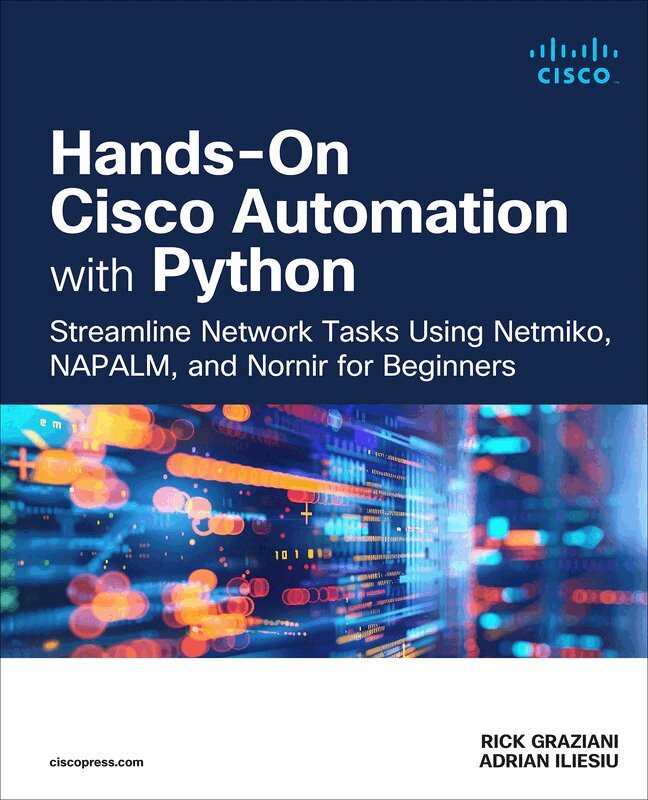
    Hands-On Cisco Automation with Python

    Streamline Network Tasks Using Netmiko, NAPALM, and Nornir for Beginners

    AvRick Graziani,Adrian Iliesiu

    Häftad, Engelska, 2026

    273 kr

    Beställningsvara. Skickas inom 7-10 vardagar. Fri frakt över 249 kr.

    Beskrivning

    Learn how to simplify Cisco network management with practical Python automation.

    Modern networks demand speed, accuracy, and scalability. Hands-On Cisco Automation with Python teaches network professionals how to automate common Cisco IOS tasks using Python and three widely adopted tools: Netmiko, NAPALM, and Nornir.

    This practical, example-driven guide shows how to replace repetitive manual work with reusable scripts that configure devices, collect operational data, and validate network state. Readers follow clear, step-by-step examples that explain both the Python code and the Cisco IOS commands involved.

    The book focuses on real-world automation, not theory, making it ideal for readers new to network automation who want immediate, usable results.

    What You’ll Learn

    • Automate Cisco IOS access and command execution with Python
    • Manage and validate configurations using NAPALM
    • Scale automation across multiple devices with Nornir
    • Work with structured data such as JSON and Python dictionaries
    • Build reusable scripts to improve consistency and reduce errors

    Who This Book Is For

    • Network engineers and administrators
    • CCNA and early-career networking professionals
    • IT practitioners transitioning into automation
    • Anyone managing Cisco IOS-based networks

    Produktinformation

    • Utgivningsdatum:2026-05-15
    • Mått:186 x 233 x 24 mm
    • Vikt:736 g
    • Format:Häftad
    • Språk:Engelska
    • Antal sidor:416
    • Upplaga:1
    • Förlag:Pearson Education
    • ISBN:9780135463192

    Utforska kategorier

    • Programspråk inom Data och IT

    Mer om författaren

    Rick Graziani has been teaching and working in the computer networking industry since 1980. He is a full time Computer Science/Computer Information Systems faculty member at Cabrillo College and an adjunct Computer Science and Engineering faculty member at the University of California Santa Cruz. Rick also works for Cisco Systems on their Curriculum Engineering team as part of the Cisco Networking Academy. He has written several books for Cisco Press including Fundamentals of IPv6 and has presented at technical conferences for the Cisco Networking Academy. Prior to teaching, he worked in the information technology field for Santa Cruz Operation, Tandem Computers, Lockheed Martin and served in the U.S. Coast Guard. When he is not working, he is most likely surfing at one of his favorite Santa Cruz surf breaks.Adrian Iliesiu, CCIE No. 43909 (EI), is a network engineer with more than 20 years of professional experience in the field. He currently works as a Principal Engineer within the Cisco DevNet organization. Throughout his career, Adrian has held a wide range of roles, including team leader and network, systems, and QA engineer across multiple industries and international organizations. In his current role at Cisco, Adrian focuses on advancing network programmability and automation, with particular emphasis on enterprise infrastructure. He is an established author, a distinguished speaker at Cisco Live!, and a recipient of the prestigious Cisco Pioneer Award. Adrian has also appeared on Cisco TechWise, Cisco Champion podcasts, and DevNet webinars. He is the host of the Simplifying Network Automation with NerGru series of live streams. He holds a Bachelor’s degree in Electronics and Telecommunications from the Technical University of Cluj-Napoca and a Master’s degree in Telecommunication Networks from Politehnica University of Bucharest.

    Innehållsförteckning

    • Introduction xxiiiChapter 1 Introducing Netmiko, NAPALM, and Nornir 1The 3 Ns: Netmiko, NAPALM, and Nornir 1Automation and Programmability for All Levels 4How Much Cisco IOS and Python Do I Need to Know? 4What Do I Need to Get Started? 5Using AI as an Alternative to Physical Equipment 6Summary 7Part 1 NetmikoChapter 2 Getting Started with Netmiko 9Why Start with Netmiko? 9A First Look at a Netmiko Program 10The Basic Netmiko Framework 11Optional: Exploring Python Classes, Objects, Instances, and Methods 15Your Turn 17Sending Command Output to a Variable 19The send_command_expect() Method 23The save_config() Method 26Debugging Netmiko by Using the Session Log 28Summary 34Chapter 3 Configuring Devices with Netmiko 35The send_command() Method 35Summary 50Chapter 4 Accessing Multiple Devices with Netmiko 53Using a Variable to Store an IP Address 53Understanding Python for Loops 54Iterating Through Multiple Devices 56Using Dictionaries to Store Device Connection Parameters 65Using Python’s getpass() for Secure Password Input 71Using Netmiko Exceptions for Troubleshooting 73Maintaining Multiple SSH Connections Simultaneously 77Summary 81Part 2 NAPALMChapter 5 Introducing NAPALM and Structured Data 85What Is NAPALM, and How Is It Different from Netmiko? 85Installing the NAPALM Library 88Basic NAPALM Framework 88How NAPALM Retrieves Data Without an API on Cisco IOS 91Good News, Bad News: Understanding Structured Data 92get_facts(): Our First NAPALM Method and Dictionary 95Assigning the Dictionary to a Variable 97Understanding Different Types of Values in a Dictionary 99Creating a NAPALM Dictionary Without a Device 100NAPALM Methods 102Using Python Interactive Mode to Experiment with NAPALM 105Summary 107Chapter 6 Understanding Python Dictionaries with NAPALM 109How NAPALM Organizes Data 110A Single Dictionary 110A Dictionary of Dictionaries 115A List of Dictionaries 122Sample Program Using All Three Types of Dictionaries 127Comparing the Three Types of Dictionaries 131Methods by Type of Data Structure 133Summary 135Chapter 7 Iterating Through NAPALM Dictionaries 137Live or Simulated Data 138Working with .keys(), .values(), and .items() in NAPALM Dictionaries 140Using a for Loop with Dictionary Methods 143Determining the Type of Value 147Looping Through Key/Value Pairs with .items() and Processing Values with isinstance() 153Iterating Through a Dictionary of Dictionaries 167Iterating Through a List of Dictionaries 173Summary 176Chapter 8 Configuring Devices with NAPALM 179A Quick Overview of NAPALM Configuration Methods 179Introducing Our Example Scenario 180Configuring a Device with load_merge_candidate() 182Using the cli() method 188Using load_replace_candidate() to Replace the Configuration 193Displaying Running and Startup Configuration Files 199Next Step: Nornir 200Summary 201Part 3 NornirChapter 9 Introducing Nornir: A Pythonic Framework for Network Orchestration 203What Is Orchestration? 204How Does Nornir Compare to Netmiko and NAPALM? 205How Nornir Uses Netmiko and NAPALM 206Installing Nornir 207Basic Nornir Framework: Python and YAML 207Your First Nornir Program and YAML Files 208What’s Next? 218Summary 219Chapter 10 Using Nornir with Netmiko 221Installing Support for Netmiko: nornir_netmiko 221Using Nornir and netmiko_send_command() 222Sending Configuration Commands with netmiko_send_config 236Summary 246Chapter 11 Using Nornir with NAPALM 247A Quick Review 247Installing Support for NAPALM: nornir_napalm 249nornir_napalm Tasks 250Advantages of Using These Tasks with Nornir 251Using Nornir and the napalm_cli Task 251Using Nornir and the napalm_get Task 261Using Nornir and the napalm_configure Task 268Summary 276Chapter 12 Inventory Management with Nornir 277A Quick Overview with a Focus on Inventory 278Where Inventory Data Comes From 280A Note on Filtering 281Inventory Management Core Architecture 282Hosts 282Groups 289Effective Values After Inheritance 292Using Group Data for Filtering 295Defaults 296Accessing Inventory Data 298Inventory Plugins 300Inventory Plugin Options 301Summary 319Part 4 What’s NextChapter 13 What’s Next 321Why Network Automation Became Necessary 321Netmiko, NAPALM, and Nornir in Context 324Ansible, NETCONF, and RESTCONF: Expanding the Automation Comparisons 331Understanding YANG Models 332Understanding APIs 334Artificial Intelligence and Network Automation 336Closing Thoughts 338Appendix A Python Virtual Environments 341Appendix B Understanding expect_string with send_command() 345Appendix C Using Python Dictionaries as NAPALM Outputs 347Appendix D The Relationship Between Python Dictionaries and JSON 353Appendix E Understanding Objects and Variables in Python 355Appendix F Using a Recursive Function to Handle Nested Dictionaries of Any Depth 357Appendix G Using Tabular Output 359Appendix H Using Public and Private Keys 361Appendix I Netmiko-Supported Network Operating Systems 365  9780135463192, TOC, 3/25/2026