• Fri frakt över 249 kr
  • •
  • Snabba leveranser
  • •
  • Billiga böcker
Kundservice

Du är på sajten för privatpersoner.

Företag, bibliotek eller offentlig verksamhet?

Du handlar på classic.bokus.com, där alla dina funktioner finns intakta.
Till classic.bokus.com
Bokus logotyp. Gå till startsidan.
  • Erbjudanden
  • Student
  • Topplistor
  • Barn & ungdom
  • Bokus Play
  • E-böcker
  • Ljudböcker
  • Pocketböcker
  • Spel & pussel

Upp till 25% på utvalda nyheter →

Sidfot

Mina sidor

    Hjälp

    • Kundservice
    • Vanliga frågor och svar
    • Frakt och leverans
    • Retur vid ångerrätt
    • Reklamera vara
    • Betalning
    • Köpvillkor
    • Allmänna villkor
    • Information om webbplatsens tillgänglighet

    Om Bokus

    • Om oss
    • Pressrum
    • För studenter
    • För företag
    • För bibliotek och offentlig verksamhet
    • För leverantörer
    • Hållbarhet

    Populärt

    • Aktuella erbjudanden
    • Presentkort
    • Studentlitteratur
    • Nya böcker
    • Topplistor
    • Signerade böcker
    • Engelska böcker

    Inspiration

    • Boktips
    • BookTok
    • Populära bokserier
    • Barnbokskaraktärer
    • Populära författare
    Logotyp för Bokus
    Följ oss på Facebook (extern länk)Följ oss på Instagram (extern länk)Följ oss på YouTube (extern länk)Följ oss på TikTok (extern länk)
    bokus @ CookiesAnpassa cookiesIntegritetspolicyKöpvillkor
    Till Citymail hemsida (extern länk)Till Budbee hemsida (extern länk)Till Postnord hemsida (extern länk)Till Schenker hemsida (extern länk)Till Early Bird hemsida (extern länk)Till Walleys hemsida (extern länk)
    1. Data och IT
    2. Systemvetenskap och AI

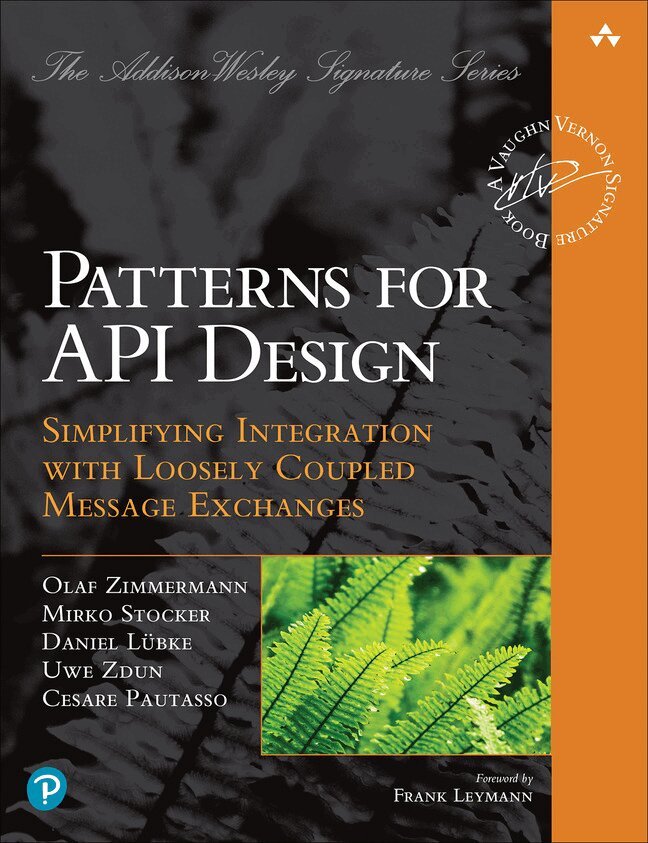
    Patterns for API Design

    Simplifying Integration with Loosely Coupled Message Exchanges

    AvOlaf Zimmermann,Mirko Stocker

    Häftad, Engelska, 2023

    Del i serien Addison-Wesley Signature Series (Vernon)

    373 kr

    Beställningsvara. Skickas inom 7-10 vardagar. Fri frakt över 249 kr.

    Beskrivning

    Proven Patterns for Designing Evolvable High-Quality APIs--For Any Domain, Technology, or Platform

    APIs enable breakthrough innovation and digital transformation in organizations and ecosystems of all kinds. To create user-friendly, reliable and well-performing APIs, architects, designers, and developers need expert design guidance. This practical guide cuts through the complexity of API conversations and their message contents, introducing comprehensive guidelines and heuristics for designing APIs sustainably and specifying them clearly, for whatever technologies or platforms you use.

    In Patterns for API Design: Simplifying Integration with Loosely Coupled Message Exchanges, five expert architects and developers cover the entire API lifecycle, from launching projects and establishing goals through defining requirements, elaborating designs, planning evolution, and creating useful documentation. They crystallize the collective knowledge of many practitioners into 44 API design patterns, consistently explained with context, pros and cons, conceptual solutions, and concrete examples. To make their pattern language accessible, they present a domain model, a running case study, decision narratives with pattern selection options and criteria, and walkthroughs of real-world projects applying the patterns in two different industries.

    • Identify and overcome API design challenges with patterns
    • Size your endpoint types and operations adequately
    • Design request and response messages and their representations
    • Refine your message design for quality
    • Plan to evolve your APIs
    • Document and communicate your API contracts
    • Combine patterns to solve real-world problems and make the right tradeoffs

    "This book provides a healthy mix of theory and practice, containing numerous nuggets of deep advice but never losing the big picture . . . grounded in real-world experience and documented with academic rigor applied and practitioner community feedback incorporated. I am confident that [it] will serve the community well, today and tomorrow."

    --Prof. Dr. Dr. h. c. Frank Leymann, Managing Director, Institute of Architecture of Application Systems, University of Stuttgart

    Produktinformation

    • Utgivningsdatum:2023-01-26
    • Mått:178 x 230 x 30 mm
    • Vikt:900 g
    • Format:Häftad
    • Språk:Engelska
    • Serie:Addison-Wesley Signature Series (Vernon)
    • Antal sidor:544
    • Upplaga:1
    • Förlag:Pearson Education
    • ISBN:9780137670109

    Utforska kategorier

    • Systemvetenskap och AI inom Data och IT
    • Webbprogrammering inom Data och IT
    • Programmeringsböcker inom Data och IT

    Mer om författaren

    Olaf Zimmermann is professor of software architecture at the Institute for Software at Eastern Switzerland University of Applied Sciences, Distinguished IT Architect at The Open Group, and co-editor of IEEE Software's Insights column. Mirko Stocker is professor of software engineering at Eastern Switzerland University of Applied Sciences, specializing on Web development and cloud solutions. Daniel Lübke is an independent coding and consulting architect who specializes in business process automation and digitization projects. Uwe Zdun is professor of software architecture at the University of Vienna, focusing on distributed systems engineering, DevOps, patterns, modeling, and empirical software engineering. Cesare Pautasso is a professor at the Università della Svizzera Italiana, where he leads the Architecture, Design, and Web Information Systems Engineering research group. The authors are active community members participating in pattern writer's workshops, shepherding other authors, serving on program committees, and chairing conferences.

    Innehållsförteckning

    • Foreword by Vaughn Vernon, Series Editor     xviiForeword by Frank Leymann     xxiPreface     xxiii  Part 1: Foundations and Narratives     1Chapter 1: Application Programming Interface (API) Fundamentals     3From Local Interfaces to Remote APIs     3Decision Drivers in API Design     14A Domain Model for Remote APIs     22Summary     28  Chapter 2: Lakeside Mutual Case Study     31Business Context and Requirements     31Architecture Overview     35API Design Activities     39Target API Specification     39Summary     41  Chapter 3: API Decision Narratives     43Prelude: Patterns as Decision Options, Forces as Decision Criteria     43Foundational API Decisions and Patterns     45Decisions about API Roles and Responsibilities     57Selecting Message Representation Patterns     70Interlude: Responsibility and Structure Patterns in the Lakeside Mutual Case     82Governing API Quality     84Deciding for API Quality Improvements     98Decisions about API Evolution     110Summary     122  Part 2: The Patterns     125Chapter 4: Pattern Language Introduction      127Positioning and Scope     128Patterns: Why and How?     130Navigating through the Patterns     131Foundations: API Visibility and Integration Types     137Basic Structure Patterns     146Summary     158  Chapter 5: Define Endpoint Types and Operations     161Introduction to API Roles and Responsibilities     162Endpoint Roles (aka Service Granularity)     167Operation Responsibilities     215Summary     248  Chapter 6: Design Request and Response Message Representations     253Introduction to Message Representation Design     253Element Stereotypes     256Special-Purpose Representations     282Summary                                                 305  Chapter 7: Refine Message Design for Quality  309Introduction to API Quality     309Message Granularity     313Client-Driven Message Content (aka Response Shaping)     325Message Exchange Optimization (aka Conversation Efficiency)     344Summary     355  Chapter 8: Evolve APIs     357Introduction to API Evolution     357Versioning and Compatibility Management     362Life-Cycle Management Guarantees     374Summary     393  Chapter 9: Document and Communicate API Contracts     395Introduction to API Documentation     395Documentation Patterns     398Summary     421    Part 3: Our Patterns in Action (Now and Then)     423Chapter 10: Real-World Pattern Stories     425Large-Scale Process Integration in the Swiss Mortgage Business     426Offering and Ordering Processes in Building Construction     438Summary     445  Chapter 11: Conclusion     447Short Retrospective     448API Research: Refactoring to Patterns, MDSL, and More     449The Future of APIs     450Additional Resources     451Final Remarks     451  Appendix A: Endpoint Identification and Pattern Selection Guides     453Appendix B: Implementation of the Lakeside Mutual Case     463Appendix C: Microservice Domain-Specific Language (MDSL)     471  Bibliography     483Index     499