• Fri frakt över 249 kr
  • •
  • Snabba leveranser
  • •
  • Billiga böcker
Kundservice

Du är på sajten för privatpersoner.

Företag, bibliotek eller offentlig verksamhet?

Du handlar på classic.bokus.com, där alla dina funktioner finns intakta.
Till classic.bokus.com
Bokus logotyp. Gå till startsidan.
  • Erbjudanden
  • Nyheter
  • Student
  • Topplistor
  • Barn & ungdom
  • Bokus Play
  • E-böcker
  • Pocketböcker
  • Spel & pussel

10% rabatt på allt med kod NYSTART10 →

Sidfot

Mina sidor

    Hjälp

    • Kundservice
    • Vanliga frågor och svar
    • Frakt och leverans
    • Retur vid ångerrätt
    • Reklamera vara
    • Betalning
    • Köpvillkor
    • Allmänna villkor
    • Information om webbplatsens tillgänglighet

    Om Bokus

    • Om oss
    • Pressrum
    • För studenter
    • För företag
    • För bibliotek och offentlig verksamhet
    • För leverantörer
    • Hållbarhet

    Populärt

    • Aktuella erbjudanden
    • Presentkort
    • Studentlitteratur
    • Nya böcker
    • Topplistor
    • Signerade böcker
    • Engelska böcker

    Inspiration

    • Boktips
    • BookTok
    • Populära bokserier
    • Barnbokskaraktärer
    • Populära författare
    Logotyp för Bokus
    Följ oss på Facebook (extern länk)Följ oss på Instagram (extern länk)Följ oss på YouTube (extern länk)Följ oss på TikTok (extern länk)
    bokus @ CookiesAnpassa cookiesIntegritetspolicyKöpvillkor
    Till Citymail hemsida (extern länk)Till Budbee hemsida (extern länk)Till Postnord hemsida (extern länk)Till Schenker hemsida (extern länk)Till Early Bird hemsida (extern länk)Till Walleys hemsida (extern länk)
    1. Medicin
    2. Andra medicinska specialiteter
    3. Klinisk psykologi

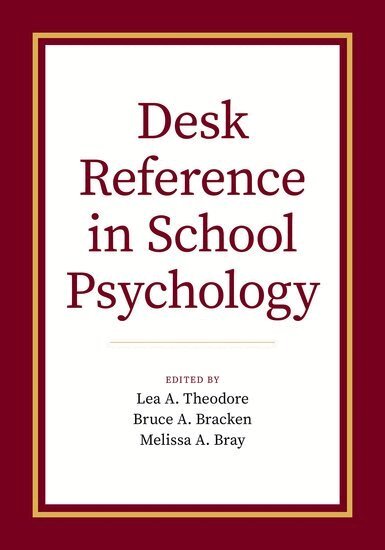
    Desk Reference in School Psychology

    AvLea A. Theodore,Bruce A. Bracken

    Inbunden, Engelska, 2024

    1 429 kr

    Beställningsvara. Skickas inom 5-8 vardagar. Fri frakt över 249 kr.

    Beskrivning

    Best practices related to assessment, consultation, and intervention have been well-documented throughout the school psychology literature, with ample empirical support. Unfortunately, despite this vast knowledge base, many practitioners continue to use outdated and ineffective assessment practices, educational interventions, and therapies, many of which lack research support. The Desk Reference's editors aim to change that by providing practitioners, academics, and students with a compendium of current, evidence-based, and state-of-the-art best practices in education and psychology.The Desk Reference's comprehensive coverage of diverse populations and important niche matters confronting school personnel are systematically addressed in a uniform step-by-step manner replete with evidence-based practices that can be implemented immediately by practicing professionals. Doing “what works” is the basis of evidence-based best practices, and when services work, they lead to consistent, efficacious, and documented benefits.Composed of contributed chapters from leading school psychology authors, the Desk Reference emphasizes sound application and comprehensive coverage within five topical sections: Assessment and Intervention (Cognitive, Academic, Social Emotional, Neuropsychology); Consultation; Medical Problems; Diversity in Learning; and Crises, Conditions, and Responses. This comprehensive, detailed, and empirically supported resource renders the Desk Reference an ideal, practical go-to guide for all school-based professionals, including classroom teachers, counselors, social workers, and school psychologists.

    Produktinformation

    • Utgivningsdatum:2024-02-26
    • Mått:251 x 185 x 66 mm
    • Vikt:1 701 g
    • Format:Inbunden
    • Språk:Engelska
    • Antal sidor:880
    • Förlag:OUP USA
    • ISBN:9780190092344

    Utforska kategorier

    • Klinisk psykologi inom Medicin
    • Pedagogisk psykologi inom Psykologi och pedagogik
    • Barnpsykologi och utvecklingspsykologi inom Psykologi och pedagogik

    Mer om författaren

    Lea A. Theodore, PhD, Professor of School Psychology at Adelphi University, licensed psychologist, and Past President of Division 16 of the APA, consults with schools, behavioral health settings, publishing companies, and the judiciary as an expert witness. Her more than two-decade career and a multitude of articles, chapters, and books advance effective intervention strategies to improve student functioning.Bruce A. Bracken, PhD, is an emeritus professor at The College of William & Mary. Dr. Bracken has published scores of articles, chapters, books, and tests; cofounded the Journal of Psychoeducational Assessment; and is Past President of the International Test Commission. He has received several awards, including the Senior Scientist award from the American Psychological Association.Melissa A. Bray, PhD, is a professor and director of the School of Psychology program at the University of Connecticut, a licensed psychologist, and Past President of Division 16 of the APA. Dr. Bray's professional experience spans more than 30 years as a consultant, school psychologist, speech-language pathologist, professor, and school psychology discipline coordinator. She has more than 215 publications.

    Innehållsförteckning

    • PrefaceLea A. Theodore, Bruce A. Bracken, Melissa A. Bray Part One: Assessment and InterventionCognitiveChapter 1: Cognitive-Intellectual Assessment of School-Age Children John D. WassermanChapter 2. Assessment of Gifted and Talented Children and Adolescents Nicholas Gelbar, Sally M. Reis, and Joseph S. RenzulliChapter 3. Nonverbal Assessment Natalie R. Hassett, R. Steve McCallum, and Bruce A. Bracken Chapter 4. Preschool Assessment Vincent C. Alfonso, Joseph R. Engler, and Esther Stavrou Chapter 5. Intellectual Disabilities Stephen Greenspan, John Driscoll, and Gail Loughlin Rogers AcademicChapter 6. Academic Assessment and InterventionRachel Brown-Chidsey Chapter 7. Supporting Student Achievement in Elementary Mathematics: The Role of the School PsychologistBen Clarke, Marah Sutherland, Taylor LesnerChapter 8. Mathematics Disabilities, Low Achievement, and Relevant Evidence-Based InterventionsElizabeth McCallum, Kathleen B. Aspiranti, and Ara J. SchmittChapter 9. Dyslexia R. Steve McCallum and Sherry Mee BellChapter 10. Homework and Study Strategies Lea A. Theodore and Dana E. BoccioChapter 11. Homeschooling in Children and AdolescentsMary Louise Cashel and Lea A. Theodore Social EmotionalChapter 12. Personality, Social-Emotional, and Behavioral Assessment in Children and AdolescentsSara Whitcomb and Hee Kyung ParkChapter 13. Functional Behavioral Assessment and Behavior Intervention PlansTammy L. Hughes, Mary Comis, and Jeffrey A. MillerChapter 14. Disruptive Behavior Disorders in Children and AdolescentsJeffrey D. Burke, Emilie J. Butler, and Asia G. PerkinsChapter 15. Attention-Deficit/Hyperactivity DisorderGeorge J. DuPaul, Chelsea Z. Busch, and Alicia ChuntaChapter 16. Depressive Disorders in Children and AdolescentsRalph E. Cash, Alyssa Newman, Shannon Worton, and Natalia María Ramírez, and Sarah Valley-GrayChapter 17. Pediatric Bipolar Disorder in Children and AdolescentsMary A. Fristad Chapter 18. Anxiety Disorders (Social, Separation, General) in Children and AdolescentsJohn S. Carlson and Sally AskarChapter 19. Obsessive-Compulsive Disorder in Children and AdolescentsMorgan M. McNeel, Stacey C. Grebe, Amanda Palo, Wayne K. Goodman, Eric A. Storch, and Sophie C. SchneiderChapter 20. Specific Phobia in Children and AdolescentsLaura D. Seligman, Liza Talavera-Garza, and Thomas H. OllendickChapter 21. School Attendance ProblemsChristopher A. Kearney, Carolina Gonzálvez, and Victoria BaconChapter 22. Post-Traumatic Stress Disorder in Children and AdolescentsStephen E. BrockChapter 23. Youth Suicidal BehaviorJames J. Mazza and David N. MillerChapter 24. Nonsuicidal Self-InjuryDavid N. Miller and James J. Mazza NeuropsychologyChapter 25. Neuropsychological Assessment in Children and Adolescents: Applications for the School PsychologistStephen R. Hooper, Peter Duquette, Cari Pittleman, and Hanna LeongChapter 26. Autism Spectrum Disorder Jonathan M. Campbell, Karena Cooper-Duffy, and Johanna PriceChapter 27. Tourette Syndrome in Children and AdolescentsAarti P. Bellara, Emily L. Winter, Johanna M. deLeyer-Tiarks, and Laura R. FreiseChapter 28. Traumatic Brain Injury and Concussions in Children and AdolescentsMargaret Semrud-Clikeman Part Two: ConsultationChapter 29. Behavioral Consultation: Linking Referral Concerns, Intervention, and OutcomesGeorge H. Noell, Kristin A. Gansle, and Anna C. J. LongChapter 30. Conjoint Behavioral ConsultationHenry P. Bass, Karalynn E. Brown, and Susan M. Sheridan Chapter 31. Instructional ConsultationSylvia Rosenfield, Lauren Kaiser, and Kate CramerChapter 32. Program Evaluation and Cultural Engagement: View with a 21st Century LensEnedina García-Vázquez and Luis A. Vázquez Part Three: Medical ProblemsChapter 33. Asthma in Children and Adolescents Melissa A. Bray, Emily Winter, Adeline Bray, Johanna M. deLeyer-Tiarks, and Sai AravalaChapter 34. Childhood Cancer in Children and AdolescentsKaren L. Cross, Lauren Gammie, and Cheryl MaykelChapter 35. Epidemiological Research in Schools: From Theory to PracticeRich GilmanChapter 36. Adolescent Sexual Behavior: Prevalence, Risks, and Health-Affirming SupportsAdena B. Meyers and Laura Finan Part Four: Diversity in LearningChapter 37. Social Emotional Learning in Children and AdolescentsFrank M. GreshamChapter 38. Evidence-Based Interventions for Children and Adolescents Who Experience Parental Separation and DivorceKarey L. O'Hara, C. Aubrey Rhodes, and Sharlene A. WolchikChapter 39. Positive Psychology in EducationShannon M. Suldo, Letty DiLeo, and Katrina ScarimboloChapter 40. Culturally Responsive Interventions: Issues, Status, Resources, and Steps-in-AdaptationsMargaret R. RogersChapter 41. Sexual and Gender Minorities (SGM) in the SchoolsAlan Smerbeck Part Five: Crises, Conditions, and ResponsesChapter 42. Crisis Prevention, Preparation, and InterventionShane R. Jimerson, Mihya Weber, and Yuexin ZhangChapter 43. Supporting Students and Schools in the Aftermath of Natural DisastersPhilip J. Lazarus and Annela CostaChapter 44. Trauma-Informed Care in Children and AdolescentsJacqueline A. Brown, Ashlyn Kincaid, and Jennifer RotzalChapter 45. Threat Assessment Dewey CornellChapter 46. Resilience Kathleen A. Yu and Frank C. Worrell