• Fri frakt över 249 kr
  • •
  • Snabba leveranser
  • •
  • Billiga böcker
Kundservice

Du är på sajten för privatpersoner.

Företag, bibliotek eller offentlig verksamhet?

Du handlar på classic.bokus.com, där alla dina funktioner finns intakta.
Till classic.bokus.com
Bokus logotyp. Gå till startsidan.
  • Erbjudanden
  • Student
  • Topplistor
  • Barn & ungdom
  • Bokus Play
  • E-böcker
  • Ljudböcker
  • Pocketböcker
  • Spel & pussel

10% rabatt på allt med kod NYSTART10 →

Sidfot

Mina sidor

    Hjälp

    • Kundservice
    • Vanliga frågor och svar
    • Frakt och leverans
    • Retur vid ångerrätt
    • Reklamera vara
    • Betalning
    • Köpvillkor
    • Allmänna villkor
    • Information om webbplatsens tillgänglighet

    Om Bokus

    • Om oss
    • Pressrum
    • För studenter
    • För företag
    • För bibliotek och offentlig verksamhet
    • För leverantörer
    • Hållbarhet

    Populärt

    • Aktuella erbjudanden
    • Presentkort
    • Studentlitteratur
    • Nya böcker
    • Topplistor
    • Signerade böcker
    • Engelska böcker

    Inspiration

    • Boktips
    • BookTok
    • Populära bokserier
    • Barnbokskaraktärer
    • Populära författare
    Logotyp för Bokus
    Följ oss på Facebook (extern länk)Följ oss på Instagram (extern länk)Följ oss på YouTube (extern länk)Följ oss på TikTok (extern länk)
    bokus @ CookiesAnpassa cookiesIntegritetspolicyKöpvillkor
    Till Citymail hemsida (extern länk)Till Budbee hemsida (extern länk)Till Postnord hemsida (extern länk)Till Schenker hemsida (extern länk)Till Early Bird hemsida (extern länk)Till Walleys hemsida (extern länk)
    1. Filosofi och religion
    2. Filosofi
    3. Filosofiska discipliner

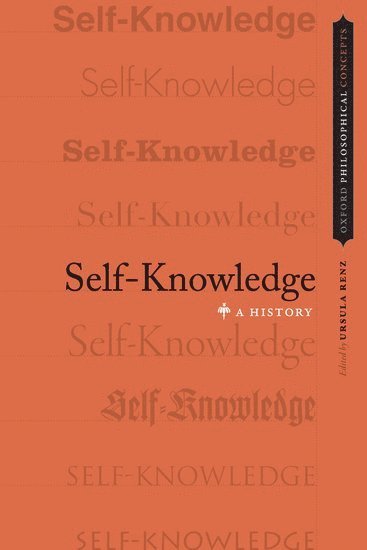
    Self-Knowledge

    A History

    AvUrsula Renz

    Häftad, Engelska, 2017

    Del i serien Oxford Philosophical Concepts

    849 kr

    Beställningsvara. Skickas inom 5-8 vardagar. Fri frakt över 249 kr.

    Beskrivning

    The acquisition of self-knowledge is often described as one of the main goals of philosophical inquiry. At the same time, some sort of self-knowledge is often regarded as a necessary condition of our being a human agent or human subject. Thus self-knowledge is taken to constitute both the beginning and the end of humans' search for wisdom, and as such it is intricately bound up with the very idea of philosophy. Not surprisingly therefore, the Delphic injunction 'Know thyself' has fascinated philosophers of different times, backgrounds, and tempers.But how can we make sense of this imperative? What is self-knowledge and how is it achieved? What are the structural features that distinguish self-knowledge from other types of knowledge? What role do external, second- and third-personal, sources of knowledge play in the acquisition of self-knowledge? How can we account for the moral impact ascribed to self-knowledge? Is it just a form of anthropological knowledge that allows agents to act in accordance with their aims? Or, does self-knowledge ultimately ennoble the self of the subjects having it? Finally, is self-knowledge, or its completion, a goal that may be reached at all?The book addresses these questions in fifteen chapters covering approaches of many philosophers from Plato and Aristotle to Edmund Husserl or Elisabeth Anscombe. The short reflections inserted between the chapters show that the search for self-knowledge is an important theme in literature, poetry, painting and self-portraiture from Homer.

    Produktinformation

    • Utgivningsdatum:2017-01-05
    • Mått:140 x 208 x 22 mm
    • Vikt:408 g
    • Format:Häftad
    • Språk:Engelska
    • Serie:Oxford Philosophical Concepts
    • Antal sidor:350
    • Förlag:OUP USA
    • ISBN:9780190226428

    Utforska kategorier

    • Filosofiska discipliner inom Filosofi och religion

    Mer om författaren

    Ursula Renz is Professor of Philosophy at the University of Klagenfurt, Austria. She has widely published about early modern philosophy, Neo-Kantianism and the history of philosophy mind. Her book Die Erklärbarkeit der Erfahrung. Realismus und Subjektivität in Spinozas Theorie des menschlichen Geistes (2010), was awarded with the Journal of the History of Philosophy Book Prize in 2011, and will be translated in English by Oxford University Press.

    Innehållsförteckning

    • Reflection I: Does Homer's Odysseus know himself? Tobias Myers1. Self-Knowledge in Plato Rachana Kamtekar2. Aristotle´s Requisite of Self-Knowledge Christopher Shields3. Self-Knowledge in Later Stoicism Marcel van Ackeren4. Self-Knowledge in Plotinus: Becoming Who You Are Pauliina Remes5. Augustine on Self-Knowledge and Human Subjectivity Johannes Brachtendorf6. Self-Knowledge in Scholasticism Dominik Perler7. Self-Knowledge, Abnegation, and Fulfillment in Medieval Mysticism Christina van Dyke8. Socratic Self-Knowledge in Early Modern Philosophy Ursula Renz9. Self-Knowledge and Self-Deception in Modern Moral Philosophy Aaron Garrett10. Kant´s Ideal of Self-Knowledge Dina Emundts Reflection II: Shelley and the Limit of Self-Knowlege Laura Quinney11. Self-Knowledge in Kierkegaard John Lippitt12. Self-Knowledge as Freedom in Schopenhauer and Freud Bernard Reginster13. Husserl´s Phenomenology and the Project of Transcendental Self-Knowledge Dermot MoranReflection III: Romare Bearden and a Collage of Self-Knowledge Yasmine Espert14. Self-Knowledge in Hermeneutic Philosophy Charles Guignon15. The First Person and Self-Knowledge in Analytic Philosophy Sebastian RödlReflection IV: Self-Knowledge and Self-Portraiture Christopher Wood