• Fri frakt över 249 kr
  • •
  • Snabba leveranser
  • •
  • Billiga böcker
Kundservice

Du är på sajten för privatpersoner.

Företag, bibliotek eller offentlig verksamhet?

Du handlar på classic.bokus.com, där alla dina funktioner finns intakta.
Till classic.bokus.com
Bokus logotyp. Gå till startsidan.
  • Erbjudanden
  • Nyheter
  • Student
  • Topplistor
  • Barn & ungdom
  • Bokus Play
  • E-böcker
  • Pocketböcker
  • Spel & pussel

10% rabatt på allt med kod: NYSTART10 →

Sidfot

Mina sidor

    Hjälp

    • Kundservice
    • Vanliga frågor och svar
    • Frakt och leverans
    • Retur vid ångerrätt
    • Reklamera vara
    • Betalning
    • Köpvillkor
    • Allmänna villkor
    • Information om webbplatsens tillgänglighet

    Om Bokus

    • Om oss
    • Pressrum
    • För studenter
    • För företag
    • För bibliotek och offentlig verksamhet
    • För leverantörer
    • Hållbarhet

    Populärt

    • Aktuella erbjudanden
    • Presentkort
    • Studentlitteratur
    • Nya böcker
    • Topplistor
    • Signerade böcker
    • Engelska böcker

    Inspiration

    • Boktips
    • BookTok
    • Populära bokserier
    • Barnbokskaraktärer
    • Populära författare
    Logotyp för Bokus
    Följ oss på Facebook (extern länk)Följ oss på Instagram (extern länk)Följ oss på YouTube (extern länk)Följ oss på TikTok (extern länk)
    bokus @ CookiesAnpassa cookiesIntegritetspolicyKöpvillkor
    Till Citymail hemsida (extern länk)Till Budbee hemsida (extern länk)Till Postnord hemsida (extern länk)Till Schenker hemsida (extern länk)Till Early Bird hemsida (extern länk)Till Walleys hemsida (extern länk)
    1. Juridik
    2. Särskilda rättsområden
    3. Finansrätt

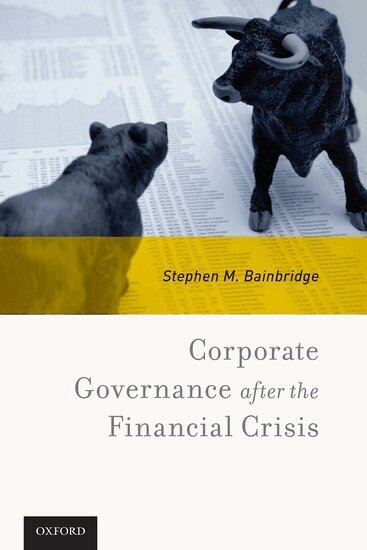
    Corporate Governance after the Financial Crisis

    AvStephen M. Bainbridge

    Häftad, Engelska, 2016

    716 kr

    Beställningsvara. Skickas inom 5-8 vardagar. Fri frakt över 249 kr.

    Fler format och utgåvor

    Inbunden

    1 688 kr

    E-bok

    342 kr

    E-bok

    474 kr

    Beskrivning

    The first decade of the new millennium was bookended by two major economic crises. The bursting of the dotcom bubble and the extended bear market of 2000 to 2002 prompted Congress to pass the Sarbanes-Oxley Act, which was directed at core aspects of corporate governance. At the end of the decade came the bursting of the housing bubble, followed by a severe credit crunch, and the worst economic downturn in decades. In response, Congress passed the Dodd-Frank Act, which changed vast swathes of financial regulation. Among these changes were a number of significant corporate governance reforms. Corporate Governance after the Financial Crisis asks two questions about these changes. First, are they a good idea that will improve corporate governance? Second, what do they tell us about the relative merits of the federal government and the states as sources of corporate governance regulation? Traditionally, corporate law was the province of the states. Today, however, the federal government is increasingly engaged in corporate governance regulation. The changes examined in this work provide a series of case studies in which to explore the question of whether federalization will lead to better outcomes. The author analyzes these changes in the context of corporate governance, executive compensation, corporate fraud and disclosure, shareholder activism, corporate democracy, and declining U.S. capital market competitiveness.

    Produktinformation

    • Utgivningsdatum:2016-04-14
    • Mått:156 x 234 x 16 mm
    • Vikt:431 g
    • Format:Häftad
    • Språk:Engelska
    • Antal sidor:308
    • Förlag:OUP USA
    • ISBN:9780190496678

    Utforska kategorier

    • Finansrätt inom Juridik
    • Nationalekonomi inom Ekonomi och Ledarskap

    Mer om författaren

    Stephen M. Bainbridge is the William D. Warren Distinguished Professor of Law at UCLA, where he teaches Business Associations, Advanced Corporation Law and a seminar on corporate governance. He has also taught at Harvard Law School as the Joseph Flom Visiting Professor of Law and Business, La Trobe University in Melbourne, and at Aoyama Gakuin University in Tokyo. In 2008, Professor Bainbridge received the UCLA School of Law's Rutter Award for Excellence in Teaching. Also, in 2008, he was named by Directorship magazine to its list of the 100 most influential people in the field of corporate governance.Professor Bainbridge is a prolific scholar. He has written over 75 law review articles which have appeared in such leading journals as Harvard Law Review, Virginia Law Review, Northwestern University Law Review, Cornell Law Review, Stanford Law Review, and Vanderbilt Law Review. His most recent books include: The New Corporate Governance in Theory and Practice (Oxford University Press, 2008); Securities Law-Insider Trading (2nd ed., 2007); Business Associations: Cases and Materials on Agency, Partnerships, and Corporations (6th ed., 2006) (with Klein and Ramseyer); Agency, Partnerships, and Limited Liability Entities: Cases and Materials on Unincorporated Business Associations (2nd ed., 2007) (with Klein and Ramseyer); Agency, Partnerships & LLCs (2004); Corporation Law and Economics (2002).Professor Bainbridge currently serves on the American Bar Association's Committee on Corporate Laws and on the Editorial Advisory Board of the Journal of Markets and Morality.

    Recensioner i media

    Stephen Bainbridge is not only an expert on corporate governance and an academic whose ideas and writing have changed the way we think about corporations. Professor Bainbridge is also one of the most perceptive academic commentators on the federal government's regulation of corporate governance. In Corporate Governance after the Financial Crisis, Professor Bainbridge has written an important book for those seeking to understand the theoretical and practical implications of Dodd-Frank, Sarbanes-Oxley and the federal government's foray into corporate regulation. It is a book that for years to come will influence the controversial debate over the federal regulation of corporate governance."

    Innehållsförteckning

    • Acknowledgements About the Author Introduction Chapter 1. Who Makes the Rules? Chapter 2. The Board's Role Chapter 3. Director Independence Chapter 4. Executive Compensation Chapter 5. Internal Controls Chapter 6. The Gatekeepers Chapter 7. Shareholder Empowerment Conclusion Index