• Fri frakt över 249 kr
  • •
  • Snabba leveranser
  • •
  • Billiga böcker
Kundservice

Du är på sajten för privatpersoner.

Företag, bibliotek eller offentlig verksamhet?

Du handlar på classic.bokus.com, där alla dina funktioner finns intakta.
Till classic.bokus.com
Bokus logotyp. Gå till startsidan.
  • Erbjudanden
  • Nyheter
  • Student
  • Topplistor
  • Barn & ungdom
  • Bokus Play
  • E-böcker
  • Pocketböcker
  • Spel & pussel

10% studentrabatt med kod TERM26

Sidfot

Mina sidor

    Hjälp

    • Kundservice
    • Vanliga frågor och svar
    • Frakt och leverans
    • Retur vid ångerrätt
    • Reklamera vara
    • Betalning
    • Köpvillkor
    • Allmänna villkor
    • Information om webbplatsens tillgänglighet

    Om Bokus

    • Om oss
    • Pressrum
    • För studenter
    • För företag
    • För bibliotek och offentlig verksamhet
    • För leverantörer
    • Hållbarhet

    Populärt

    • Aktuella erbjudanden
    • Presentkort
    • Studentlitteratur
    • Nya böcker
    • Topplistor
    • Signerade böcker
    • Engelska böcker

    Inspiration

    • Boktips
    • BookTok
    • Populära bokserier
    • Barnbokskaraktärer
    • Populära författare
    Logotyp för Bokus
    Följ oss på Facebook (extern länk)Följ oss på Instagram (extern länk)Följ oss på YouTube (extern länk)Följ oss på TikTok (extern länk)
    bokus @ CookiesAnpassa cookiesIntegritetspolicyKöpvillkor
    Till Citymail hemsida (extern länk)Till Budbee hemsida (extern länk)Till Postnord hemsida (extern länk)Till Schenker hemsida (extern länk)Till Early Bird hemsida (extern länk)Till Walleys hemsida (extern länk)
    1. Naturvetenskap och teknik
    2. Matematik och naturvetenskap
    3. Biologi
    4. Djurens beteende

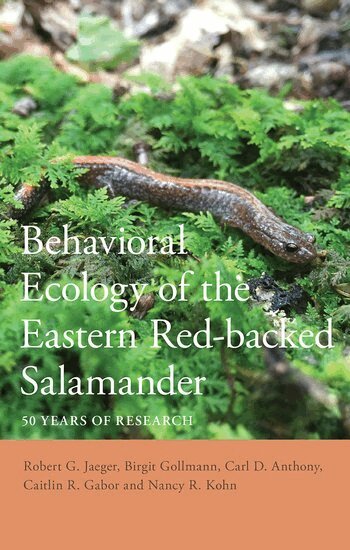
    Behavioral Ecology of the Eastern Red-backed Salamander

    50 Years of Research

    AvRobert G. Jaeger,Birgit Gollmann

    Inbunden, Engelska, 2016

    1 581 kr

    Beställningsvara. Skickas inom 5-8 vardagar. Fri frakt över 249 kr.

    Beskrivning

    The small, terrestrial eastern red-backed salamander is abundant on many forest floors of northeastern North America. Dr. Robert Jaeger and many of his graduate students spent over 50 years studying this species in New York and Virginia, using ecological techniques in forests and behavioral experiments in laboratory chambers in an attempt to understand how this species interacts with other species in the forest and the components of its intra- and intersexual social behaviors.The competitive and social behaviors of this species are unusually complex for an amphibian. This species is highly aggressive towards other similar-size species where they cohabit in forests, often leading to very little geographic overlap between the species. The authors examine the fascinating behavioral traits of this species including social monogamy, mutual mate guarding, sexual coercion, inter-species communication, and conflict resolution.

    Produktinformation

    • Utgivningsdatum:2016-09-22
    • Mått:157 x 236 x 17 mm
    • Vikt:522 g
    • Format:Inbunden
    • Språk:Engelska
    • Antal sidor:248
    • Förlag:OUP USA
    • ISBN:9780190605506

    Utforska kategorier

    • Djurens beteende inom Naturvetenskap och teknik
    • Groddjur och reptiler inom Naturvetenskap och teknik
    • Biovetenskap inom Naturvetenskap och teknik

    Mer om författaren

    Robert G. Jager is a retired former Professor of Biology at the Unviersity of Lousiana at Lafayette. He has spent the last forty years working on territoriality and interspecific competition in the red-backed salamanders, Plethodon cinereus. He is currently retired but continues to publish actively. Current research examines social behavior and, in particular, social monogamy/polygamy in red-backed salamanders.Birgit Gollmann is a Researcher at the Institut fur Zoologie at the Universitat Wien in Vienna, Austria.Caitlin Gabor is a Professor of Biology at Texas State University.Nancy Kohn is an adjunct faculty member in the department of Biology at the College of New Jersey.Carl D. Anthony is a Professor in the Biology Department at John Carroll University.

    Recensioner i media

    The research program of Jaeger et al. has had a profound effect not only on our understanding of red-backed salamanders, but has also made clear how remarkably complex animal behavior can be in species once considered lowly and simple. [...] Finally, this volume ends with a call to future scientists: [the studies] reviewed in this book have produced a jigsaw puzzle of P. cinereus, with only a few of the pieces fitting together. We hope that younger colleagues now studying P. cinereus will complete the jigsaw puzzle, or at least add new pieces to it. I was certainly inspired to sit down at the puzzle table.

    Innehållsförteckning

    • List of FiguresAcknowledgmentsAbout the Authors Chapter 1: Prelude1.1 Bob Jaeger meets the eastern red-backed salamander, Plethodon cinereus1.2 An introduction to red-backed salamanders1.3 The plot of our research program1.4 Comments concerning methodology and statistical paradigms Chapter 2: Interspecific competition between P. cinereus and P. shenandoah2.1 Ecological studies2.2 Behavioral experiments2.3 Selected recent research by others: Interspecific competition Chapter 3: Intraspecific territoriality by P. cinereus3.1 Definition and theory3.2 Distribution and prey availability3.3 Site tenacity by P. cinereus3.4 Determining sex and defining behavioral patterns3.5 The use of odors and dear enemy recognition3.6 The expulsion of intruders3.7 Testing territoriality in the forest3.8 Variables that affect territorial contests3.8.1 Length of residency3.8.2 Body size3.8.3 Body size without residency3.8.4 Sex and reproductive condition3.8.5 Intruder number3.8.6 Tail condition3.8.7 Food quantity3.8.8 Food quality 3.8.9 Signal honesty3.9 Life history traits and territorial contests3.9.1 Variation in reproductive success among females3.9.2 Payoffs to and RHP of territorial owners3.9.3 Resource acquisition and energy allocation3.10 Seasonal and geographic variation in territorial agonistic behavior3.10.1 Seasonal variation3.10.2 Geographical variation3.11 Selected recent research by others: Intraspecific territoriality Chapter 4: Foraging tactics by P. cinereus within territories4.1 Foraging on live versus dead prey4.2 Diet breadth4.3 Optimal prey choice4.4 Territorial and foraging behavioral conflicts4.5 Assessing prey densities4.6 Judging prey profitabilities4.7 Conflicts between foraging behavior and territorial defense4.8 Diet diversity and clutch size4.9 Selected recent research by others: Foraging tactics Chapter 5: Pheromonal glands and pheromonal communication by P. cinereus5.1 Early studies suggest pheromones do occur5.2 Do males of P. cinereus produce territorial pheromones?5.3 Do females of P. cinereus produce territorial pheromones?5.4 Where are those pheromones produced in males and females?5.5 Focusing on the postcloacal gland5.6 What information does the postcloacal gland communicate?5.7 What signals do pheromones communicate?5.8 Scent matching and tail autotomy5.9 Do territorial pheromones aid in homing behavior by P. cinereus?5.10 Are pheromones volatile?5.11 Selected recent research by others: Pheromonal communication Chapter 6: Interspecific territoriality and other interspecific behavioral interactions6.1 Interspecific territoriality between P. cinereus and P. shenandoah6.2 Rules of engagement with juveniles of P. glutinosus6.3 Plethodon cinereus in an assemblage of salamanders6.4 Ecological tests of behavioral predictions: Enclosed plots on the forest floor6.5 More ecological tests of behavioral predictions: Unenclosed plots on the forest floor6.6 Character displacement: P. cinereus versus P. hoffmani6.7 Competition between P. cinereus and P. hubrichti6.7.1 Habitat niche partitioning?6.7.2 Microhabitat niche partitioning?6.7.3 Intra- and interspecific competition?6.7.4 Intra- and interspecific territoriality?6.7.5 Summary6.8 Diversity of behaviors by P. cinereus toward other species6.9 Selected recent research by others: Interspecific territoriality Chapter 7: Intraspecific social behavior within P. cinereus7.1 Interactions of adults and juveniles in the forest and in the laboratory7.2 Distributions of adult males and females7.3 Microdistributions of adults and juveniles7.4 Female-female interactions7.5 Male-female behavioral interactions in the forest7.6 The ESS dating game7.7 Males, females, and feces7.8 Females prefer larger males7.9 Males and females prefer familiar opposite-sex individuals7.10 Social monogamy7.11 Mutual mate guarding7.12 Sexual coercion7.13 Imperfect information during sexual discrimination?7.14 Relationship value and conflict resolution7.15 Natural versus forced partnerships7.16 Females are often genetically polyandrous7.17 Switching from social monogamy to social polygamy7.18 Brooding behavior and neonates: Kin recognition?7.19 What 3,487 uniquely marked salamanders reveal about social relationships7.19.1 Basic population ecology7.19.2 Size distribution and growth rates 7.19.3 Sexual maturity and female fecundity7.19.4 Population size 7.19.5 Sex ratio7.19.6 Intersexual associational behavior 7.19.7 Consequences of tail autotomy 7.20 A preliminary model of social organization within P. cinereus7.21 Selected recent research by others: Social behavior Chapter 8: Predator-prey interactions between P. cinereus and a snake8.1 Can P. cinereus detect the snake visually or chemically?8.2 Can the snake detect chemical cues from P. cinereus?8.3 Naïve snakes recognize odors of P. cinereus8.4 Tail autotomy deceives the snake8.5 The snake follows the trail of P. cinereus8.6 The predator-prey evolutionary arms race8.7 Selected recent research by others: Predator-prey arms races Chapter 9: Cognitive ecology of P. cinereus9.1 Numerical discrimination by P. cinereus9.2 Both learning and heritability affect foraging ability9.3 Displacement of territorial aggression9.4. The impact of familiarity on salamander behavior9.5 Individual recognition memory9.5.1 The formation of individual recognition memory 9.5.2 Sensory modalities used during recognition 9.5.3 Do distractors inhibit individual recognition memory? 9.5.4 Overview 9.6 Selected recent research by others: Cognitive ecology Chapter 10: Coda: Synthesis and social behaviors by P. cinereus10.1 Behavioral variation within a population 10.1.1 Age 10.1.2 Tail autotomy 10.1.3 Polymorphism 10.1.4 Health 10.1.5 Bold and shy 10.1.6 Experimental flaws10.2 Behavioral options during contests10.3 How salamanders choose among options10.4 Definitions of social, mating, and genetic monogamy10.5 Mea maxima culpa ReferencesIndex