• Fri frakt över 249 kr
  • •
  • Snabba leveranser
  • •
  • Billiga böcker
Kundservice

Du är på sajten för privatpersoner.

Företag, bibliotek eller offentlig verksamhet?

Du handlar på classic.bokus.com, där alla dina funktioner finns intakta.
Till classic.bokus.com
Bokus logotyp. Gå till startsidan.
  • Erbjudanden
  • Nyheter
  • Student
  • Topplistor
  • Barn & ungdom
  • Bokus Play
  • E-böcker
  • Pocketböcker
  • Spel & pussel

10% rabatt på allt med kod: NYSTART10 →

Sidfot

Mina sidor

    Hjälp

    • Kundservice
    • Vanliga frågor och svar
    • Frakt och leverans
    • Retur vid ångerrätt
    • Reklamera vara
    • Betalning
    • Köpvillkor
    • Allmänna villkor
    • Information om webbplatsens tillgänglighet

    Om Bokus

    • Om oss
    • Pressrum
    • För studenter
    • För företag
    • För bibliotek och offentlig verksamhet
    • För leverantörer
    • Hållbarhet

    Populärt

    • Aktuella erbjudanden
    • Presentkort
    • Studentlitteratur
    • Nya böcker
    • Topplistor
    • Signerade böcker
    • Engelska böcker

    Inspiration

    • Boktips
    • BookTok
    • Populära bokserier
    • Barnbokskaraktärer
    • Populära författare
    Logotyp för Bokus
    Följ oss på Facebook (extern länk)Följ oss på Instagram (extern länk)Följ oss på YouTube (extern länk)Följ oss på TikTok (extern länk)
    bokus @ CookiesAnpassa cookiesIntegritetspolicyKöpvillkor
    Till Citymail hemsida (extern länk)Till Budbee hemsida (extern länk)Till Postnord hemsida (extern länk)Till Schenker hemsida (extern länk)Till Early Bird hemsida (extern länk)Till Walleys hemsida (extern länk)
    1. Naturvetenskap och teknik
    2. Teknik och industri
    3. Elektronik och kommunikationer

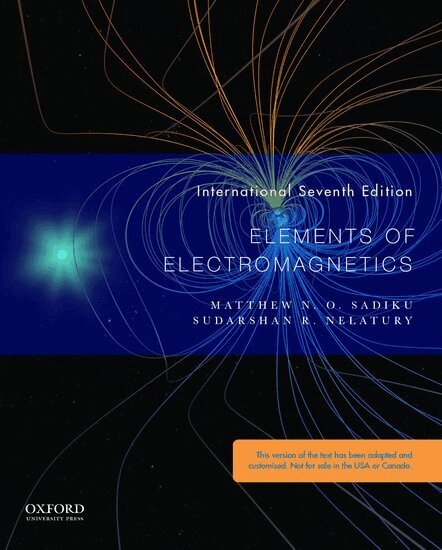
    Elements of Electromagnetics

    AvMatthew Sadiku,Sudarshan Nelatury

    Häftad, Engelska, 2021

    Del i serien The Oxford Series in Electrical and Computer Engineering

    3 375 kr

    Beställningsvara. Skickas inom 5-8 vardagar. Fri frakt över 249 kr.

    Beskrivning

    Using a vectors-first approach, Elements of Electromagnetics, Seventh Edition, covers electrostatics, magnetostatics, fields, waves, and applications like transmission lines, waveguides, and antennas. The text also provides a balanced presentation of time-varying and static fields, preparing students for employment in today's industrial and manufacturing sectors.Streamlined to facilitate student understanding, Elements of Electromagnetics, Seventh Edition, features worked examples in every chapter that explain how to use the theory presented in the text to solve different kinds of problems. It also covers numerical methods, including MATLAB and vector analysis, to help students analyze situations that they are likely to encounter in industry practice.

    Produktinformation

    • Utgivningsdatum:2021-01-19
    • Mått:229 x 191 x 27 mm
    • Vikt:1 247 g
    • Format:Häftad
    • Språk:Engelska
    • Serie:The Oxford Series in Electrical and Computer Engineering
    • Antal sidor:824
    • Upplaga:7
    • Förlag:OUP USA
    • ISBN:9780190698621

    Utforska kategorier

    • Elektronik och kommunikationer inom Naturvetenskap och teknik

    Mer om författaren

    Matthew Sadiku is Professor of Electrical Engineering at Prairie View A&M University and a fellow of IEEE.

    Recensioner i media

    This is one of the best electromagnetics textbooks on the market. With its understandable language and strong approach, Elements of Electromagnetics is almost perfect.

    Innehållsförteckning

    • BRIEF TABLE OF CONTENTS TABLE OF CONTENTS PREFACE A NOTE TO THE STUDENT MATH ASSESSMENT PART 1: VECTOR ANALYSIS 1. VECTOR ALGEBRA--1.1 Introduction--1.2 A Preview of the Book--1.3 Scalars and Vectors--1.4 Unit Vector--1.5 Vector Addition and Subtraction--1.6 Position and Distance Vectors--1.7 Vector Multiplication--1.8 Components of a Vector---Summary---Review Questions---Problems 2. COORDINATE SYSTEMS AND TRANSFORMATION--2.1 Introductio--2.2 Cartesian Coordinates (x, y, z)--2.3 Circular Cylindrical Coordinates (r, f, z)--2.4 Spherical Coordinates (r, u, f)--2.5 Constant-Coordinate Surfaces---Summary---Review Questions---Problems 3. VECTOR CALCULUS--3.1 Introduction--3.2 Differential Length, Area, and Volume--3.3 Line, Surface, and Volume Integrals--3.4 Del Operator--3.5 Gradient of a Scalar--3.6 Divergence of a Vector and Divergence Theorem--3.7 Curl of a Vector and Stokes's Theorem--3.8 Laplacian of a Scalar--3.9 Classification of Vector Fields---Summary---Review Questions---Problems PART 2: ELECTROSTATICS 4. ELECTROSTATIC FIELDS--4.1 Introduction--4.2 Coulomb's Law and Field Intensity--4.3 Electric Fields Due to Continuous Charge Distributions--4.4 Electric Flux Density--4.5 Gauss's Law-Maxwell's Equation--4.6 Applications of Gauss's Law--4.7 Electric Potential--4.8 Relationship between E and V-Maxwell's Equation--4.9 An Electric Dipole and Flux Lines--4.10 Energy Density in Electrostatic Fields--4.11 Application Note-Electrostatic Discharge---Summary---Review Questions---Problems 5. ELECTRIC FIELDS IN MATERIAL SPACE--5.1 Introduction--5.2 Properties of Materials--5.3 Convection and Conduction Currents--5.4 Conductors--5.5 Polarization in Dielectrics--5.6 Dielectric Constant and Strength--5.7 Linear, Isotropic, and Homogeneous Dielectrics--5.8 Continuity Equation and Relaxation Time--5.9 Boundary Conditions--5.10 Application Note-High Dielectric Constant Materials--5.11 Application Note-Graphene--5.12 Application Note - Piezoelectrics---Summary---Review Questions---Problems 6. ELECTROSTATIC BOUNDARY-VALUE PROBLEMS--6.1 Introduction--6.2 Poisson's and Laplace's Equations--6.3 Uniqueness Theorem--6.4 General Procedures for Solving Poisson's or Laplace's Equation--6.5 Resistance and Capacitance--6.6 Method of Images--6.7 Application Note-Capacitance of Microstrip Lines--6.8 Application Note-RF MEMS--6.9 Application NOte-Supercapacitors---Summary---Review Questions---Problems PART 3: MAGNETOSTATICS 7. MAGNETOSTATIC FIELDS--7.1 Introduction--7.2 Biot-Savart's Law--7.3 Ampère's Circuit Law-Maxwell's Equation--7.4 Applications of Ampère's Law--7.5 Magnetic Flux Density-Maxwell's Equation--7.6 Maxwell's Equations for Static Fields--7.7 Magnetic Scalar and Vector Potentials--7.8 Derivation of Biot-Savart's Law and Ampère's Law--7.9 Application Note-Lightning--7.10 Application Note-Polywell---Summary---Review Questions---Problems 8. MAGNETIC FORCES, MATERIALS, AND DEVICES--8.1 Introduction--8.2 Forces Due to Magnetic Fields--8.3 Magnetic Torque and Moment--8.4 A Magnetic Dipole--8.5 Magnetization in Materials--8.6 Classification of Materials--8.7 Magnetic Boundary Conditions--8.8 Inductors and Inductances--8.9 Magnetic Energy--8.10 Magnetic Circuits--8.11 Force on Magnetic Materials--8.12 Application Note-Magnetic Levitation--8.13 Application Note-SQUIDs---Summary---Review Questions---Problems PART 4: WAVES AND APPLICATIONS 9. MAXWELL'S EQUATIONS--9.1 Introduction--9.2 Faraday's Law--9.3 Transformer and Motional Electromotive Forces--9.4 Displacement Current--9.5 Maxwell's Equations in Final Forms--9.6 Time-Varying Potentials--9.7 Time-Harmonic Fields--9.8 Application Note-Memristor--9.9 Application Note-Optical Nanocircuits--9.10 Application Note-Wireless Power Transfer and Qi Standard---Summary---Review Questions---Problems 10. ELECTROMAGNETIC WAVE PROPAGATION--10.1 Introduction--10.2 Waves in General--10.3 Wave Propagation in Lossy Dielectrics--10.4 Plane Waves in Lossless Dielectrics--10.5 Plane Waves in Free Space--10.6 Plane Waves in Good Conductors--10.7 Wave Polarization--10.8 Power and the Poynting Vector--10.9 Reflection of a Plane Wave at Normal Incidence--10.10 Reflection of a Plane Wave at Oblique Incidence--10.11 Application Note-Microwaves--10.12 Application Note-60 GHz Technology---Summary---Review Questions---Problems 11. TRANSMISSION LINES--11.1 Introduction--11.2 Transmission Line Parameters--11.3 Transmission Line Equations--11.4 Input Impedance, Standing Wave Ratio, and Power--11.5 The Smith Chart--11.6 Some Applications of Transmission Lines--11.7 Transients on Transmission Lines 574--11.8 Application Notes-Microstrip Lines and Characterization of Data Cables--11.9 Application Note-Metamaterials--11.10 Application Note-Microwave Imaging---Summary---Review Questions---Problems 12. WAVEGUIDES--12.1 Introduction--12.2 Rectangular Waveguides--12.3 Transverse Magnetic (TM) Modes--12.4 Transverse Electric (TE) Modes--12.5 Wave Propagation in the Guide--12.6 Power Transmission and Attenuation--12.7 Waveguide Current and Mode Excitation--12.8 Waveguide Resonators--12.9 Application Note-Optical Fiber--12.10 Application Note-Cloaking and Invisibility---Summary---Review Questions---Problems 13. ANTENNAS--13.1 Introduction--13.2 Hertzian Dipole--13.3 Half-Wave Dipole Antenna--13.4 Quarter-Wave Monopole Antenna--13.5 Small-Loop Antenna--13.6 Antenna Characteristics--13.7 Antenna Arrays--13.8 Effective Area and the Friis Equation--13.9 The Radar Equation--13.10 Application Note-Electromagnetic Interference and Compatibility--13.11 Application Note-Textile Antennas and Sensors--13.12 Application Note-Fractal Antennas---Summary---Review Questions---Problems 14. NUMERICAL METHODS--14.1 Introduction--14.2 Field Plotting--14.3 The Finite Difference Method--14.4 The Moment Method--14.5 The Finite Element Method--14.6 Application Note-Microstrip Lines---Summary---Review Questions---Problems APPENDIX A: Mathematical FormulasAPPENDIX B: Material ConstantsAPPENDIX C: MATLABAPPENDIX D: The Complete Smith ChartAPPENDIX E: Answers to Odd-Numbered Problems INDEX