The Oxford Series in Electrical and Computer Engineering - Böcker
Visar alla böcker i serien The Oxford Series in Electrical and Computer Engineering. Handla med fri frakt och snabb leverans.
19 produkter
19 produkter
1 655 kr
Skickas inom 5-8 vardagar
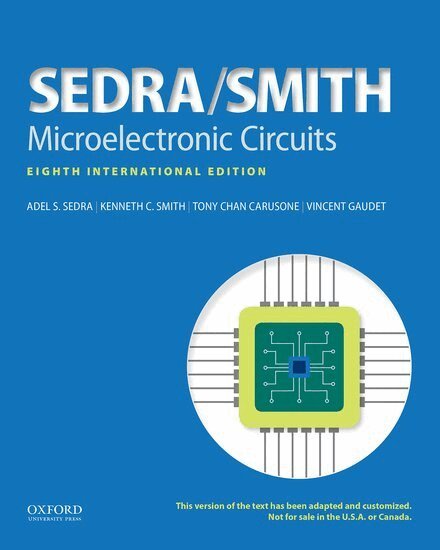
Microelectronic Circuits by Sedra and Smith has served generations of electrical and computer engineering students as the best and most widely-used text for this required course. Respected equally as a textbook and reference, "Sedra/Smith" combines a thorough presentation of fundamentals with an introduction to present-day IC technology. It remains the best text for helping students progress from circuit analysis to circuit design, developing design skills and insights that are essential to successful practice in the field. Significantly revised with the input of two new coauthors, slimmed down, and updated with the latest innovations, Microelectronic Circuits, Eighth Edition, remains the gold standard in providing the most comprehensive, flexible, accurate, and design-oriented treatment of electronic circuits available today.
1 984 kr
Skickas inom 5-8 vardagar
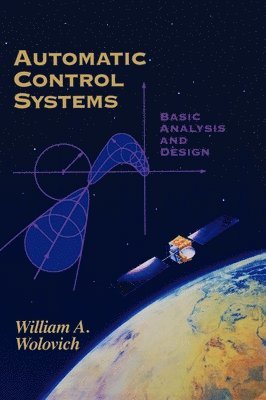
The ultimate objective of any controls text is to teach students how to achieve the best possible design. In this new text, Wolovich integrates classical and modern techniques, systematically develops all the background material necessary to achieve the best possible design, and stresses flexibility to attain this goal. All the relevant controls topics are presented in a clear pedagogical sequence beginning with the equivalence of system descriptions, followed bycoverage of performance goals and tests, and concluding with some new and innovative design methods for achieving the goals independent of the particular system description.
3 000 kr
Skickas inom 5-8 vardagar
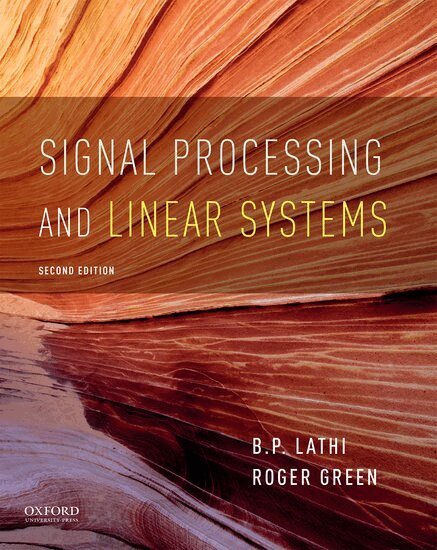
This second edition contains much of the content of Linear Systems and Signals, Third Edition, by the same authors, with added chapters on analog and digital filters and digital signal processing, plus additional applications to communications and controls. Unlike Linear Systems and Signals, Third Edition, in this book the Laplace transform follows Fourier. This book contains enough material on discrete-time systems to be used in a traditional course in Signals and Systems and in an introductory course in Digital Signal Processing.
1 719 kr
Skickas inom 5-8 vardagar
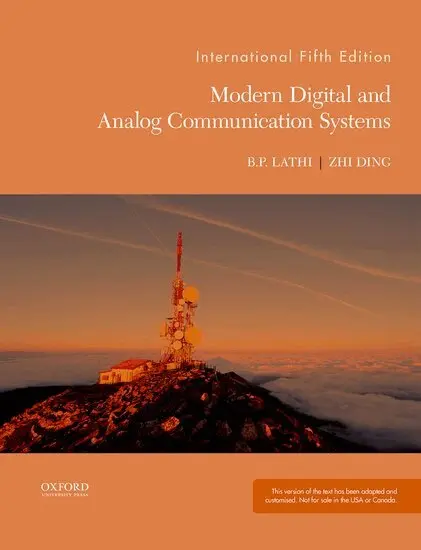
This is the latest edition of the landmark communications systems textbook by one of electrical engineering's most prolific educators, B.P. Lathi, and co-author Zhi Ding. The Fifth Edition features over 200 fully worked-through examples incorporating current technology, an expansive amount of illustrations throughout the book, MATLAB codes throughout, and a full review of key signals and systems concepts. As digital communication technology has become important part of daily life, enrollment in courses on communications engineering has increased. Communications systems courses are now one of the most popular upper-level EE offerings because of intense student interest in the topic. In the new edition, Drs. Lathi and Ding have updated the book's examples to reflect current technology and including more MATLAB coding where appropriate.
3 156 kr
Skickas inom 5-8 vardagar
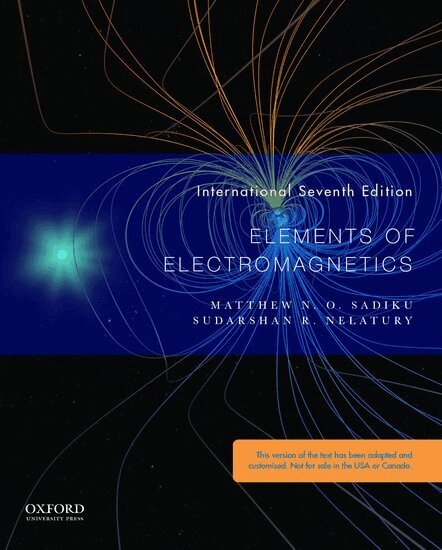
Using a vectors-first approach, Elements of Electromagnetics, Seventh Edition, covers electrostatics, magnetostatics, fields, waves, and applications like transmission lines, waveguides, and antennas. The text also provides a balanced presentation of time-varying and static fields, preparing students for employment in today's industrial and manufacturing sectors.Streamlined to facilitate student understanding, Elements of Electromagnetics, Seventh Edition, features worked examples in every chapter that explain how to use the theory presented in the text to solve different kinds of problems. It also covers numerical methods, including MATLAB and vector analysis, to help students analyze situations that they are likely to encounter in industry practice.
543 kr
Skickas inom 7-10 vardagar
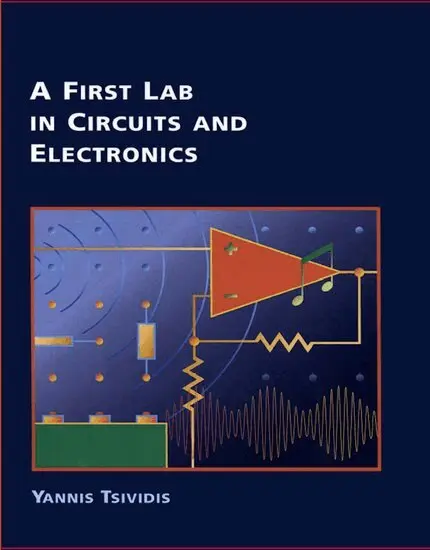
Written by an award-winning educator and researcher, the sixteen experiments in this book have been extensively class-tested and fine-tuned. This lab manual, like no other, provides an exciting, active exploration of concepts and measurements and encourages students to tinker, experiment, and become creative on their own. This benefits their further study and subsequent professional work. The manual includes self-contained background for all electronics experiments, so that the lab can be run concurrently with any circuits or electronics course, at any level. It uses circuits in real applications which students can relate to, in order to motivate them and convince them that what they learn is for real. As a result, the material is not only made interesting, but helps motivate further study in circuits, electronics, communications and semiconductor devices.EXTENSIVE INSTRUCTOR RESOURCES:* "Putting the Lab Together" is an extensive resource for instructors who are considering starting a lab based on this book. Includes an overview of a typical lab station, suggestions for choosing measurement equipment, equipment list with relevant information, and detailed information on parts required. This resource is openly available.* "Instructor's Manual" includes hints for choosing lab TAs, hints on how to run the lab experiments, guidelines for shortening or combining experiments, answers to experiment questions, and suggestions for projects and exams. This manual is available to instructors who adopt the book.
3 353 kr
Skickas inom 7-10 vardagar
The second edition of the highly successful Fundamentals of Electrical Engineering is thoroughly expanded and updated. The text is divided into four parts: circuits, electronics, digital systems, and electromagnetics. Although it delves in depth into each of these topics, the text represents more than your basic survey of the basics of electrical engineering. A solid understanding of the fundamental principles on which modern electrical engineering is based is also provided. This edition includes a chapter on circuit analysis software SPICE, with a detailed discussion of the PC version known as PSPICE (from MicroSim Corp.). Numerous drill exercises have been added to this new edition, reinforcing ideas presented in the examples. There are over 1,000 end-of-chapter problems. This text is suitable for a variety of electrical engineering courses. It can be used as a text for an introduction to electrical engineering for both majors and non-majors or both, or can be split and the various chapters utilized for an introduction to circuits course, a first electronics course, or for a course on digital electronics and logic design.
3 353 kr
Skickas inom 7-10 vardagar
From one of the best known and successful authors in the field, this new edition provides concise, practical coverage of digital system design aimed at undergraduates. The primary goal of this book is to illustrate that sequential circuits can be designed using state machine techniques. These methods apply to sequential circuit design as efficiently as Boolean algebra and Karnaugh mapping methods apply to combinatorial design. Comer presents the techniques involved, then proceeds directly to designing digital systems - a task comprising producing the schematic or block diagram of a system based on a given set of specifications. The design serves as the basis for the construction of the actual hardware system. This new edition introduces state machines earlier than in previous editions, amd adds new chapters on programmable logic devices and computer organization.
990 kr
Skickas inom 5-8 vardagar
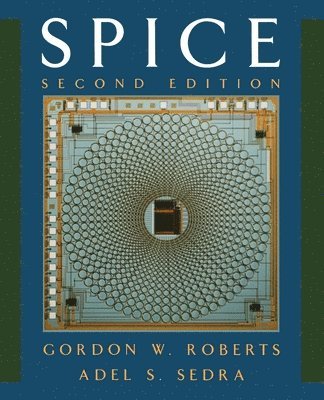
Today, most, if not at all, microelectronic circuit design is carried out with the aid of a computer-aided circuit analysis program such as SPICE. SPICE, an acronym for Simulation Program with Integrated Circuit Emphasis, is considered by many to be the de-facto industrial standard for computer-aided circuit analysis for microelectronic circuits, mainly because it is used by the majority of IC designers in North America today. It is reasonable to say that to master electronic circuit design, one must also develop a fair amount of expertise in a circuit analysis program such as SPICE. It is therefore our aim in this text to describe how SPICE is used to analyse microelectronic circuits, and more importantly, outline how SPICE is used in the process of design itself. There is a tendency for new designers of electronic circuits to be overwhelmed by the analysis capability of a circuit analysis program such as SPICE, and ignore the thought-process provided by a hand analysis using simple models for the transistors. Experience has shown that this generally leads to poor designs because most of the design effort is spent blindly searching for ways to improve the design using a brute-foce hit-and-miss approach. It is our intention in this book to avoid this pitfall and teach the reader what not to do with SPICE. This is accomplished by keying each example of this text to those presented in Microelectronic Circuits, Third Edition, by Sedra and Smith, where a complete hand analysis is provided. In this way, the insight provided by a hand analysis is readily available to our readers. All examples in this text are also available on-line via the world-wide-web site http://www.macs.ee.mcgill.ca/~roberts/.
3 353 kr
Skickas inom 7-10 vardagar
A straight reprint under the OUP imprint of ISBN 0-03-012884-6.An introductory text for advanced undergraduates and graduate students, this book covers the theory and applications of digital control systems, assuming a knowledge of matrix algebra, differential equations. Laplace transforms, and the basic principles of continuous-data control systems.
3 064 kr
Skickas inom 5-8 vardagar
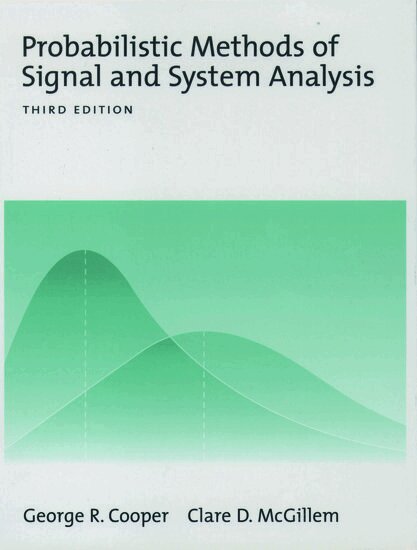
Since its original publication in 1971, this text has been a standard for signals and systems courses that emphasize probability. It provides an introduction to probability theory, statistics, random processes, and the analysis of systems with random inputs. The third edition will utilize MATLAB as a computational tool. It will be thoroughly revised to include new examples and problems, and updated to reflect the most current research and technologies. This book is intended for the junior/senior level engineering students.
3 353 kr
Skickas inom 7-10 vardagar
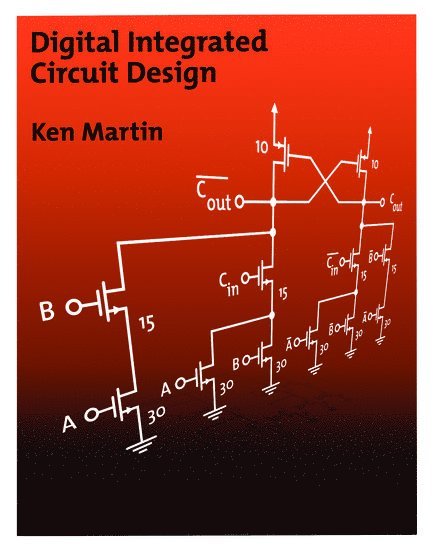
Working from the fundamentals of transistor-level design and building up to system-level considerations, Digital Integrated Circuit Design shows students with minimal background in electronics how to design state-of-the-art high performance digital integrated circuits. Ideal as an upper-level undergraduate text, it can also be used in first-year graduate courses and as a reference for practicing engineers. Digital Integrated Circuit Design: * Presents transistor-level details first, building up to system considerations * Emphasizes CMOS technology but also includes in-depth explanations of designing in bipolar, BiCMOS, and GaAs technologies * Features modern, well-designed examples and problems * Covers important system-level considerations such as timing, pipelining, clock distribution, and system building blocks in detail * Discusses key elements of semiconductor physics, integrated circuit processing, transistor-level design, logic-level design, system-level design, testing, and more * Provides physical and intuitive explanations throughout * Emphasizes conceptual thinking and design methodology over detailed circuit analysis techniques
3 353 kr
Skickas inom 7-10 vardagar
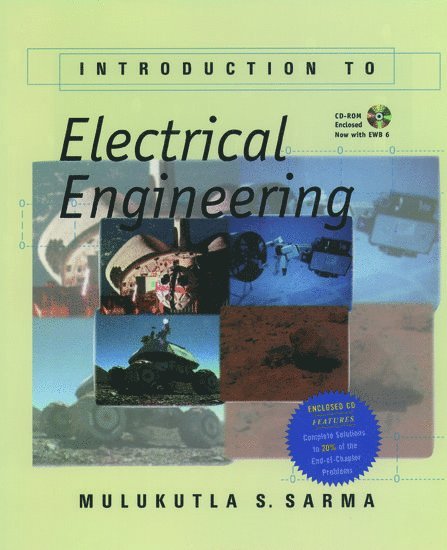
The purpose of this text is to present a problem-oriented introductory survey of electrical engineering, by arousing student enthusiasm while addressing the underlying concepts and methods behind various applications ranging from consumer gadgets and biomedical electronics to sophisticated instrumentation systems, computers, and multifarious electric machinery. The focus is on acquainting students majroing in all branches of engineering and science, especially in courses for non-electrical-engieering majors, with the nature of the subject and the potentialities of its techniques, while emphasizing the principles. Sine principles and concepts are most effectively taught by means of a problem-oriented course, judicially selected topics are treated in sufficient depth so as to permit the assignment of adequately challenging problems which tend to implant the relevant principles in student's minds. In addition to an academic-year (two semesters or three quarters) introductory course traditionally offered to non-electrical engineering majors in a number of universities. Modern technology demands a team approach in which electrical engineers and non-electrical engineers have to work together sharing a common technical vocabulary. This text is a result based on almost 40 years of experience teaching a wide variety of courses to electrical as well as non-electrical majors, an dmore particularly on the need to answer many of the questions raised by so many of my students. The book is divided into five parts in order to provide flexibility. A glance at the Table of Contents will show that Part I concerns itself with basic electric circuits, in which circuit concepts, analysis techniques, time-dependent analysis including transients, as well as three-phase circuits are covered. Part II deals with electronic ananlog and digital systems, in which analog and digital building blocks are considered along with operational amplifiers, semiconductor devices, integrated circuits, and digital circuits. Part III of the book is devoted to energy systems, in which AC power systems, magnetic circuits and transformers, principles of electromechanics, and rotating machines causing electromechanical energy conversion are presented. Part IV of the text deals with information systems, in which the underlying principles of signal processing and communication systems are included. Finally, Part V presents control systems, including the concepts of feedback control, digital control, and power semiconductor-controlled drives. The text material is organized for optimum flexibility, so that certain topics my be omitted without loss of continuity when lack of time or interest dictates.
2 803 kr
Skickas inom 5-8 vardagar
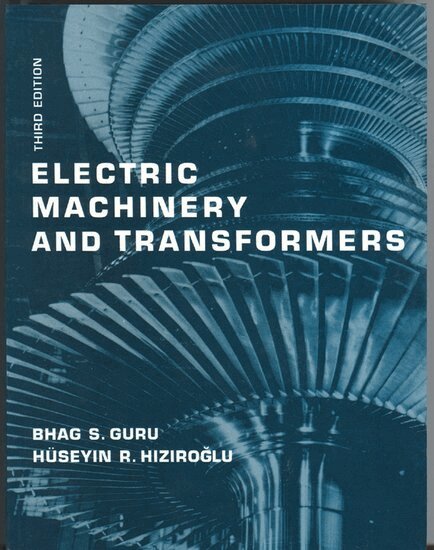
This is a revision of Guru/Hiziroglu: Electric Machinery and Transformers, 2/E. The text is designed for the standard third or fourth year (junior/senior) course in electrical engineering commonly called electric machinery or electromechanical energy conversion. This text discusses the principles behind building the primary infrastructure for the generation of electricity (such as hydroelectric dams, turbines, etc.) that supplies the energy needs of people throughout the world. In addition to power generation, the book covers the basics of various types of electric motors, from large electric train motors, to those in hair dryers and smaller devices. The largest markets for a book such as this will be found in countries with developing infrastructures. The text is best known for its accuracy, pedagogy, and clear writing style. This revision should make Electric Machinery and Transformers the most up-to-date text on the market. Electric Machinery and Transformers continues its strong pedagogical tradition with a wealth of examples, new exercises, review questions, and effective chapter summaries. Electric Machinery and Transformers begins with a review of the basics of circuit theory and electromagnetics. Chapter 3 begins the heart of the course with the principles of electromehcanical energy conversion; Chapter 4 covers transformers; Chapters 5 & 6 cover direct current generators and motors; Chapters 7 & 8 cover synchronous generators and motors. Chapters 9 and 10 round out the motors coverage with an introduction to polyphase induction motors and single-phase motors. Finally, Chapter 11 deals with dynamics of electrics machines and Chapter 12 covers special purpoe machines. This revised second edition features updated examples for modern applications, new problems, and additional material on power electronics. An instructor's manual will accompany the main text and will be available free to adopters.
3 589 kr
Skickas inom 3-6 vardagar
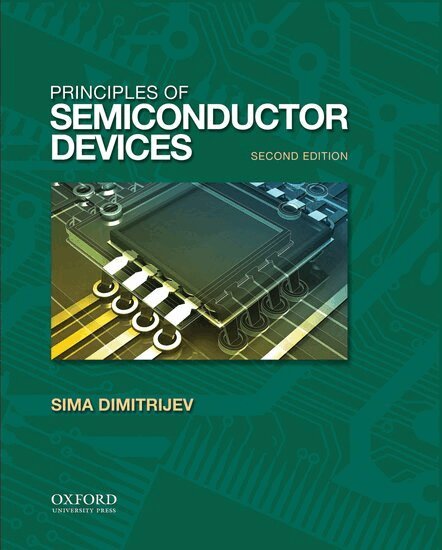
The dimensions of modern semiconductor devices are reduced to the point where classical semiconductor theory, including the concepts of continuous particle concentration and continuous current, becomes questionable. Further questions relate to two-dimensional transport in the most important field-effect devices and one-dimensional transport in nanowires and carbon nanotubes.Designed for upper-level undergraduate and graduate courses, Principles of Semiconductor Devices, Second Edition, presents the semiconductor-physics and device principles in a way that upgrades classical semiconductor theory and enables proper interpretations of numerous quantum effects in modern devices. The semiconductor theory is directly linked to practical applications, including the links to the SPICE models and parameters that are commonly used during circuit design. The text is divided into three parts: Part I explains semiconductor physics; Part II presents the principles of operation and modeling of the fundamental junctions and transistors; and Part III provides supplementary topics, including a dedicated chapter on the physics of nanoscale devices, description of the SPICE models and equivalent circuits that are needed for circuit design, introductions to the most important specific devices (photonic devices, JFETs and MESFETs, negative-resistance diodes, and power devices), and an overview of integrated-circuit technologies. The chapters and the sections in each chapter are organized so as to enable instructors to select more rigorous and design-related topics as they see fit.New to this Edition* A new chapter on the physics of nanoscale devices* A revised chapter on the energy-band model and fully reworked and updated material on crystals to include graphene and carbon nanotubes* A revised P-N junction chapter to emphasize the current mechanisms that are relevant to modern devices* JFETs and MESFETs in a stand-alone chapter* Fifty-seven new problems and eleven new examples
1 379 kr
Skickas inom 5-8 vardagar
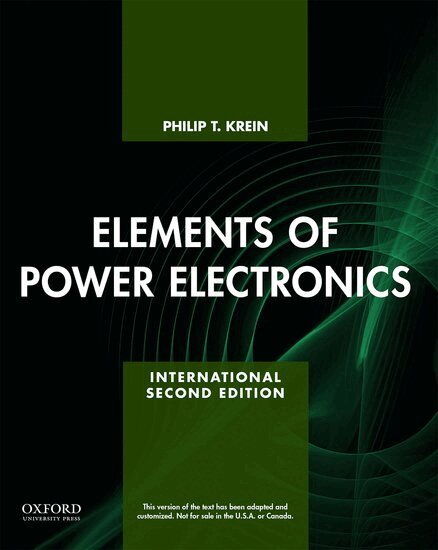
Building on the tradition of its classic first edition, the long-awaited second edition of Elements of Power Electronics provides comprehensive coverage of the subject at a level suitable for undergraduate engineering students, students in advanced degree programs, and novices in the field. It establishes a fundamental engineering basis for power electronics analysis, design, and implementation, offering broad and in-depth coverage of basic material. Streamlined throughout to reflect new innovations in technology, the second edition also features updates on renewable and alternative energy.Elements of Power Electronics features a unifying framework that includes the physical implications of circuit laws, switching circuit analysis, and the basis for converter operation and control. It discusses dc-dc, ac-dc, dc-ac, and ac-ac conversion tasks and principles of resonant converters and discontinuous converters. The text also addresses magnetic device design, thermal management and drivers for power semiconductors, control system aspects of converters, and both small-signal and geometric controls. Models for real devices and components-including capacitors, inductors, wire connections, and power semiconductors-are developed in depth, while newly expanded examples show students how to use tools like Mathcad, Matlab, and Mathematica to aid in the analysis and design of conversion circuits.Features:*More than 160 examples and 350 chapter problems support the presented concepts*An extensive Companion Website includes additional problems, laboratory materials, selected solutions for students, computer-based examples, and analysis tools for Mathcad, Matlab, and Mathematica
2 803 kr
Skickas inom 5-8 vardagar
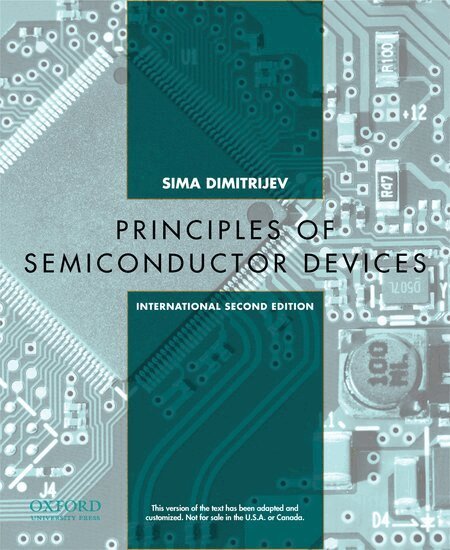
For the international second edition, the author builds upon and expands on hallmark features of the book established in the first edition, adding sections on new technology and increasing the number of end-of-chapter problems by 30%. Updated material relating to the environmental applications of technology was added , as well as a new chapter on nanoscale devices. Chapters on MOS capacitor and generation and recombination were also revised and updated. The book is divided into 4 parts: Part I on Semiconductor Physics; Part II on the principles of operation and modeling of the fundamental junctions and transistors; Part III on the diode, MOSFET and BJT topics needed for circuit design, and Part IV on photonic devices, microwave FETs, negative-resistance diodes, and power devices. Within each part, material is presented hierarchically, with core topics first, followed by advanced topics.
Instructor's Manual for "Principles of Semiconductor Devices", International Second Edition (gratis for those adopting the text)
Häftad, Engelska, 2012
255 kr
Skickas inom 7-10 vardagar
For the international second edition, the author builds upon and expands on hallmark features of the book established in the first edition, adding sections on new technology and increasing the number of end-of-chapter problems by 30%. Updated material relating to the environmental applications of technology was added , as well as a new chapter on nanoscale devices. Chapters on MOS capacitor and generation and recombination were also revised and updated. The book is divided into 4 parts: Part I on Semiconductor Physics; Part II on the principles of operation and modeling of the fundamental junctions and transistors; Part III on the diode, MOSFET and BJT topics needed for circuit design, and Part IV on photonic devices, microwave FETs, negative-resistance diodes, and power devices. Within each part, material is presented hierarchically, with core topics first, followed by advanced topics.
3 261 kr
Skickas inom 7-10 vardagar
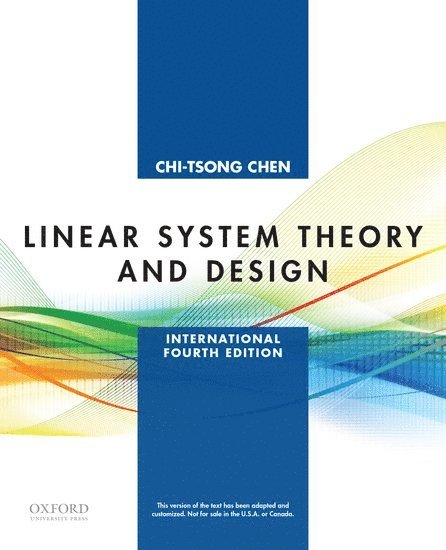
Striking a balance between theory and applications, Linear System Theory and Design, INternational Fourth Edition, uses simple and efficient methods to develop results and design procedures that students can readily employ. Ideal for advanced underrgraduate courses and first-year graduate courses in linear systems and multivariable system design, it is also a helpful resource for practicing engineers.