Adel S. Sedra - Böcker
Visar alla böcker från författaren Adel S. Sedra. Handla med fri frakt och snabb leverans.
2 produkter
2 produkter
1 655 kr
Skickas inom 5-8 vardagar
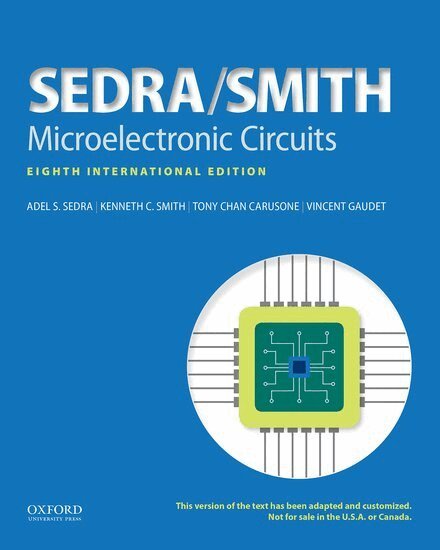
Microelectronic Circuits by Sedra and Smith has served generations of electrical and computer engineering students as the best and most widely-used text for this required course. Respected equally as a textbook and reference, "Sedra/Smith" combines a thorough presentation of fundamentals with an introduction to present-day IC technology. It remains the best text for helping students progress from circuit analysis to circuit design, developing design skills and insights that are essential to successful practice in the field. Significantly revised with the input of two new coauthors, slimmed down, and updated with the latest innovations, Microelectronic Circuits, Eighth Edition, remains the gold standard in providing the most comprehensive, flexible, accurate, and design-oriented treatment of electronic circuits available today.
990 kr
Skickas inom 5-8 vardagar
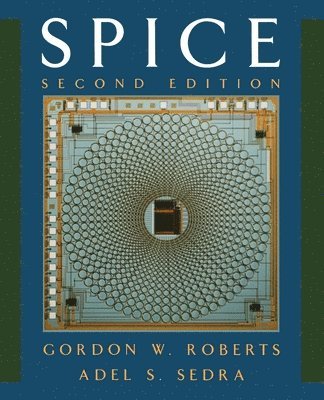
Today, most, if not at all, microelectronic circuit design is carried out with the aid of a computer-aided circuit analysis program such as SPICE. SPICE, an acronym for Simulation Program with Integrated Circuit Emphasis, is considered by many to be the de-facto industrial standard for computer-aided circuit analysis for microelectronic circuits, mainly because it is used by the majority of IC designers in North America today. It is reasonable to say that to master electronic circuit design, one must also develop a fair amount of expertise in a circuit analysis program such as SPICE. It is therefore our aim in this text to describe how SPICE is used to analyse microelectronic circuits, and more importantly, outline how SPICE is used in the process of design itself. There is a tendency for new designers of electronic circuits to be overwhelmed by the analysis capability of a circuit analysis program such as SPICE, and ignore the thought-process provided by a hand analysis using simple models for the transistors. Experience has shown that this generally leads to poor designs because most of the design effort is spent blindly searching for ways to improve the design using a brute-foce hit-and-miss approach. It is our intention in this book to avoid this pitfall and teach the reader what not to do with SPICE. This is accomplished by keying each example of this text to those presented in Microelectronic Circuits, Third Edition, by Sedra and Smith, where a complete hand analysis is provided. In this way, the insight provided by a hand analysis is readily available to our readers. All examples in this text are also available on-line via the world-wide-web site http://www.macs.ee.mcgill.ca/~roberts/.