Mulukutla S. Sarma - Böcker
Visar alla böcker från författaren Mulukutla S. Sarma. Handla med fri frakt och snabb leverans.
2 produkter
2 produkter
3 353 kr
Skickas inom 7-10 vardagar
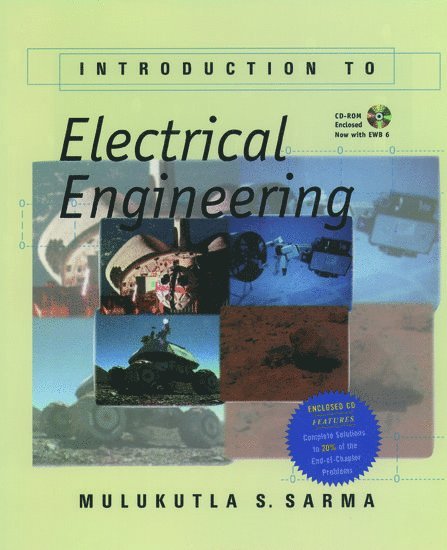
The purpose of this text is to present a problem-oriented introductory survey of electrical engineering, by arousing student enthusiasm while addressing the underlying concepts and methods behind various applications ranging from consumer gadgets and biomedical electronics to sophisticated instrumentation systems, computers, and multifarious electric machinery. The focus is on acquainting students majroing in all branches of engineering and science, especially in courses for non-electrical-engieering majors, with the nature of the subject and the potentialities of its techniques, while emphasizing the principles. Sine principles and concepts are most effectively taught by means of a problem-oriented course, judicially selected topics are treated in sufficient depth so as to permit the assignment of adequately challenging problems which tend to implant the relevant principles in student's minds. In addition to an academic-year (two semesters or three quarters) introductory course traditionally offered to non-electrical engineering majors in a number of universities. Modern technology demands a team approach in which electrical engineers and non-electrical engineers have to work together sharing a common technical vocabulary. This text is a result based on almost 40 years of experience teaching a wide variety of courses to electrical as well as non-electrical majors, an dmore particularly on the need to answer many of the questions raised by so many of my students. The book is divided into five parts in order to provide flexibility. A glance at the Table of Contents will show that Part I concerns itself with basic electric circuits, in which circuit concepts, analysis techniques, time-dependent analysis including transients, as well as three-phase circuits are covered. Part II deals with electronic ananlog and digital systems, in which analog and digital building blocks are considered along with operational amplifiers, semiconductor devices, integrated circuits, and digital circuits. Part III of the book is devoted to energy systems, in which AC power systems, magnetic circuits and transformers, principles of electromechanics, and rotating machines causing electromechanical energy conversion are presented. Part IV of the text deals with information systems, in which the underlying principles of signal processing and communication systems are included. Finally, Part V presents control systems, including the concepts of feedback control, digital control, and power semiconductor-controlled drives. The text material is organized for optimum flexibility, so that certain topics my be omitted without loss of continuity when lack of time or interest dictates.
2 029 kr
Skickas inom 10-15 vardagar
Both deregulation in the electrical supply industry and the creation of new electricity markets present electric utility companies with the challenge of becoming more efficient without compromising quality of service.Providing new solutions for this newly deregulated paradigm, Power Quality: VAR Compensation in Power Systems presents comprehensive coverage of power quality, harmonics, and static var compensators in one single volume. The book explains how to ensure that power quality is not affected by the harmonics generated by power electronic equipment and explains how to reduce labor costs and increase reliability of supply by employing a single pole autoreclosing scheme. It also addresses how to analyze frequency response of current transformers and voltage transformers while measuring harmonics. Based on the authors’ extensive experience in the electric supply industry, Power Quality enables engineers to meet the demands of increased loads, strengthen their transmission systems, and ensure reliable electric supply.