• Fri frakt över 249 kr
  • •
  • Snabba leveranser
  • •
  • Billiga böcker
Kundservice

Du är på sajten för privatpersoner.

Företag, bibliotek eller offentlig verksamhet?

Du handlar på classic.bokus.com, där alla dina funktioner finns intakta.
Till classic.bokus.com
Bokus logotyp. Gå till startsidan.
  • Erbjudanden
  • Nyheter
  • Student
  • Topplistor
  • Barn & ungdom
  • Bokus Play
  • E-böcker
  • Pocketböcker
  • Spel & pussel

10% rabatt på allt med kod: NYSTART10 →

Sidfot

Mina sidor

    Hjälp

    • Kundservice
    • Vanliga frågor och svar
    • Frakt och leverans
    • Retur vid ångerrätt
    • Reklamera vara
    • Betalning
    • Köpvillkor
    • Allmänna villkor
    • Information om webbplatsens tillgänglighet

    Om Bokus

    • Om oss
    • Pressrum
    • För studenter
    • För företag
    • För bibliotek och offentlig verksamhet
    • För leverantörer
    • Hållbarhet

    Populärt

    • Aktuella erbjudanden
    • Presentkort
    • Studentlitteratur
    • Nya böcker
    • Topplistor
    • Signerade böcker
    • Engelska böcker

    Inspiration

    • Boktips
    • BookTok
    • Populära bokserier
    • Barnbokskaraktärer
    • Populära författare
    Logotyp för Bokus
    Följ oss på Facebook (extern länk)Följ oss på Instagram (extern länk)Följ oss på YouTube (extern länk)Följ oss på TikTok (extern länk)
    bokus @ CookiesAnpassa cookiesIntegritetspolicyKöpvillkor
    Till Citymail hemsida (extern länk)Till Budbee hemsida (extern länk)Till Postnord hemsida (extern länk)Till Schenker hemsida (extern länk)Till Early Bird hemsida (extern länk)Till Walleys hemsida (extern länk)
    1. Juridik
    2. Internationell rätt

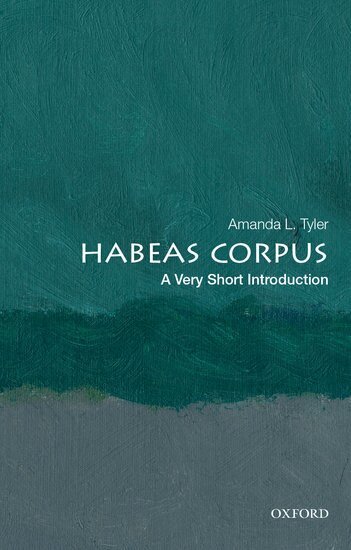
    Habeas Corpus

    A Very Short Introduction

    AvAmanda L. Tyler

    Häftad, Engelska, 2021

    Del i serien Very Short Introductions

    99 kr

    Beställningsvara. Skickas inom 5-8 vardagar. Fri frakt över 249 kr.

    Beskrivning

    Legal scholar Amanda L. Tyler discusses the history and future of habeas corpus in America and around the world. The concept of habeas corpus--literally, to receive and hold the body--empowers courts to protect the right of prisoners to know the basis on which they are being held by the government and grant prisoners their freedom when they are held unlawfully. It is no wonder that habeas corpus has long been considered essential to freedom. For nearly eight hundred years, the writ of habeas corpus has limited the executive in the Anglo-American legal tradition from imprisoning citizens and subjects with impunity. Writing in the eighteenth century, the widely influential English jurist and commentator William Blackstone declared the writ a "bulwark" of personal liberty. Across the Atlantic, in the leadup to the American Revolution, the Continental Congress declared that the habeas privilege and the right to trial by jury were among the most important rights in a free society. This Very Short Introduction chronicles the storied writ of habeas corpus and how its common law and statutory origins spread from England throughout the British Empire and beyond, witnessing its use today around the world in nations as varied as Canada, Israel, India, and South Korea. Beginning with the English origins of the writ, the book traces its historical development both as a part of the common law and as a parliamentary creation born out of the English Habeas Corpus Act of 1679, a statute that so dramatically limited the executive's power to detain that Blackstone called it no less than a "second Magna Carta." The book then takes the story forward to explore how the writ has functioned in the centuries since, including its controversial suspension by President Abraham Lincoln during the Civil War. It also analyzes the major role habeas corpus has played in such issues as the World War II incarceration of Japanese Americans and the US Supreme Court's recognition during the War on Terror of the concept of a "citizen enemy combatant." Looking ahead the story told in these pages reveals the immense challenges that the habeas privilege faces today and suggests that in confronting them, we would do well to remember how the habeas privilege brought even the king of England to his knees before the law.

    Produktinformation

    • Utgivningsdatum:2021-05-27
    • Mått:114 x 137 x 5 mm
    • Vikt:159 g
    • Format:Häftad
    • Språk:Engelska
    • Serie:Very Short Introductions
    • Antal sidor:184
    • Förlag:OUP USA
    • ISBN:9780190918989

    Utforska kategorier

    • Internationell rätt inom Juridik
    • Lag och samhälle inom Juridik
    • Mänskliga och medborgerliga rättigheter inom Juridik

    Mer om författaren

    Amanda L. Tyler is the Shannon Cecil Turner Professor of Law at the University of California, Berkeley School of Law, where she teaches and writes about the federal courts, the Supreme Court, constitutional law, legal history, and procedure. Tyler is the author of Habeas Corpus in Wartime: From the Tower of London to Guantanamo Bay. She is also a co-author, with Justice Ruth Bader Ginsburg, of Justice, Justice Thou Shalt Pursue: A Life's Work Fighting for a More Perfect Union. In addition, Tyler has served since 2016 as a co-editor of Hart and Wechsler's The Federal Courts and the Federal System, and she was a contributing author to Federal Court Stories and the Cambridge Companion to the United States Constitution. Tyler is a graduate of Stanford University and Harvard Law School and a former law clerk to the Honorable Guido Calabresi at the United States Court of Appeals for the Second Circuit and the Honorable Ruth Bader Ginsburg at the Supreme Court of the United States.

    Recensioner i media

    It is a real achievement to encapsulate and illustrate these various themes and principles so concisely, enabling even the reader without any prior legal knowledge to gain an insight into the nature of what has long been celebrated as this "great palladium of the liberties of the subject".

    Innehållsförteckning

    • Lists of Illustrations Acknowledgments Introduction 1: The English origins 2: The limits and potential of habeas corpus 3: Revolution 4: Habeas corpus comes to America 5: Habeas corpus in the early United States 6: Civil war and suspension 7: Reconstruction and expansion of the writ 8: World War II and the demise of the great writ 9: Habeas corpus today Conclusion References Further Reading Index