• Fri frakt över 249 kr
  • •
  • Snabba leveranser
  • •
  • Billiga böcker
Kundservice

Du är på sajten för privatpersoner.

Företag, bibliotek eller offentlig verksamhet?

Du handlar på classic.bokus.com, där alla dina funktioner finns intakta.
Till classic.bokus.com
Bokus logotyp. Gå till startsidan.
  • Erbjudanden
  • Nyheter
  • Student
  • Topplistor
  • Barn & ungdom
  • Bokus Play
  • E-böcker
  • Pocketböcker
  • Spel & pussel

10% rabatt på allt med kod NYSTART10 →

Sidfot

Mina sidor

    Hjälp

    • Kundservice
    • Vanliga frågor och svar
    • Frakt och leverans
    • Retur vid ångerrätt
    • Reklamera vara
    • Betalning
    • Köpvillkor
    • Allmänna villkor
    • Information om webbplatsens tillgänglighet

    Om Bokus

    • Om oss
    • Pressrum
    • För studenter
    • För företag
    • För bibliotek och offentlig verksamhet
    • För leverantörer
    • Hållbarhet

    Populärt

    • Aktuella erbjudanden
    • Presentkort
    • Studentlitteratur
    • Nya böcker
    • Topplistor
    • Signerade böcker
    • Engelska böcker

    Inspiration

    • Boktips
    • BookTok
    • Populära bokserier
    • Barnbokskaraktärer
    • Populära författare
    Logotyp för Bokus
    Följ oss på Facebook (extern länk)Följ oss på Instagram (extern länk)Följ oss på YouTube (extern länk)Följ oss på TikTok (extern länk)
    bokus @ CookiesAnpassa cookiesIntegritetspolicyKöpvillkor
    Till Citymail hemsida (extern länk)Till Budbee hemsida (extern länk)Till Postnord hemsida (extern länk)Till Schenker hemsida (extern länk)Till Early Bird hemsida (extern länk)Till Walleys hemsida (extern länk)
    1. Filosofi och religion
    2. Filosofi
    3. Filosofiska discipliner

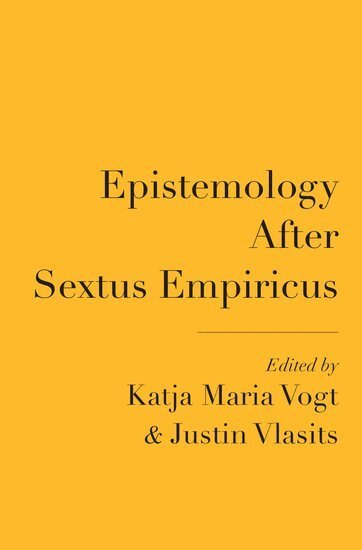
    Epistemology After Sextus Empiricus

    AvKatja Maria Vogt,Justin Vlasits

    Inbunden, Engelska, 2020

    2 145 kr

    Beställningsvara. Skickas inom 5-8 vardagar. Fri frakt över 249 kr.

    Beskrivning

    Sextus Empiricus was the voice of ancient Greek skepticism for posterity. His writings contain the most subtle and detailed versions of the ancient skeptical arguments known as Pyrrhonism, adding up to a distinctive philosophical approach. Instead of viewing philosophy as valuable because of the answers it gives to important questions, Sextus considered the search for answers itself to be fundamental and offered a philosophy centered on inquiry. Assuming the point of view of an active inquirer, Sextus developed arguments concerning conflicting appearances, infinite regress in argument, dogmatic assertion of premises that are insufficiently justified, and many other ideas that fascinated later philosophers of knowledge across the centuries. He provided a unique perspective on topics of enduring relevance such as perception, language, logical consequence, belief, ignorance, disagreement, and induction.While Sextus's importance to epistemology was appreciated by early modern and modern philosophers, he is underrepresented in contemporary discussions. In order to put Sextus back in the center of epistemology, these essays discuss his influence in the history of modern philosophy as well as contemporary engagements with Sextus's version of Pyrrhonian skepticism. The contributors investigate epistemology after Sextus, addressing four core themes of Sextus's skepticism: appearances and perception, the structure of justification and proof, belief and ignorance, and ethics and action. The arguments presented here bridge the divide between contemporary and ancient debates about knowledge and skepticism and will appeal to philosophers interested in epistemology and philosophy of mind as well as those interested in ancient philosophy and the history of philosophy more generally.

    Produktinformation

    • Utgivningsdatum:2020-01-31
    • Mått:236 x 160 x 33 mm
    • Vikt:699 g
    • Format:Inbunden
    • Språk:Engelska
    • Antal sidor:348
    • Förlag:OUP USA
    • ISBN:9780190946302

    Utforska kategorier

    • Filosofiska discipliner inom Filosofi och religion

    Mer om författaren

    Katja Maria Vogt is Professor of Philosophy at Columbia University. She specializes in ancient philosophy, ethics, and normative epistemology. In her books and papers, she focuses on questions that figure both in ancient and in contemporary discussions: What are values? What kind of values are knowledge and truth? What does it mean to want one's life to go well? Justin Vlasits is Assistant Professor at the University of Tübingen. He obtained his PhD from the University of California, Berkeley and specializes in ancient philosophy as well as contemporary epistemology and logic. In his research, he is particularly interested in questions about inquiry, knowledge, and method from both historical and contemporary perspectives.

    Innehållsförteckning

    • AcknowledgmentsAbout the Contributors Justin Vlasits and Katja Maria Vogt, Introduction Appearances and perception1: John Morrison, Perceptual Relativism: Ancient and Contemporary2: Kathrin Glüer, Illusory Looks 3: Megan Feeney and Susanna Schellenberg, Bayesian Liberalism4: MGF Martin, Variation and Change in Appearances5: Peter Pagin, The Force of Assumptions and Self-Attributions The structure of justification and proof6: Marko Malink, Hypothetical Syllogisms and Infinite Regress7: Jessica N. Berry, Sextan Skepticism and the Rise and Fall of German Idealism8: Duncan Pritchard, Wittgensteinian Epistemology, Epistemic Vertigo, and Pyrrhonian Skepticism Belief and ignorance9: Kathryn Tabb, "The Skeptical Physitian": Locke, Pyrrhonism, and the Case against Innate Ideas10: Don Garrett, Pyrrhonian Skepticism and Humean Skepticism: Belief, Evidence, and Causal Power11: Justin Vlasits, The First Riddle of Induction: Sextus Empiricus and the Formal Learning Theorists12: Jens Haas and Katja Maria Vogt, Incomplete Ignorance Ethics and action13: Richard Bett, Echoes of Sextus Empiricus in Nietzsche?14: Sergio Tenenbaum, Value Disagreement, Action, and Commitment ReferencesIndex