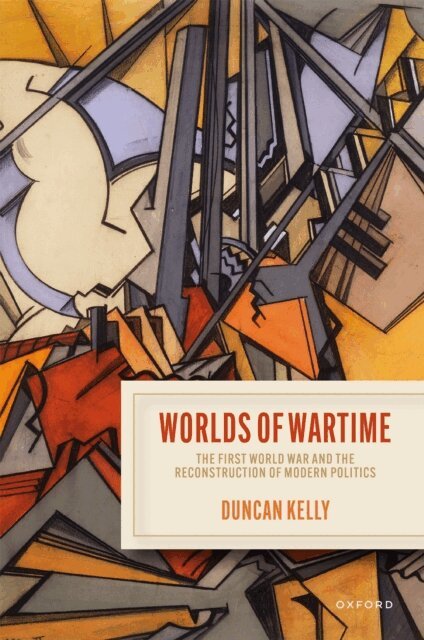
E-bok, Engelska, 2025
Worlds of Wartime
Av Duncan Kelly
470 kr
Läs direkt i Bokus Reader – eller ladda ned till din enhet
Beskrivning
The First World War hardly ended with the formal Armistice in Europe on November 11, 1918, amid the continuing violence of blockades and epidemics, amid numerous forms of reconstruction and revolution. Its legacies, in fact, resonate deeply in our present. Nor is it obvious that it only began on July 28, 1914, just a month after the assassination of the Archduke Franz Ferdinand, in Sarajevo. Rather than these formal legal openings and closings, the beginnings and endings of wartime are many, depending upon the questions we ask, and the frames of reference we provide. For many at the time, the outbreak of what would become the First World War was an inevitability, the result of rising tensions over decades, whether due to the dynamics and systems of international politics within Europe, or a result of the competitive logic of imperial politics as practised by Europe outside its borders, rebounding back upon it. This resulted in equally persistent ideas down to our own time, about the inevitability that followed from victory; namely, that to be successful and realistic, modern politics and economics must necessarily be fixed in the form of a democratic nation-state. But this new world of democracy, forged in war, could easily become its own sort of intellectual prison-house, curating and limiting political and economic possibilities just as securely as any form of tyranny. That the tyranny of victory was a danger recognized by many of the leading analysts of the First World War at the time, helped to foster a continued search for ideas that might keep the worlds of politics and economics open to alternative futures, rather than being closed by the force of a few great powers or the presentational fiat of democracy. Those hopes paved the way for the wide variety of anti-imperial, federal, diasporic, and revolutionary forms of political and economic arrangements, which were designed to challenge the seemingly inevitable rise of the nation-state.
Worlds of Wartime: The First World War and the Reconstruction of Modern Politics provides a new intellectual history of the many and varied ideas about politics and economics that were made, and remade, through wartime and revolution, by political and economic thinkers working across the globe, from the 1880s to the 1930s. Spanning continents, connecting networks of people, power, and possibilities, in new and often experimental ways, the worlds of wartime saw histories of modern politics and economics revised and updated, used as well as abused, in myriad attempts to interpret, explain, understand, explore, and indeed to win, the war. This book takes the measure of a great many of these overlapping visions, and it does so by trying to learn some of the lessons that literary and artistic modernism can teach us about the complexities of political and economic ideas, their contingency and uncertainty, and how they are fixed into focus only at very particular moments. Moving from the stylised narratives of European and American political theory and intellectual history, through to the futurist politics of revolutionaries in Ireland, India, Ottoman-Turkey, and Russia, this book also tracks arguments and strategies for Pan-African diasporic federation, alongside German and American debates about federal pasts and federal futures. From the invention of the world economy, to the reality of multiple war economies, from revolutionary conjunctures to ideas of democracy and climate catastrophe in the Anthropocene today, Worlds of Wartime tells the story of just how strongly modern politics in general, and modern ideas about political and economic possibility, were fixed by the intellectual turbulence wrought during the First World War.
Worlds of Wartime: The First World War and the Reconstruction of Modern Politics provides a new intellectual history of the many and varied ideas about politics and economics that were made, and remade, through wartime and revolution, by political and economic thinkers working across the globe, from the 1880s to the 1930s. Spanning continents, connecting networks of people, power, and possibilities, in new and often experimental ways, the worlds of wartime saw histories of modern politics and economics revised and updated, used as well as abused, in myriad attempts to interpret, explain, understand, explore, and indeed to win, the war. This book takes the measure of a great many of these overlapping visions, and it does so by trying to learn some of the lessons that literary and artistic modernism can teach us about the complexities of political and economic ideas, their contingency and uncertainty, and how they are fixed into focus only at very particular moments. Moving from the stylised narratives of European and American political theory and intellectual history, through to the futurist politics of revolutionaries in Ireland, India, Ottoman-Turkey, and Russia, this book also tracks arguments and strategies for Pan-African diasporic federation, alongside German and American debates about federal pasts and federal futures. From the invention of the world economy, to the reality of multiple war economies, from revolutionary conjunctures to ideas of democracy and climate catastrophe in the Anthropocene today, Worlds of Wartime tells the story of just how strongly modern politics in general, and modern ideas about political and economic possibility, were fixed by the intellectual turbulence wrought during the First World War.
Produktinformation
- Utgivningsdatum: 2025-10-16
- Språk: Engelska
- Filformat: EPUB
- Kopieringsskydd: LCP
- ISBN: 9780192520111
- Förlag: Oxford University Press
Utforska kategorier
Betyg & recensioner
0 recensioner
Inga recensioner tillgängliga.