• Fri frakt över 249 kr
  • •
  • Snabba leveranser
  • •
  • Billiga böcker
Kundservice

Du är på sajten för privatpersoner.

Företag, bibliotek eller offentlig verksamhet?

Du handlar på classic.bokus.com, där alla dina funktioner finns intakta.
Till classic.bokus.com
Bokus logotyp. Gå till startsidan.
  • Erbjudanden
  • Nyheter
  • Student
  • Topplistor
  • Barn & ungdom
  • Bokus Play
  • E-böcker
  • Pocketböcker
  • Spel & pussel

10% rabatt på allt med kod NYSTART10 →

Sidfot

Mina sidor

    Hjälp

    • Kundservice
    • Vanliga frågor och svar
    • Frakt och leverans
    • Retur vid ångerrätt
    • Reklamera vara
    • Betalning
    • Köpvillkor
    • Allmänna villkor
    • Information om webbplatsens tillgänglighet

    Om Bokus

    • Om oss
    • Pressrum
    • För studenter
    • För företag
    • För bibliotek och offentlig verksamhet
    • För leverantörer
    • Hållbarhet

    Populärt

    • Aktuella erbjudanden
    • Presentkort
    • Studentlitteratur
    • Nya böcker
    • Topplistor
    • Signerade böcker
    • Engelska böcker

    Inspiration

    • Boktips
    • BookTok
    • Populära bokserier
    • Barnbokskaraktärer
    • Populära författare
    Logotyp för Bokus
    Följ oss på Facebook (extern länk)Följ oss på Instagram (extern länk)Följ oss på YouTube (extern länk)Följ oss på TikTok (extern länk)
    bokus @ CookiesAnpassa cookiesIntegritetspolicyKöpvillkor
    Till Citymail hemsida (extern länk)Till Budbee hemsida (extern länk)Till Postnord hemsida (extern länk)Till Schenker hemsida (extern länk)Till Early Bird hemsida (extern länk)Till Walleys hemsida (extern länk)
    1. Naturvetenskap och teknik
    2. Matematik och naturvetenskap
    3. Fysik
    4. Tillämpad fysik

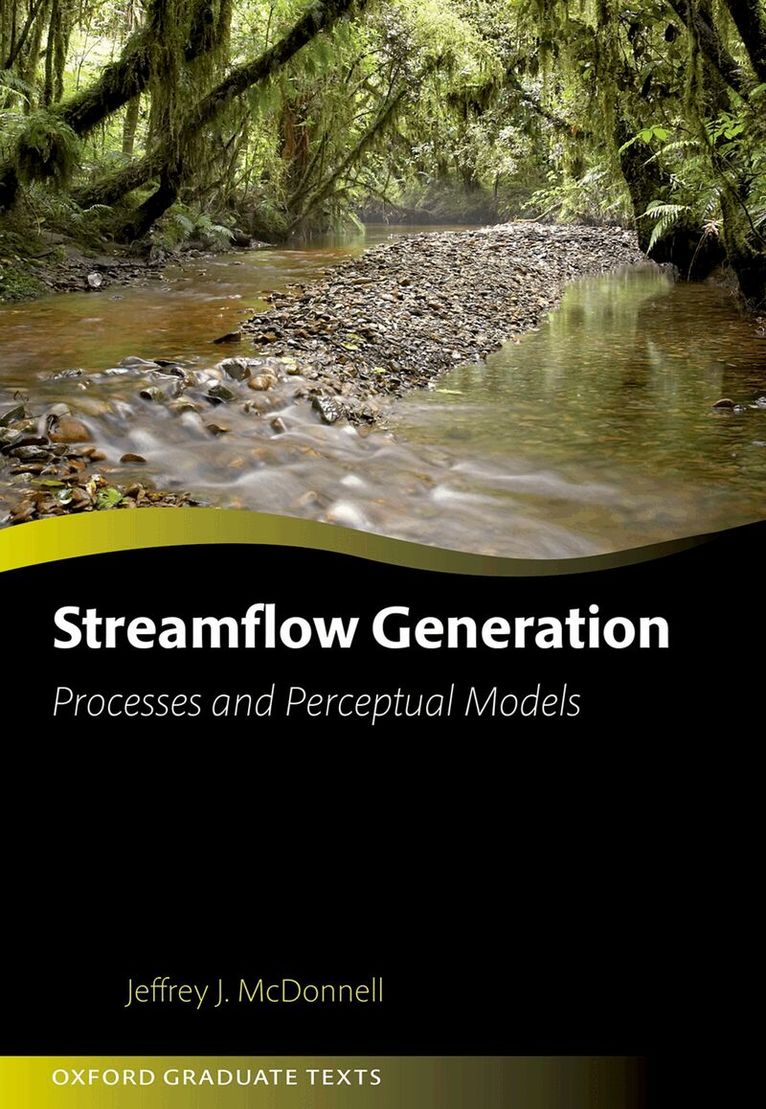
    Streamflow Generation

    Processes and Perceptual Models

    AvJeffrey J. McDonnell

    Inbunden, Engelska, 2026

    Del i serien Oxford Graduate Texts

    1 006 kr

    Kommande

    Beskrivning

    Streamflow Generation is a synthesis of field-based understanding of how catchments store and release water. Where does water go when it rains? What flowpath does water take to the stream? And, how old is the water leaving the catchment by streamflow and transpiration?Observing catchments through field work and field discovery are an essential part of hydrological science. This book is a new equation-free narrative of what we know about the flow pathways, sources, and travel times of water through headwater catchments.Streamflow Generation lowers the barrier of entry into the world of process hydrology, covering the period from the first field-based measurements in the early 20th Century to the development of early rainfall-runoff concepts. It covers the 1960s' great expansion of studies during the International Hydrological Decade, and the subsequent use of isotope tracers in catchment hydrology that brought about radical shifts in our understanding of the science.McDonnell explores our modern understanding of how catchments store and release water at the point-, hillslope- and catchment-scales, and how bottom-up and top-down measures have been used to develop perceptual models. The opportunities and challenges for catchment science are discussed, as well as what remains to be discovered about hydrological connectivity, the sources, residence times, and transit time distributions of streamflow and plant transpiration. What remains to be discovered is vast in comparison to what is known – early career hydrologists must continue field-based discovery science in streamflow generation.

    Produktinformation

    • Utgivningsdatum:2026-10-01
    • Mått:189 x 246 x undefined mm
    • Format:Inbunden
    • Språk:Engelska
    • Serie:Oxford Graduate Texts
    • Antal sidor:272
    • Förlag:OUP OXFORD
    • ISBN:9780192862693

    Utforska kategorier

    • Tillämpad fysik inom Naturvetenskap och teknik
    • Hydrologi inom Naturvetenskap och teknik
    • Miljövetenskap och miljöpolitik inom Naturvetenskap och teknik

    Mer om författaren

    Jeffrey J. McDonnell is a Distinguished Professor of Hydrology at the University of Saskatchewan in Canada. His research focuses on streamflow generation and the use of stable isotopes for tracing the water cycle. He is winner of a number of prizes, including the Horton Medal from the American Geophysical Union (2025), the Ray K. Linsley Award for Surface Water from the American Institute of Hydrology (2023), the International Hydrology Prize from the International Association of Hydrological, UNESCO and the World Meteorological Organization (2016), and the Dalton Medal from the European Geosciences Union (2009). McDonnell is a 2024 Officer of the Order of Canada and a fellow of the Royal Society of Canada, the American Association for the Advancement of Science, Academia Europaea, the American Geophysical Union, and the Geological Society of America. He is the former President of the AGU Hydrology Section.

    Innehållsförteckning

    • 1: Introduction Part 1 What Do We Know? 2: Streamflow: The first process discoveries (1674-1960) 3: The variable source area concept (1960-1970) 4: Subsurface stormflow: Process advancements (1965-1974) 5: The role of groundwater in storm runoff (1975-1999) Part 2 What Do We Think We Know? 6: Flowpath connectivity (~2000-present) 7: Streamwater age and catchment storage (2010-present) 8: Ecohydrological impacts on streamflow generation (~2000-present) Part 3 What Do We Need To Know? 9: Opportunities and challenges ahead