• Fri frakt över 249 kr
  • •
  • Snabba leveranser
  • •
  • Billiga böcker
Kundservice

Du är på sajten för privatpersoner.

Företag, bibliotek eller offentlig verksamhet?

Du handlar på classic.bokus.com, där alla dina funktioner finns intakta.
Till classic.bokus.com
Bokus logotyp. Gå till startsidan.
  • Erbjudanden
  • Nyheter
  • Student
  • Topplistor
  • Barn & ungdom
  • Bokus Play
  • E-böcker
  • Pocketböcker
  • Spel & pussel

Må bättre, för mindre! Upp till 50% rabatt på hälsoböcker

Sidfot

Mina sidor

    Hjälp

    • Kundservice
    • Vanliga frågor och svar
    • Frakt och leverans
    • Retur vid ångerrätt
    • Reklamera vara
    • Betalning
    • Köpvillkor
    • Allmänna villkor
    • Information om webbplatsens tillgänglighet

    Om Bokus

    • Om oss
    • Pressrum
    • För studenter
    • För företag
    • För bibliotek och offentlig verksamhet
    • För leverantörer
    • Hållbarhet

    Populärt

    • Aktuella erbjudanden
    • Presentkort
    • Studentlitteratur
    • Nya böcker
    • Topplistor
    • Signerade böcker
    • Engelska böcker

    Inspiration

    • Boktips
    • BookTok
    • Populära bokserier
    • Barnbokskaraktärer
    • Populära författare
    Logotyp för Bokus
    Följ oss på Facebook (extern länk)Följ oss på Instagram (extern länk)Följ oss på YouTube (extern länk)Följ oss på TikTok (extern länk)
    bokus @ CookiesAnpassa cookiesIntegritetspolicyKöpvillkor
    Till Citymail hemsida (extern länk)Till Budbee hemsida (extern länk)Till Postnord hemsida (extern länk)Till Schenker hemsida (extern länk)Till Early Bird hemsida (extern länk)Till Walleys hemsida (extern länk)
    1. Medicin
    2. Andra medicinska specialiteter
    3. Psykiatri

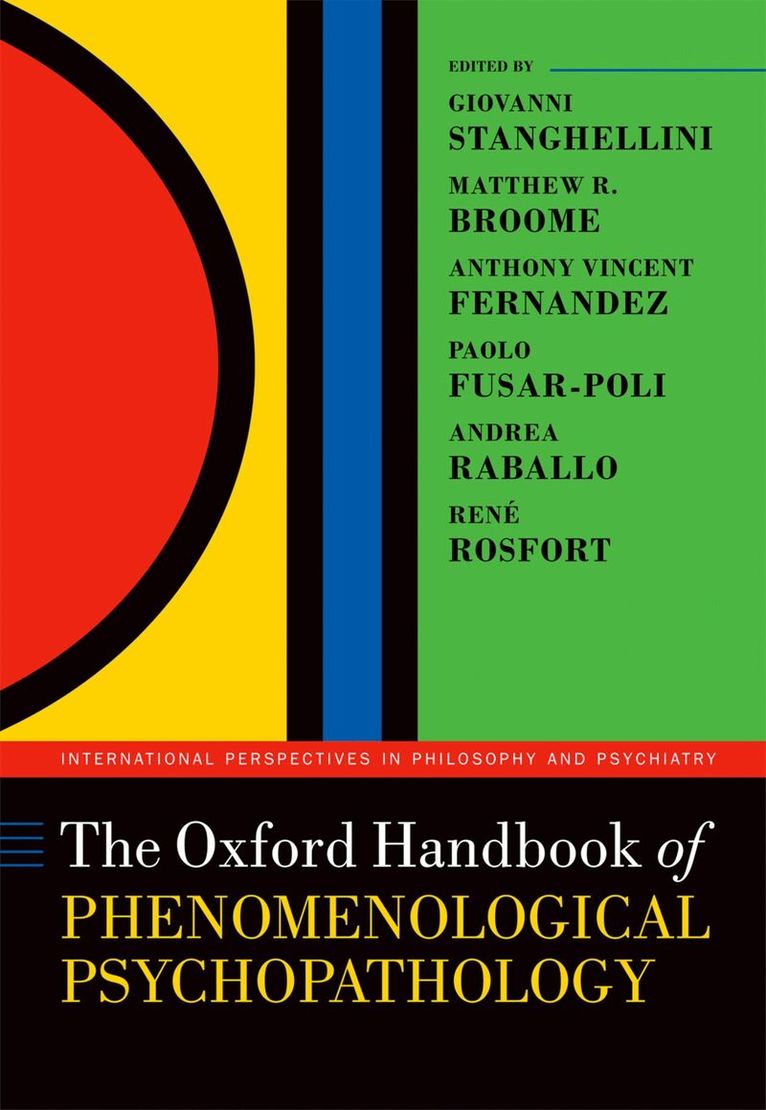
    The Oxford Handbook of Phenomenological Psychopathology

    AvGiovanni Stanghellini,Matthew Broome

    Häftad, Engelska, 2021

    1 033 kr

    Beställningsvara. Skickas inom 5-8 vardagar. Fri frakt över 249 kr.

    Beskrivning

    The field of phenomenological psychopathology (PP) is concerned with exploring and describing the individual experience of those suffering from mental disorders. Whilst there is often an understandable emphasis within psychiatry on diagnosis and treatment, the subjective experience of the individual is frequently overlooked. Yet a patient's own account of how their illness affects their thoughts, values, consciousness, and sense of self, can provide important insights into their condition - insights that can complement the more empirical findings from studies of brain function or behaviour. The Oxford Handbook of Phenomenological Psychopathology is the first ever comprehensive review of the field. It considers the history of PP, its methodology, key concepts, and includes a section exploring individual experiences within schizophrenia, depression, borderline personality disorder, OCD, and phobia. In addition it includes chapters on some of the leading figures throughout the history of this field. Bringing together chapters from a global team of leading academics, researchers and practitioners, the book will be valuable for those within the fields of psychiatry, clinical psychology, and philosophy.

    Produktinformation

    • Utgivningsdatum:2021-02-04
    • Mått:170 x 244 x 58 mm
    • Vikt:1 839 g
    • Format:Häftad
    • Språk:Engelska
    • Antal sidor:1 216
    • Förlag:OUP OXFORD
    • ISBN:9780192895929

    Utforska kategorier

    • Psykiatri inom Medicin
    • Filosofiska discipliner inom Filosofi och religion

    Mer om författaren

    Giovanni Stanghellini, MD and Dr. Phil. honoris causa, psychiatrist, is professor of Dynamic Psychology and Psychopathology at "G. d'Annunzio" University (Chieti, Italy), Profesor Adjuncto "D. Portales" University (Santiago, Chile) and chair of the Scuola di Psicoterapia Fenomenologico-Dinamica in Florence. He is one of the leading figures in contemporary philosophy of psychiatry and phenomenological psychopathology. Among his books published by Oxford University Press: Nature and Narrative (with KWM Fulford, K. Morris and JZ Sadler, OUP 2003), Disembodied Spirits and Deanimated Bodies. The Psychopathology of Common Sense (OUP 2004), Emotions and Personhood (with R. Rosfort, OUP 2013), One Ceentury of Karl Jaspers' General Psychopathology (with T. Fuchs, OUP 2013), the Oxford Handbook of Philosophy and Psychiatry (with KWM Fulford et al., OUP 2013) and Lost in dialogue. Anthropology, pychopathology and care (OUP 2016).Matthew Broome is Professor of Psychiatry and Youth Mental Health and Director of the Institute for Mental Health at the University of Birmingham, UK, and Distinguished Research Fellow, Oxford Uehiro Centre for Practical Ethics, University of Oxford, UK. Matthew trained in psychiatry at the Maudsley Hospital, Bethlem Royal Hospital, and the National Hospital for Neurology and Neurosurgery, and has a PhD in Psychiatry from the Institute of Psychiatry, University of London, UK and in Philosophy from the University of Warwick, UK. He is a former chair of the Philosophy Special Interest Group at the Royal College of Psychiatrists, a founder member of the Maudsley Philosophy Group, and is series editor to the Oxford University Press series, International Perspectives in Philosophy and Psychiatry. He is deputy editor for the British Journal of Psychiatry.Anthony Vincent Fernandez received his Ph.D. in philosophy from the University of South Florida in 2016. He is currently an assistant professor of philosophy at Kent State University. His work is on the foundations of applied phenomenology, focusing on the challenges of applying phenomenology to domains that it was not originally designed to study-especially psychopathology.Andrea Raballo MD, Spec. Psych., PhD is Associate Professor of Psychiatry at the University of Perugia, Italy, where he serves as scientific and clinical Head of the Center for Translational, Phenomenological and Developmental Psychopathology. He is currently co-chair of the World Psychiatric Association (WPA) Section for Clinical Psychopathology, and board member of both the European Psychiatric Association (EPA) and the IEPA Early Intervention in Mental Health. His main research interests are phenomenological and developmental psychopathology, with a specific focus on child-adolescent vulnerability and related trajectories towards more severe mental disorders. He is also interested in developing innovative frameworks for service implementation.René Rosfort, born 1975 in Copenhagen, Denmark (PhD, University of Copenhagen, 2008) has studied theology in Copenhagen and philosophy in Florence, Italy. His research deals primarily with ethics, phenomenology, and hermeneutics from the combined perspective of philosophy and psychiatry, and with a particular interest in Kant, Kierkegaard, Ricoeur.

    Innehållsförteckning

    • 1: Giovanni Stanghellini, Matthew Broome, Anthony Vincent Fernandez, Paolo Fusar Poli, Andrea Raballo, and René Rosfort: Introduction Section One: History 2: Roberta de Monticelli: Edmund Husserl 3: Angela Ales Bello: The Role of Psychology According to Edith Stein 4: Anthony Vincent Fernandez: Martin Heidegger 5: Anthony Hatzimoysis: Jean-Paul Sartre 6: Maxine Sheets-Johnstone: Merleau-Ponty, Phenomenology, and Psychopathology 7: Shannon M. Mussett: Simone de Beauvoir 8: John Cutting: Max Scheler 9: Andrzej Wiercinski: Hans-Georg Gadamer 10: René Rosfort: Paul Ricoeur 11: Richard A. Cohen: Emmanuel Levinas 12: Federico Leoni: Critiques and Integrations of Phenomenology: Derrida, Foucault, Deleuze 13: Matthias Bormuth: Karl Jaspers 14: Annick Urfer-Parnas: Eugène Minkowski 15: Klaus Hoffmann and Roman Knorr: Ludwig Binswanger 16: Franz Mayr: Medard Boss 17: Thomas Fuchs: Erwin Straus 18: Mario Rossi Monti: Ernst Kretschmer 19: Stefano Micali: Hubertus Tellenbach 20: James Phillips: Kimura Bin 21: Martin Heinze: Wolfgang Blankenburg 22: John Foot: Franco Basaglia 23: Lewis R. Gordon: Frantz Fanon 24: Allan Beveridge: R.D. Laing Section Two: Foundations and Methods 25: Shaun Gallagher: Phenomenology and cognitive science 26: Massimiliano Aragona: Phenomenology, naturalism and the neurosciences 27: Dermot Moran: The Phenomenological Approach 28: Dorothée Legrand: Clinical Phenomenology: Descriptive, structural and transcendental 29: Louis Sass and Adam Fishman: Introspection, Phenomenology, and Psychopathology 30: René Rosfort: Phenomenology and Hermeneutics 31: Sara Heinämaa and Joona Taipale: Normality 32: Anthony Steinbock: Genetic Phenomenology 33: Anthony Vincent Fernandez and Allan Køster: The Subject Matter of Phenomenological Psychopathology Section Three: Key-concepts 34: Dan Zahavi: Self 35: René Rosfort: Emotion 36: Roberta Lanfredini: The Unconscious in Phenomenology 37: Joel Krueger: Intentionality 38: René Rosfort: Personhood 39: Francesca Brencio: Befindlichkeit: Disposition 40: KWM (Bill) Fulford and Giovanni Stanghellini: Values and Values-based Practice 41: Eric Matthews: Embodiment 42: Katerina Deligiorgi: Autonomy 43: Søren Overgaard and Mads Gram Henriksen: Alterity 44: Federico Leoni: Time 45: Marcin Moskalewicz: Conscience 46: Christoph Hoerl: Understanding and Explaining Section Four: Descriptive Psychopathology 47: Femi Oyebode: Consciousness and its Disorders 48: Thomas Fuchs: The Experience of Time and its Disorders 49: Julian C. Hughes: Attention, Concentration, Memory, and their Disorders 50: John Cutting: Thought, Speech and Language Disorders 51: Kevin Aho: Affectivity and its Disorders 52: Josef Parnas and Mads Gram Henriksen: Selfhood and its disorders 53: Maria Inés López-Ibor and Dra Julia Picazo Zapinno: Vital Anxiety 54: Aaron Mishara and Yuliya Zaytseva: Hallucinations and Phenomenal Consciousness 55: John Cutting: Bodily Experience and its Disorders 56: Gabor S. Ungvari: The psychopathological concept of catatonia 57: Giovanni Castellini and Valdo Ricca: Eating behavior and its disorders 58: Matthew Ratcliffe: The Phenomenological Clarification of Grief and its Relevance for Psychiatry 59: Giovanni Castellini and Milena Mancini: Gender Dysphoria 60: Maria Luísa Figueira and Luís Madeira: Hysteria, dissociation, conversion and somatisation 61: Claire Ahern, Daniel B. Fassnacht, and Michael Kyrios: Obsessions and phobias 62: Clara S. Humpston: Thoughts without Thinkers: Agency, Ownership and the Paradox of Thought Insertion Section Five: Life-worlds 63: Louis Sass: The Life-World of Persons with Schizophrenia (considered as a Disorder of Basic Self) 64: Thomas Fuchs: The Life-World of Persons with Mood Disorders as Disorders of Temporality 65: Martin Bürgy: The Life-World of the Obsessive-Compulsive Person 66: Guilherme Messas, Rafaela Zorzanelli, and Melissa Tamelini: The Life-World of Persons with Hysteria 67: Giovanni Stanghellini and Milena Mancini: The Life-World of persons with borderline personality disorder 68: G. Di Petta: The Life-World of Persons with Drug Addictions 69: Francesco Barale, Davide Broglia, Giulia Zelda De Vidovich, and Stefania Ucelli di Nemi Translated by Martino Rossi Monti: The Life-World of Persons with Autism Section Six: Clinical Psychopathology 70: Lennart Jansson: First Rank Symptoms of Schizophrenia 71: Arnaldo Ballerini: Schizophrenic Delusion 72: Mads Gram Henriksen and Josef Parnas: Delusional mood 73: Otto Doerr: Delusion and Mood Disorders 74: Paolo Scudellari: Paranoia 75: Matthew Ratcliffe: Auditory Verbal Hallucinations and their Phenomenological Context 76: Andrea Raballo and Lorenzo Pelizza: Affective temperaments 77: Richard Gipps and Sanneke de Haan: Schizophrenic Autism 78: Mario Rossi Monti and Alessandra D'Agostino: Dysphoria in Borderline Persons 79: Luis Madeira, Ilaria Bonoldi, and Barnaby Nelson: Psychosis High Risk states 80: Gareth S. Owen: Psychopathology and Law 81: Cristina Costa, Sergio Carmenates, Luis Madeira, and Giovanni Stanghellini: Atmospheres and the Clinical Encounter 82: Jérôme Englebert: The Psychopathology of Psychopaths 83: Robert D. Stolorow: A Phenomenological-Contextual, Existential, and Ethical Perspective on Emotional Trauma Section Seven: Phenomenological Psychopathology 84: Georg Northoff: Phenomenological Psychopathology and Neuroscience 85: Massimo Ballerini: Phenomenological Psychopathology and Qualitative Research 86: Julie Nordgaard and Mads Gram Henriksen: Phenomenological Psychopathology and Quantitative Research 87: Giovanni Stanghellini: Phenomenological Psychopathology and Psychotherapy 88: René Rosfort: Phenomenological Psychopathology and Psychiatric Ethics 89: Jake Jackson: Phenomenological Psychopathology and America's Social Life-World 90: Giovanni Stanghellini: Phenomenological Psychopathology and the Formation of Clinicians 91: Anthony Vincent Fernandez: Phenomenological Psychopathology and Psychiatric Classification 92: Eduardo Iacoponi and Harvey Wickham: Phenomenological Psychopathology and Clinical Decision Making 93: Federico Leoni: Phenomenological Psychopathology and Psychoanalysis 94: Anna Bortolan: Phenomenological Psychopathology and Autobiography 95: Grant Gillett and Patrick Seniuk: Phenomenological Psychopathology, Neuroscience, Psychiatric Disorders and the Intentional Arc 96: Marco O. Bertelli, Johan De Groef, and Elisa Rondini: The phenomenology of Neurodiversity 97: Francesca Ferri and Vittorio Gallese: The Bodily Self in Schizophrenia: From Phenomenology to Neuroscience