• Fri frakt över 249 kr
  • •
  • Snabba leveranser
  • •
  • Billiga böcker
Kundservice

Du är på sajten för privatpersoner.

Företag, bibliotek eller offentlig verksamhet?

Du handlar på classic.bokus.com, där alla dina funktioner finns intakta.
Till classic.bokus.com
Bokus logotyp. Gå till startsidan.
  • Erbjudanden
  • Nyheter
  • Student
  • Topplistor
  • Barn & ungdom
  • Bokus Play
  • E-böcker
  • Pocketböcker
  • Spel & pussel

10% rabatt på allt med kod: NYSTART10 →

Sidfot

Mina sidor

    Hjälp

    • Kundservice
    • Vanliga frågor och svar
    • Frakt och leverans
    • Retur vid ångerrätt
    • Reklamera vara
    • Betalning
    • Köpvillkor
    • Allmänna villkor
    • Information om webbplatsens tillgänglighet

    Om Bokus

    • Om oss
    • Pressrum
    • För studenter
    • För företag
    • För bibliotek och offentlig verksamhet
    • För leverantörer
    • Hållbarhet

    Populärt

    • Aktuella erbjudanden
    • Presentkort
    • Studentlitteratur
    • Nya böcker
    • Topplistor
    • Signerade böcker
    • Engelska böcker

    Inspiration

    • Boktips
    • BookTok
    • Populära bokserier
    • Barnbokskaraktärer
    • Populära författare
    Logotyp för Bokus
    Följ oss på Facebook (extern länk)Följ oss på Instagram (extern länk)Följ oss på YouTube (extern länk)Följ oss på TikTok (extern länk)
    bokus @ CookiesAnpassa cookiesIntegritetspolicyKöpvillkor
    Till Citymail hemsida (extern länk)Till Budbee hemsida (extern länk)Till Postnord hemsida (extern länk)Till Schenker hemsida (extern länk)Till Early Bird hemsida (extern länk)Till Walleys hemsida (extern länk)
    1. Juridik
    2. Särskilda rättsområden
    3. Rättsordning

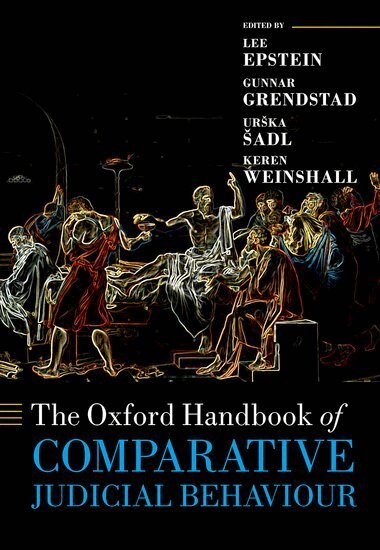
    The Oxford Handbook of Comparative Judicial Behaviour

    AvLee Epstein,Urska %Sadl

    Inbunden, Engelska, 2024

    2 692 kr

    Beställningsvara. Skickas inom 5-8 vardagar. Fri frakt över 249 kr.

    Beskrivning

    These are momentous times for the comparative analysis of judicial behaviour. Once the sole province of U.S. scholars—and mostly political scientists at that—now, researchers throughout the world, drawing on history, economics, law, and psychology, are illuminating how and why judges make the choices they do and what effect those choices have on society.Bringing together leading scholars in the field, The Oxford Handbook of Comparative Judicial Behaviour consists of ten sections, each devoted to important subfields: fundamentals—providing overviews designed to identify common trends in courts worldwide; approaches to judging; data, methods, and technologies; staffing the courts; advocacy, litigation, and appellate review; opinions; relations within, between, and among courts; judicial independence; court and society; and frontiers of comparative judicial behaviour—dedicated to expanding on opportunities for advancement.Rather than focusing on particular courts, countries, or regions, the organization of the individual chapters is topical. Each chapter explores an important topic-critically evaluating the state of that topic and identifying opportunities for future work. While the forty-two chapters share a common interest in explaining the causes and effects of judicial choices, the range of approaches to comparative research is wide, inclusive, and interdisciplinary, from contrasts and similarities to sophisticated research agendas reflecting the emerging field of judicial behaviour around the world.

    Produktinformation

    • Utgivningsdatum:2024-11-12
    • Mått:176 x 250 x 52 mm
    • Vikt:2 142 g
    • Format:Inbunden
    • Språk:Engelska
    • Antal sidor:1 040
    • Förlag:OUP OXFORD
    • ISBN:9780192898579

    Utforska kategorier

    • Rättsordning inom Juridik
    • Komparativ rätt inom Juridik
    • Lag och samhälle inom Juridik

    Mer om författaren

    Lee Epstein is University Professor of Law & Political Science and the Hilliard Distinguished Professor of Law at University of Southern California, and a Distinguished Visiting Professor at Hebrew University and at Washington University in St. Louis.Gunnar Grendstad is Professor of Political Science at Department of Comparative Politics at the University of Bergen and principal investigator of Doranoh, a relational database of judicial behaviour on the Norwegian Supreme Court.Urška %Sadl is part-time Professor of Law at the European University Institute. She is principal investigator of Judging Under the Influence: A Critical Assessment of the Role of Legal Actors on the Jurisprudence of the European Court of Justice.Keren Weinshall is Professor of Law and the Edward S. Silver Chair in Civil Procedure at Hebrew University. Weinshall served as Founding Director of the Israeli Courts Research Division and represented Israel at the European Commission for the Efficiency of Justice in the Council of Europe.

    Recensioner i media

    Other essays in the volume are just as illuminating. As befits a work published under the Handbook rubric, this tome is very wide-ranging in its coverage of the subject. OUP deserves credit for encouraging such works.

    Innehållsförteckning

    • 1 - Fundamentals 1: Lee Epstein, Gunnar Grendstad, Ur%ska %Sadl, and Keren Weinshall: Introduction to the Study of Comparative Judicial Behaviour 2: Nuno Garoupa: Legal Traditions and Their Relation to Judicial Behavior 3: Tom Ginsburg and Mila Versteeg: Models of Constitutional Review 4: Ran Hirschl: The Global Expansion of Judicial Power 5: Daniel Naurin and Erik Voeten: Transcending the Domestic-International Divide 2 -Approaches to Judging 6: Alexander Morell: Legalism and Professional Norms 7: Rorie Spill and Eric Waltenburg: Attitudinal Judging: Partisanship and Ideology 8: Santiago Basabe-Serrano, Lee Epstein, and Keren Weinshall: Backgrounds, Attributes, and Identities 9: Shai Dothan: Strategic Analysis 10: Lee Epstein and Jack Knight: How Personal Motivations Affect Judges' Decisions 11: Eileen Braman: Research on Cognitive Shortcomings in Comparative Judicial Behavior 3 - Data, Methods, and Technologies 12: Benjamin Engst and Thomas Gschwend: Observational Databases 13: Christoph Engel: Experiments 14: Wolfgang Alschner: Network Analysis for the Comparative Study of Judicial Behavior 15: Michael A. Livermore and Bao Kham Chau: Studying Judicial Behavior with Text Analysis 16: Lee Epstein, Andrew D. Martin, and Kevin Quinn: Measuring Political Preferences 4 - Staffing the Courts 17: Lydia Brashear Tiede: Selecting Judges 18: Michael Nelson and Michael Burnham: Judicial Elections and Judicial Behavior 19: Aníbal Pérez-Liñán and Andrea Castagnola: Judicial Tenure and Retirements 20: Anne Sanders: Law Clerks 5 - Advocacy, Litigation, and Appellate Review 21: Yun-chien Chang and Ching-Fang Hsu: Lawyering in the Private Sector 22: Tommaso Pavone: Agendas, Decisions, and Autonomy: How Government Lawyers Shape Judicial Behavior 23: Ivar A. Hartmann and Diego Werneck Arguelhes: Agenda Setting 24: Jay Krehbiel: The Form and Function of Oral Arguments in High Courts 6 - Opinions 25: Katalin Kelemen: Dissents and Other Separate Opinions 26: Jens Frankenreiter: Studying Judicial Citations and Citation Data 27: Elliot Ash: Language Choices 7 - Relations Within, Between, and Among Courts 28: Henrik Litleré Bentsen and Jon Kåre Skiple: Leadership in Courts 29: Cynthia L. Ostberg and Matthew E. Wetstein: Panel Effects on Courts Around the World 30: Benjamin Bricker, Matthew J. Gabel, and Clifford J. Carrubba: Referrals 31: Björn Dressel: Judge Networks 32: Ori Aronson: Hierarchies of Justice 8 - Judicial Independence 33: Alex Schwartz: Threats to Judicial Independence 34: Brad Epperly: Developing Judicial Independence 35: Frans van Dijk: Conceptualizing and Measuring Judicial Independence 9 - Courts and Society 36: Russell Smyth: Public Opinion and Legitimacy 37: Elin Skaar: Courts and Transitional Justice 38: Courtney Hillbrecht: Compliance with Judicial Decisions 39: Gerald Rosenberg: Courts as Agents of Change 10 - On the Frontiers of Comparative Judicial Behavior 40: Kevin L. Cope: The Conceptual Challenge to Measuring Ideology 41: Jeff Staton: Research Communities and the Collective Investment in Data Infrastructure 42: Anthony Niblett: Artificial Intelligence and Judging