• Fri frakt över 249 kr
  • •
  • Snabba leveranser
  • •
  • Billiga böcker
Kundservice

Du är på sajten för privatpersoner.

Företag, bibliotek eller offentlig verksamhet?

Du handlar på classic.bokus.com, där alla dina funktioner finns intakta.
Till classic.bokus.com
Bokus logotyp. Gå till startsidan.
  • Erbjudanden
  • Nyheter
  • Student
  • Topplistor
  • Barn & ungdom
  • Bokus Play
  • E-böcker
  • Pocketböcker
  • Spel & pussel

10% rabatt på allt med kod NYSTART10 →

Sidfot

Mina sidor

    Hjälp

    • Kundservice
    • Vanliga frågor och svar
    • Frakt och leverans
    • Retur vid ångerrätt
    • Reklamera vara
    • Betalning
    • Köpvillkor
    • Allmänna villkor
    • Information om webbplatsens tillgänglighet

    Om Bokus

    • Om oss
    • Pressrum
    • För studenter
    • För företag
    • För bibliotek och offentlig verksamhet
    • För leverantörer
    • Hållbarhet

    Populärt

    • Aktuella erbjudanden
    • Presentkort
    • Studentlitteratur
    • Nya böcker
    • Topplistor
    • Signerade böcker
    • Engelska böcker

    Inspiration

    • Boktips
    • BookTok
    • Populära bokserier
    • Barnbokskaraktärer
    • Populära författare
    Logotyp för Bokus
    Följ oss på Facebook (extern länk)Följ oss på Instagram (extern länk)Följ oss på YouTube (extern länk)Följ oss på TikTok (extern länk)
    bokus @ CookiesAnpassa cookiesIntegritetspolicyKöpvillkor
    Till Citymail hemsida (extern länk)Till Budbee hemsida (extern länk)Till Postnord hemsida (extern länk)Till Schenker hemsida (extern länk)Till Early Bird hemsida (extern länk)Till Walleys hemsida (extern länk)
    1. Samhälle och politik
    2. Politik och statsskick
    3. Politiska ideologier och rörelser

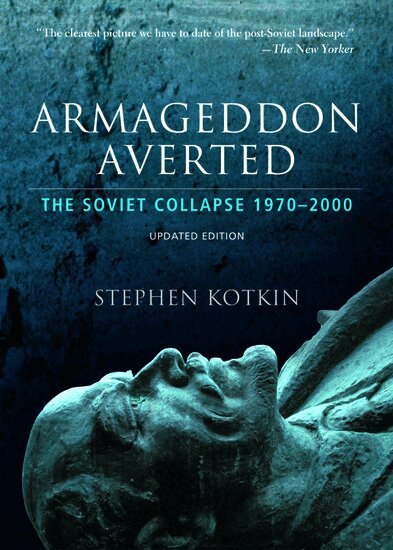
    Armageddon Averted

    The Soviet Collapse, 1970-2000

    AvStephen Kotkin

    Häftad, Engelska, 2008

    240 kr

    Beställningsvara. Skickas inom 5-8 vardagar. Fri frakt över 249 kr.

    Fler format och utgåvor

    Inbunden

    2 163 kr

    E-bok

    195 kr

    Beskrivning

    Featuring extensive revisions to the text as well as a new introduction and epilogue-bringing the book completely up to date on the tumultuous politics of the previous decade and the long-term implications of the Soviet collapse-this compact, original, and engaging book offers the definitive account of one of the great historical events of the last fifty years.Combining historical and geopolitical analysis with an absorbing narrative, Kotkin draws upon extensive research, including memoirs by dozens of insiders and senior figures, to illuminate the factors that led to the demise of Communism and the USSR. The new edition puts the collapse in the context of the global economic and political changes from the 1970s to the present day. Kotkin creates a compelling profile of post Soviet Russia and he reminds us, with chilling immediacy, of what could not have been predicted-that the world's largest police state, with several million troops, a doomsday arsenal, and an appalling record of violence, would liquidate itself with barely a whimper. Throughout the book, Kotkin also paints vivid portraits of key personalities. Using recently released archive materials, for example, he offers a fascinating picture of Gorbachev, describing this virtuoso tactician and resolutely committed reformer as "flabbergasted by the fact that his socialist renewal was leading to the system's liquidation"-and more or less going along with it.At once authoritative and provocative, Armageddon Averted illuminates the collapse of the Soviet Union, revealing how "principled restraint and scheming self interest brought a deadly system to meek dissolution." Acclaim for the First Edition: "The clearest picture we have to date of the post-Soviet landscape."--The New Yorker "A triumph of the art of contemporary history. In fewer than 200 pagesKotkin elucidates the implosion of the Soviet empire-the most important and startling series of international events of the past fifty years-and clearly spells out why, thanks almost entirely to the 'principal restraint' of the Soviet leadership, that collapse didn't result in a cataclysmic war, as all experts had long forecasted." -The Atlantic Monthly "Concise and persuasive The mystery, for Kotkin, is not so much why the Soviet Union collapsed as why it did so with so little collateral damage." --The New York Review of Books

    Produktinformation

    • Utgivningsdatum:2008-12-25
    • Mått:135 x 188 x 17 mm
    • Vikt:340 g
    • Format:Häftad
    • Språk:Engelska
    • Antal sidor:304
    • Upplaga:2
    • Förlag:OUP USA
    • ISBN:9780195368635

    Utforska kategorier

    • Politiska ideologier och rörelser inom Samhälle och politik
    • Historia inom Historia och arkeologi

    Mer om författaren

    Stephen Kotkin is Professor of European and Asian History at Princeton University, where he also directs the Russian-Eurasian Studies Program. He is the author of nine books, including an acclaimed two-volume study of the rise and fall of Soviet socialism: Magnetic Mountain: Stalinism as a Civilization and Steeltown, USSR: Soviet Society in the Gorbachev Era.

    Recensioner i media

    "The clearest picture we have to date of the post-Soviet landscape."--The New Yorker"A triumph of the art of contemporary history. In fewer than 200 pages, Kotkin elucidates the implosion of the Soviet empire--the most important and startling series of international events of the past fifty years--and clearly spells out why, thanks almost entirely to the 'principal restraint' of the Soviet leadership, that collapse didn't result in a cataclysmic war, as all experts had long forecasted."--The Atlantic Monthly"Concise and persuasive The mystery, for Kotkin, is not so much why the Soviet Union collapsed as why it did so with so little collateral damage."--The New York Review of Books

    Innehållsförteckning

    • Introduction ; Part 1: Phenomenal Knowledge ; 1. What RoboMary Knows, Daniel Dennet, Tufts University ; 2. So This is What it's Like: a Defense of the Ability Hypothesis, Laurence Nemirow, Davis Graham & Stubbs Income Tax, Benefits & Estate Group ; 3. The Knowledge Argument, Diaphanousness, Representationalism, Frank Jackson, Australian National University, British Academy, Australian Academy of the Social Sciences in Australia, and Fand Institut International de Philosophie ; 4. Does Representationalism Undermine the Knowledge Argument?, Torin Alter, The University of Alabama ; 5. What is This Thing You Call Color: Can a Totally Color-Blind Person Know about Color?, Knut Nordby, formerly University of Oslo and Telnor Communications, Research and Development ; Part 2: Phenomenal Concepts ; 6. What is a Phenomenal Concept?, Janet Levin, University of Southern California ; 7. Phenomenal and Perceptual Conepts, David Papineau, King's College, Cambridge University ; 8. Phenomenal Concepts and the Materialist Constraint, Joseph Levine, The University of Massachusetts at Amherst ; 9. Phenomenal Concepts and the Explanatory Gap, David Chalmers, Australian National University ; 10. Direct Reference and Dancing Qualia, John Hawthorne, Rutgers University ; 11. Property Dualism, Phenomenal Concepts, and the Semantic Premise, Stephen White, Tufts University ; 12. Max Black's Objection to Mind-Brain Identity, Ned Block, New York University ; 13. Grasping Phenomenal Properties, Martine Nida-Rumelin, University of Fribourg

    Betyg & recensioner

    5/5