• Fri frakt över 249 kr
  • •
  • Snabba leveranser
  • •
  • Billiga böcker
Kundservice

Du är på sajten för privatpersoner.

Företag, bibliotek eller offentlig verksamhet?

Du handlar på classic.bokus.com, där alla dina funktioner finns intakta.
Till classic.bokus.com
Bokus logotyp. Gå till startsidan.
  • Erbjudanden
  • Student
  • Topplistor
  • Barn & ungdom
  • Bokus Play
  • E-böcker
  • Ljudböcker
  • Pocketböcker
  • Spel & pussel

Upp till 25% på utvalda nyheter →

Sidfot

Mina sidor

    Hjälp

    • Kundservice
    • Vanliga frågor och svar
    • Frakt och leverans
    • Retur vid ångerrätt
    • Reklamera vara
    • Betalning
    • Köpvillkor
    • Allmänna villkor
    • Information om webbplatsens tillgänglighet

    Om Bokus

    • Om oss
    • Pressrum
    • För studenter
    • För företag
    • För bibliotek och offentlig verksamhet
    • För leverantörer
    • Hållbarhet

    Populärt

    • Aktuella erbjudanden
    • Presentkort
    • Studentlitteratur
    • Nya böcker
    • Topplistor
    • Signerade böcker
    • Engelska böcker

    Inspiration

    • Boktips
    • BookTok
    • Populära bokserier
    • Barnbokskaraktärer
    • Populära författare
    Logotyp för Bokus
    Följ oss på Facebook (extern länk)Följ oss på Instagram (extern länk)Följ oss på YouTube (extern länk)Följ oss på TikTok (extern länk)
    bokus @ CookiesAnpassa cookiesIntegritetspolicyKöpvillkor
    Till Citymail hemsida (extern länk)Till Budbee hemsida (extern länk)Till Postnord hemsida (extern länk)Till Schenker hemsida (extern länk)Till Early Bird hemsida (extern länk)Till Walleys hemsida (extern länk)
    1. Data och IT
    2. Systemvetenskap och AI

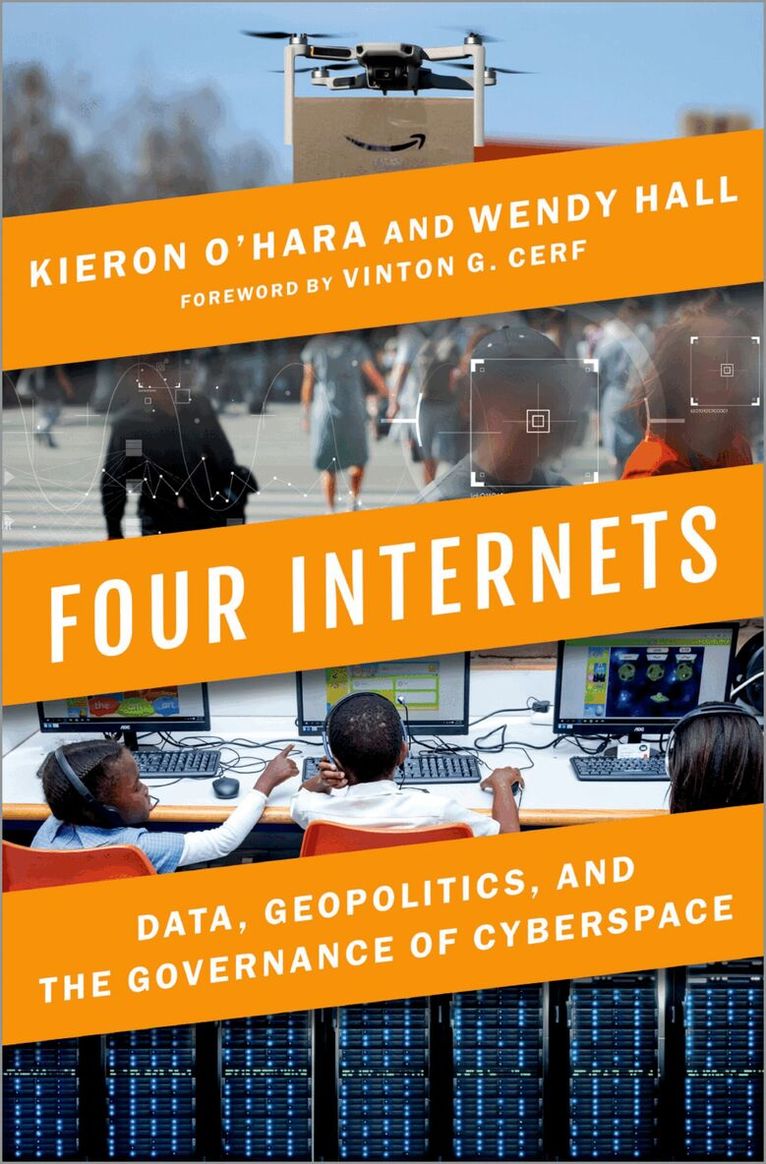
    Four Internets

    Data, Geopolitics, and the Governance of Cyberspace

    AvKieron O'Hara,Wendy Hall

    Inbunden, Engelska, 2021

    388 kr

    Beställningsvara. Skickas inom 7-10 vardagar. Fri frakt över 249 kr.

    Beskrivning

    The Internet has become a staple of modern civilized life, now as vital a utility as electricity. But despite its growing influence, the Internet isn't as stable as it might seem; rather, it can be best thought of as a network of networks reliant on developing technical and social measures to function, including hardware, software, standards, and protocols. As millions of new internet users sign on each year, governing bodies need to balance evolving social ideas surrounding internet use against shifting political pressures on internet governance--or risk disconnection.Four Internets offers a revelatory new approach for conceptualizing the Internet and understanding the sometimes rival values that drive its governance and stability. Four Internets contends that the apparently monolithic "Internet" is in fact maintained by four distinct value systems--the Silicon Valley Open Internet, the Brussels Bourgeois Internet, the DC Commercial Internet, and the Beijing Paternal Internet--competing to determine the future directions of internet affordances for freedom, innovation, security, and human rights. Starting with an analysis of the original vision of an "Open Internet," the book outlines challenges facing this vision and the subsequent rise of other internets popularized through political and monetary machinations. It then unravels how tensions between these internets play out across politics, economics, and technology, and offers perspectives on potential new internets that might arise from emerging technologies like artificial intelligence and smart cities. The book closes with an evaluation of whether all these models can continue to co-exist--and what might happen if any fall away. Visionary and accessible, Four Internets lends readers the confidence to believe in a diverse yet resilient Internet through a deeper understanding of this everyday commodity.

    Produktinformation

    • Utgivningsdatum:2021-10-22
    • Mått:164 x 237 x 31 mm
    • Vikt:594 g
    • Format:Inbunden
    • Språk:Engelska
    • Antal sidor:360
    • Förlag:OUP USA
    • Medarbetare:Vinton Cerf
    • ISBN:9780197523681

    Utforska kategorier

    • Systemvetenskap och AI inom Data och IT
    • IT-rätt och kommunikationsrätt inom Juridik
    • Media och underhållning inom Ekonomi och Ledarskap

    Mer om författaren

    Kieron O'Hara is a philosopher and computer scientist who researches the social and political effects of technology, specialising in the World Wide Web. His particular interests are in privacy, trust, and digital modernity. He has also written extensively on conservatism and the British Conservative Party. He is an Emeritus Fellow at the University of Southampton.Dame Wendy Hall, DBE, FRS, FREng, is Regius Professor of Computer Science, Associate Vice President of International Engagement, and Executive Director of the Web Science Institute at the University of Southampton. She became a Dame Commander of the British Empire in the 2009 UK New Year's Honours list, and is a Fellow of the Royal Society and the Royal Academy of Engineering. Dame Wendy was co-chair of the UK government's AI Review and the first Skills Champion for AI in the UK. In May 2020, she was appointed as Chair of the Ada Lovelace Institute and she serves as a fellow of the Atlantic Council GeoTech Center.Vinton Cerf is the Vice President and Chief Internet Evangelist of Google, LLC.

    Recensioner i media

    A stunning challenge to notions of a fixed and idealized Internet and a must-read account of how many geopolitical networks can, and must, co-exist.

    Innehållsförteckning

    • ForewordPrefaceAcknowledgements Chapter One: Preliminary concepts: Networks and data PART I: THE FIRST INTERNET: THE SILICON VALLEY OPEN INTERNET Chapter Two: How the Internet developed Chapter Three: Governing the Internet Chapter Four: The vision of the Open Internet Chapter Five: Policy question: How can quality be ensured in an open system like Wikipedia? PART II: ALTERNATIVES TO OPENNESS Chapter Six: Openness and its discontents Chapter Seven: The second Internet: The Brussels Bourgeois Internet Chapter Eight: Policy question: When is surveillance justified? Chapter Nine: The third Internet: The DC Commercial Internet Chapter Ten: Policy question: How can competition against the tech giants be fostered? Chapter Eleven: The fourth Internet: The Beijing Paternal Internet Chapter Twelve: Policy question: Is Huawei infrastructure a threat to Western national security? Chapter Thirteen: The Moscow spoiler model Chapter Fourteen: Policy question: Is a sovereign Internet feasible? Chapter Fifteen: Peaceful co-existence PART III: FUTURES Chapter Sixteen: India, the "swing state" Chapter Seventeen: Policy question: When should personal data cross borders? Chapter Eighteen: Artificial Intelligence Chapter Nineteen: Smart cities and the Internet of Things Chapter Twenty: Social machines Chapter Twenty-One: The unity of freedom Glossary of abbreviationsReferencesEndnotes