• Fri frakt över 249 kr
  • •
  • Snabba leveranser
  • •
  • Billiga böcker
Kundservice

Du är på sajten för privatpersoner.

Företag, bibliotek eller offentlig verksamhet?

Du handlar på classic.bokus.com, där alla dina funktioner finns intakta.
Till classic.bokus.com
Bokus logotyp. Gå till startsidan.
  • Erbjudanden
  • Nyheter
  • Student
  • Topplistor
  • Barn & ungdom
  • Bokus Play
  • E-böcker
  • Pocketböcker
  • Spel & pussel

10% rabatt på allt med kod: NYSTART10 →

Sidfot

Mina sidor

    Hjälp

    • Kundservice
    • Vanliga frågor och svar
    • Frakt och leverans
    • Retur vid ångerrätt
    • Reklamera vara
    • Betalning
    • Köpvillkor
    • Allmänna villkor
    • Information om webbplatsens tillgänglighet

    Om Bokus

    • Om oss
    • Pressrum
    • För studenter
    • För företag
    • För bibliotek och offentlig verksamhet
    • För leverantörer
    • Hållbarhet

    Populärt

    • Aktuella erbjudanden
    • Presentkort
    • Studentlitteratur
    • Nya böcker
    • Topplistor
    • Signerade böcker
    • Engelska böcker

    Inspiration

    • Boktips
    • BookTok
    • Populära bokserier
    • Barnbokskaraktärer
    • Populära författare
    Logotyp för Bokus
    Följ oss på Facebook (extern länk)Följ oss på Instagram (extern länk)Följ oss på YouTube (extern länk)Följ oss på TikTok (extern länk)
    bokus @ CookiesAnpassa cookiesIntegritetspolicyKöpvillkor
    Till Citymail hemsida (extern länk)Till Budbee hemsida (extern länk)Till Postnord hemsida (extern länk)Till Schenker hemsida (extern länk)Till Early Bird hemsida (extern länk)Till Walleys hemsida (extern länk)
    1. Data och IT
    2. Nätverk och kommunikation

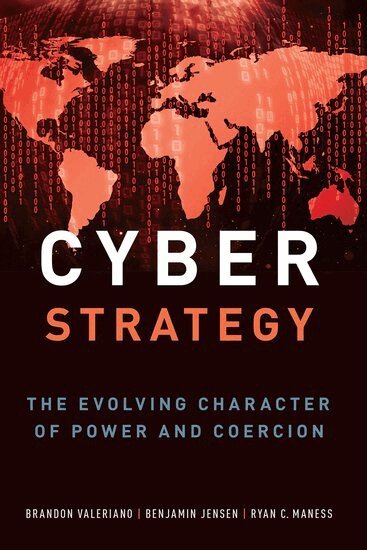
    Cyber Strategy

    The Evolving Character of Power and Coercion

    AvBrandon Valeriano,Benjamin Jensen

    Häftad, Engelska, 2020

    471 kr

    Beställningsvara. Skickas inom 3-6 vardagar. Fri frakt över 249 kr.

    Fler format och utgåvor

    Inbunden

    587 kr

    Beskrivning

    Some pundits claim cyber weaponry is the most important military innovation in decades, a transformative new technology that promises a paralyzing first-strike advantage difficult for opponents to deter. Yet, what is cyber strategy? How do actors use cyber capabilities to achieve a position of advantage against rival states? This book examines the emerging art of cyber strategy and its integration as part of a larger approach to coercion by states in the international system between 2000 and 2014. To this end, the book establishes a theoretical framework in the coercion literature for evaluating the efficacy of cyber operations. Cyber coercion represents the use of manipulation, denial, and punishment strategies in the digital frontier to achieve some strategic end. As a contemporary form of covert action and political warfare, cyber operations rarely produce concessions and tend to achieve only limited, signaling objectives. When cyber operations do produce concessions between rival states, they tend to be part of a larger integrated coercive strategy that combines network intrusions with other traditional forms of statecraft such as military threats, economic sanctions, and diplomacy. The books finds that cyber operations rarely produce concessions in isolation. They are additive instruments that complement traditional statecraft and coercive diplomacy.The book combines an analysis of cyber exchanges between rival states and broader event data on political, military, and economic interactions with case studies on the leading cyber powers: Russia, China, and the United States. The authors investigate cyber strategies in their integrated and isolated contexts, demonstrating that they are useful for maximizing informational asymmetries and disruptions, and thus are important, but limited coercive tools. This empirical foundation allows the authors to explore how leading actors employ cyber strategy and the implications for international relations in the 21st century. While most military plans involving cyber attributes remain highly classified, the authors piece together strategies based on observations of attacks over time and through the policy discussion in unclassified space. The result will be the first broad evaluation of the efficacy of various strategic options in a digital world.

    Produktinformation

    • Utgivningsdatum:2020-06-05
    • Mått:156 x 234 x 18 mm
    • Vikt:494 g
    • Format:Häftad
    • Språk:Engelska
    • Antal sidor:320
    • Förlag:OUP USA
    • ISBN:9780197523780
    • Utmärkelser:2019 CHOICE Outstanding Academic Title

    Utforska kategorier

    • Nätverk och kommunikation inom Data och IT
    • IT-säkerhet inom Data och IT
    • Internationella relationer inom Samhälle och politik

    Mer om författaren

    Brandon Valeriano is the Donald Bren Chair of Armed Conflict at the Marine Corps University and a Senior Fellow at the Niskanen Center. He has published five books and dozens of articles in outlets including The Washington Post, Journal of Politics, and International Studies Quarterly. His ongoing research explores documenting cyber events, biological examinations of cyber threat, and repression in cyberspace.Benjamin Jensen is an Associate Professor at Marine Corps University and a Scholar-in-Residence at American University, School of International Service. His research explores the changing character of conflict as it relates to strategy and military innovation, themes explored in his first book, Forging the Sword: Doctrinal Change in the U.S. Army (Stanford University Press 2016) and his "Next War" column at War on the Rocks. Ryan C. Maness is an Assistant Professor in the Defense Analysis Department at the Naval Postgraduate School. His researchincludes cyber conflict, cyber security, cyber coercion, cyber strategies, information warfare, Russian foreign policy, American foreign policy, and conflict-cooperation dynamics between states using Big Data. He is coauthor of Russia's Coercive Diplomacy: Energy, Cyber and Maritime Policy as New Sources of Power (Palgrave Macmillan, 2015), and Cyber War versus Cyber Realities: Cyber Conflict in the International System (Oxford University Press, 2015).

    Recensioner i media

    This hugely important work needs to be an inspiration for future works across the cyber field. Nuanced, subtle, and extremely well written, the work aims to explain what cyber strategy may actually be, how it comes in diverse forms not only across issue areas but across state interests, and whether or not cyber really does signal an entirely new and different era in warfare. Summing up: Essential.

    Innehållsförteckning

    • PrefaceAcknowledgementsChapter 1 - Introduction: Are Cyber Strategies Coercive? Chapter 2 - How Rival States Employ Cyber Strategy: Disruption, Espionage, and Degradation Chapter 3 - The Correlates of Cyber StrategyChapter 4 - Cyber Coercion as a Combined StrategyChapter 5 - Commissars and Crooks: Russian Cyber CoercionChapter 6 - China and the Technology Gap: Chinese Strategic Behavior in CyberspaceChapter 7 - The United States: The Cyber Reconnaissance-Strike ComplexChapter 8 - Conclusion: Cyber Political Warfare with Limited EffectsAppendix 1: The Dyadic Cyber Incident and Dispute Dataset Version 1.1Appendix 2: Cyber Strategy SummaryAppendix 3: The Dyadic Cyber Incident and Dispute Dataset (DCID), version 1.1, summarized version NotesBibliographyIndex