• Fri frakt över 249 kr
  • •
  • Snabba leveranser
  • •
  • Billiga böcker
Kundservice

Du är på sajten för privatpersoner.

Företag, bibliotek eller offentlig verksamhet?

Du handlar på classic.bokus.com, där alla dina funktioner finns intakta.
Till classic.bokus.com
Bokus logotyp. Gå till startsidan.
  • Erbjudanden
  • Nyheter
  • Student
  • Topplistor
  • Barn & ungdom
  • Bokus Play
  • E-böcker
  • Pocketböcker
  • Spel & pussel

10% rabatt på allt med kod: NYSTART10 →

Sidfot

Mina sidor

    Hjälp

    • Kundservice
    • Vanliga frågor och svar
    • Frakt och leverans
    • Retur vid ångerrätt
    • Reklamera vara
    • Betalning
    • Köpvillkor
    • Allmänna villkor
    • Information om webbplatsens tillgänglighet

    Om Bokus

    • Om oss
    • Pressrum
    • För studenter
    • För företag
    • För bibliotek och offentlig verksamhet
    • För leverantörer
    • Hållbarhet

    Populärt

    • Aktuella erbjudanden
    • Presentkort
    • Studentlitteratur
    • Nya böcker
    • Topplistor
    • Signerade böcker
    • Engelska böcker

    Inspiration

    • Boktips
    • BookTok
    • Populära bokserier
    • Barnbokskaraktärer
    • Populära författare
    Logotyp för Bokus
    Följ oss på Facebook (extern länk)Följ oss på Instagram (extern länk)Följ oss på YouTube (extern länk)Följ oss på TikTok (extern länk)
    bokus @ CookiesAnpassa cookiesIntegritetspolicyKöpvillkor
    Till Citymail hemsida (extern länk)Till Budbee hemsida (extern länk)Till Postnord hemsida (extern länk)Till Schenker hemsida (extern länk)Till Early Bird hemsida (extern länk)Till Walleys hemsida (extern länk)
    1. Medicin
    2. Andra medicinska specialiteter
    3. Neurologi och klinisk neurofysiologi
    4. Autism och Aspergers syndrom

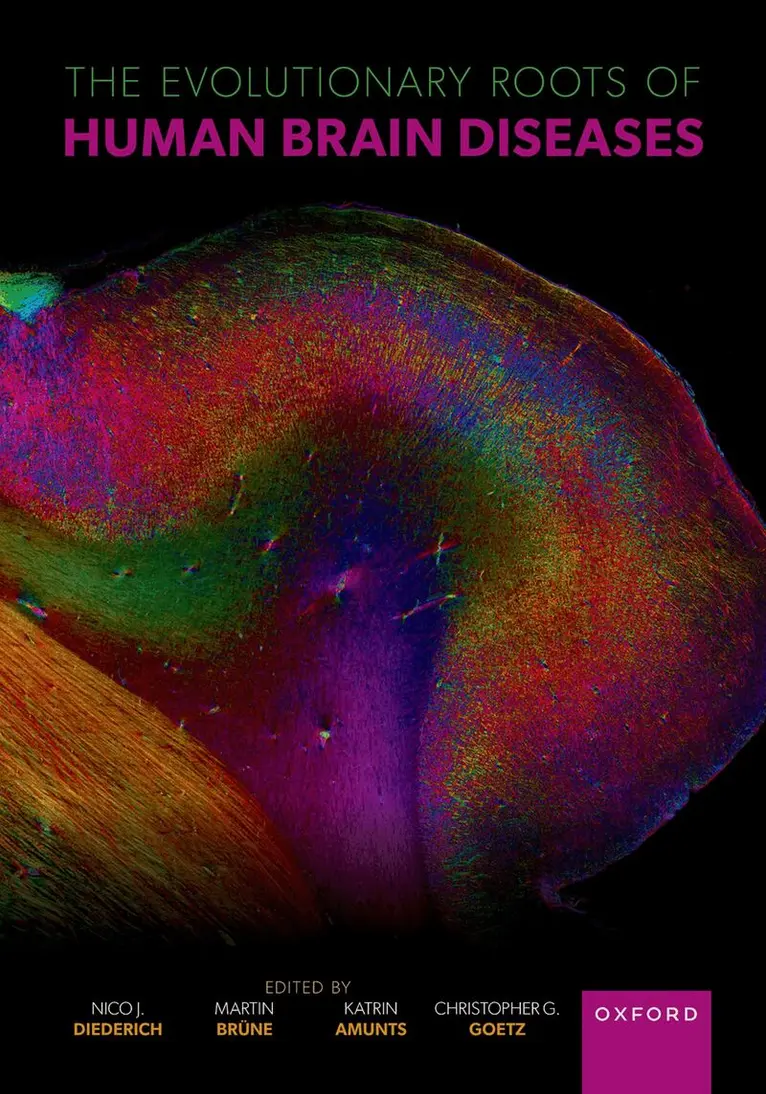
    The Evolutionary Roots of Human Brain Diseases

    AvNico J. Diederich,Martin Brüne

    Inbunden, Engelska, 2024

    2 177 kr

    Beställningsvara. Skickas inom 5-8 vardagar. Fri frakt över 249 kr.

    Beskrivning

    Richly illustrated with figures and examples and supplemented with a glossary of terms, The Evolutionary Roots of Human Brain Diseases assembles recent findings in clinical neuroscience, evolutionary biology, anthropology, and cellular biology to elucidate the origins of human brain diseases and how evolution has given rise to exclusive impacts on brain health only in humans. The book is succinct, up-to-date, and written by researchers across numerous disciplines, making it a compulsory read for clinical neurologists, psychologists, and all medical researchers interested in the brain. The book's 22 chapters cover basic science concepts behind cerebral cellular specificities or human-specific network developments, detailed discussions of neurological or psychiatric diseases and their clinical expression with an evolutionary focus, the newest imaging techniques to study the brain, future medication developments, as well as cultural and societal repercussions. Evolutionary concepts ranging from genetic pleiotropic antagonism to disease remnants of ancient behaviours crucial for survival are also presented. Insightful and innovative in its approach, this book offers a fascinating interdisciplinary dialogue on the potential repercussions of ongoing human brain evolution.

    Produktinformation

    • Utgivningsdatum:2024-12-24
    • Mått:185 x 256 x 29 mm
    • Vikt:1 379 g
    • Format:Inbunden
    • Språk:Engelska
    • Antal sidor:576
    • Förlag:OUP USA
    • ISBN:9780197676592

    Utforska kategorier

    • Autism och Aspergers syndrom inom Medicin
    • Biovetenskap inom Naturvetenskap och teknik

    Mer om författaren

    Nico J. Diederich, MD, is Adjunct Professor of Neurology at the University of Cologne, Germany, and a Consultant in Neurology at the Centre Hospitalier de Luxembourg. His research and clinical work focus on movement disorders particularly Parkinson's disease (PD), from visual deficits to sleep syndromes or dysautonomia. Martin Brüne, MD, is Professor of Psychiatry and Head of the Division of Social Neuropsychiatry and Evolutionary Medicine at the LWL University-Hospital, Ruhr-University Bochum, Germany. He was previously a Visiting Research Scientist at the Centre for the Mind, a joint venture of the Australian National University and University of Sydney.Katrin Amunts, PhD, is Professor Director of the C. and O. Vogt Institute for Brain Research, HHU Duesseldorf, and of the Institute of Neuroscience and Medicine (INM-1), Research Center Juelich. Since 2023, she holds the position of Joint CEO of the non-profit EBRAINS AISBL. Christopher G. Goetz, MD, is Professor ofNeurological Sciences and Pharmacology at Rush Medical College, USA and oversees Research Development and Strategic Planning for the Parkinson and Movement Disorder Program. His research specialties are in pharmacology, neurochemistry, clinimetrics, and statistical modelling. He is past President of the International Parkinson and Movement Disorder Society and past Co-Editor-in-Chief of the journal, Movement Disorders.

    Innehållsförteckning

    • Foreword by Sten GrillnerIntroduction by the Editors, Nico J. Diederich, Martin Brüne, Katrin Amunts, Christopher G. Goetz Part I: Human Brain Evolution: From Anatomy to Function Chapter 1: Human TelencephalizationKatrin Amunts and Felix Ströckens Chapter 2: Evolutionary Aspects of Glial ExpansionPierre Magistretti, Patrick Hof , Corrado Cali, and Nicole Ackermans Chapter 3: The Contribution of Mitochondrial Evolution and Dysfunction to NeurodegenerationAnne Grünewald, Sandro Pereira, and Kobi Wasner Chapter 4: Intrinsic Templates for Neurodegenerations Featuring Disease-specific Axonal or Dendritic VulnerabilityToshiki Uchihara Chapter 5: Differences in Brain Gene Expression Between Humans and PrimatesGeneviève Konopka and Emre Caglayan Chapter 6: Adapative Archaic IntrogressionOlga Dolgova and Oscar Lao Chapter 7: Goal-directed and Habitual Behaviors: Anatomical and Functional Circuits in Health and Neurological DiseaseLedia F. Hernandez and Ignacio Obeso Part II: How Human Brain Diseases Are Impacted By Human Evolution Chapter 8: Alzheimer's Disease, the Parietal Lobes, and the Evolution of the Human GenusEmiliano Bruner and Heidi I.L. Jacobs Chapter 9: Parkinson's Disease - Overstrain Focused of Basal Ganglia and Brainstem NucleiNico J. Diederich and Christopher G. Goetz Chapter 10: Brain Diseases Associated with Unstable RepeatsPeng Jin, Katharine Shelly, and Emily G. Allen Chapter 11: The Properties of Cortico-Motoneuronal Connections and Their Evolutionary Significance for Amyotrophic Lateral SclerosisRoger Lemon Chapter 12: REM Sleep Behavior Disorder - Nocturnal Replay of a "Fight and Flee"Nico Diederich and Isabelle Arnulf Chapter 13: Mood Disorders: An Evolutionary Psycho-Neuro-Immunological ApproachMarkus J Rantala Javier I. Borráz-León Chapter 14: Schizophrenia - Embracing the SpectrumJohn S. Allen Chapter 15: Williams Syndrome and Autism - Dysfunction of Frontal NetworksKaterina Semendeferi and Isabel August Chapter 16: ADHD - An Evolutionary View Annie Swanepoel Chapter 17: Addiction - Diverted Reward and Motivation PrinciplesRoger Sullivan and Edward Hagen Part 3: Consequences and perspectives on research and clinical sciences Chapter 18: Conditions of Comparative Brain ConnectomicsKathleen Rockland, Daniel Zachlod, and Katrin Amunts Chapter 19: Are Evolutionary Concepts Helfpul in Designing Preventive Strategies for Brain Diseases?Gilberto Levy and Bruce Levin Chapter 20: Evolutionary Aspects of Neuro-PsychopharmocologyMartin Brüne, Riadh Abed, and Paul St. John-Smith Chapter 21: Ongoing Human Evolution?Frank Rühli, Maciej Henneberg, and Nicole Bender Chapter 22: Human Cultural Evolution Outpaces Biological Evolution: A Brain Connectomic ApproachJean-Pierre Changeux Chapter 23: Concluding Remarks and Future DirectionsMartin Brüne, Katrin Amunts, Nico J. Diederich, and Christopher G. Goetz