• Fri frakt över 249 kr
  • •
  • Snabba leveranser
  • •
  • Billiga böcker
Kundservice

Du är på sajten för privatpersoner.

Företag, bibliotek eller offentlig verksamhet?

Du handlar på classic.bokus.com, där alla dina funktioner finns intakta.
Till classic.bokus.com
Bokus logotyp. Gå till startsidan.
  • Erbjudanden
  • Nyheter
  • Student
  • Topplistor
  • Barn & ungdom
  • Bokus Play
  • E-böcker
  • Pocketböcker
  • Spel & pussel

10% rabatt på allt med kod: NYSTART10 →

Sidfot

Mina sidor

    Hjälp

    • Kundservice
    • Vanliga frågor och svar
    • Frakt och leverans
    • Retur vid ångerrätt
    • Reklamera vara
    • Betalning
    • Köpvillkor
    • Allmänna villkor
    • Information om webbplatsens tillgänglighet

    Om Bokus

    • Om oss
    • Pressrum
    • För studenter
    • För företag
    • För bibliotek och offentlig verksamhet
    • För leverantörer
    • Hållbarhet

    Populärt

    • Aktuella erbjudanden
    • Presentkort
    • Studentlitteratur
    • Nya böcker
    • Topplistor
    • Signerade böcker
    • Engelska böcker

    Inspiration

    • Boktips
    • BookTok
    • Populära bokserier
    • Barnbokskaraktärer
    • Populära författare
    Logotyp för Bokus
    Följ oss på Facebook (extern länk)Följ oss på Instagram (extern länk)Följ oss på YouTube (extern länk)Följ oss på TikTok (extern länk)
    bokus @ CookiesAnpassa cookiesIntegritetspolicyKöpvillkor
    Till Citymail hemsida (extern länk)Till Budbee hemsida (extern länk)Till Postnord hemsida (extern länk)Till Schenker hemsida (extern länk)Till Early Bird hemsida (extern länk)Till Walleys hemsida (extern länk)
    1. Samhälle och politik
    2. Sociologi och antropologi
    3. Sociologi

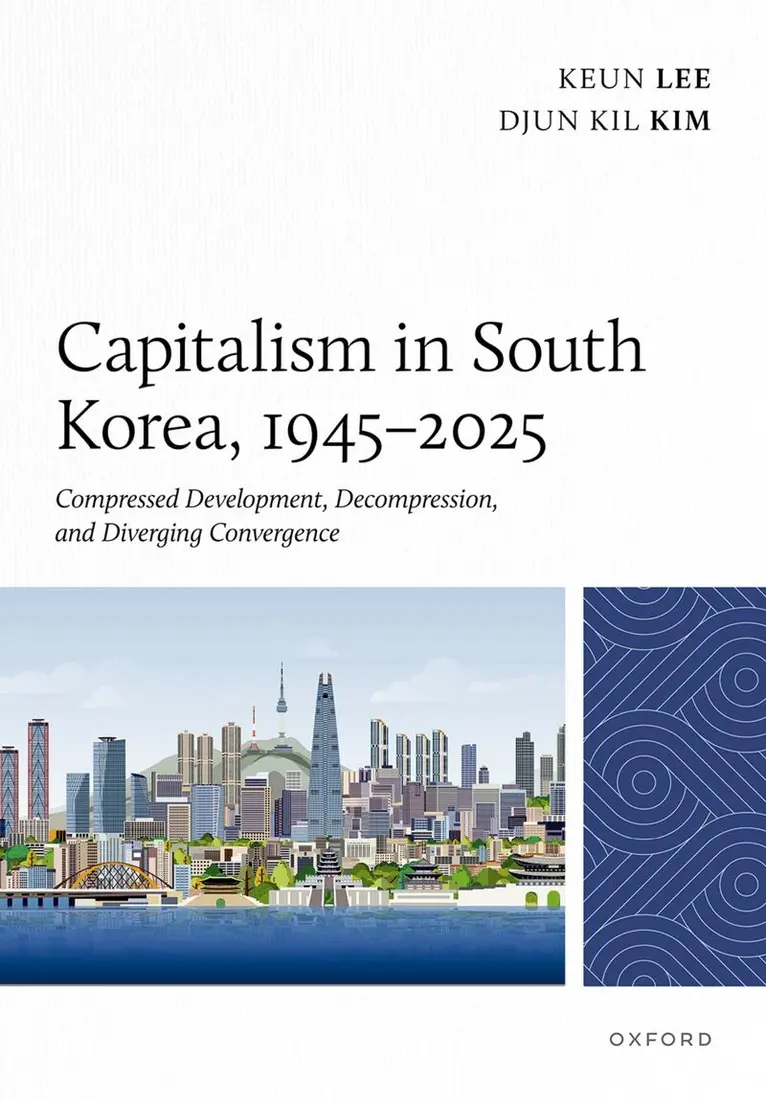
    Capitalism in South Korea, 1945–2025

    Compressed Development, Decompression, and Diverging Convergence

    AvKeun Lee,Djun Kil Kim

    Inbunden, Engelska, 2026

    946 kr

    Kommande

    Beskrivning

    Capitalism in South Korea, 1945–2025 provides an interdisciplinary and analytical account of the evolution of South Korea since 1945. This book employs a framework of "compressed development, decompression, and convergence" to better understand Korea's turbulent journey, which has been marked by economic miracles, crises, and, more recently, a slowdown in growth and rising inequality. The book begins by defining "decompression" as political democratization and economic liberalization while demonstrating that economic achievements under the regime of compressed growth enabled the emergence of a Korean middle class that demanded political freedom, facilitating a peaceful transition to democracy in the late 1980s. Capitalism in South Korea, 1945–2025 then goes on to show how the post-crisis reforms imposed by the IMF set Korea on a trajectory of convergence with Anglo-American capitalism and brought an end to the so-called "East Asian miracle". This book highlights the unexpected co-existence of two different paths of convergence displayed by Korea. The first path involves convergence with Anglo-American capitalism, which is characterized by slow growth, worsening inequality, and "free but not-so-clean" democracy. The second path is convergence with the "safe capitalism" of several continental European countries, which is typified by low birth rates, low divorce and crime rates, and long-life expectancy, as well as the pursuit of active labor market policies emulating Northern Europe. Capitalism in South Korea, 1945–2025 concludes that contemporary Korea is undergoing a period of "diverging convergence". That is, Korea shows some signs of converging with certain advanced capitalist nations while also remaining distinct according to various indicators.

    Produktinformation

    • Utgivningsdatum:2026-11-19
    • Mått:165 x 237 x 19 mm
    • Vikt:481 g
    • Format:Inbunden
    • Språk:Engelska
    • Antal sidor:216
    • Förlag:OUP USA
    • ISBN:9780197852989

    Utforska kategorier

    • Sociologi inom Samhälle och politik
    • Internationella relationer inom Samhälle och politik
    • Nationalekonomi inom Ekonomi och Ledarskap

    Mer om författaren

    Keun Lee is a Distinguished Professor of economics at Chung-Ang University and Seoul National University (emeritus). He is the winner of the Schumpeter Prize in 2024 and founding director of the Center for Economic Catch-Up. In 2021 he served as vice-chairman of the National Economic Advisory Council for the chair and the President of Korea. He is a regular writer for Project Syndicate and an editor for Research Policy. His recent books include China's Technological Leapfrogging and Economic Catch-up (2022) which he authored and The Challenges of Technology and Economic Catch-up in Emerging Economies (2021) which he co-edited. Djun Kil Kim is a fellow of the Center for Economic Catch-up and was a visiting research fellow at the Institute of Economic Research, Seoul National University from 2017 to 2025. He is the author of the 2005 book The History of Korea. In October 2011 he was awarded the "Global Korea Award" by the Council on Korean Studies at Michigan StateUniversity. He has taught and conducted research on Korean studies at Yonsei University, Sejong Institute, Chongju University, and Myongji University in Korea, as well as at Brigham Young University in the United States, Stockholm University in Sweden, and the University of Asia and the Pacific in the Philippines. Kim also served in several key government positions in South Korea and prior to this had an extensive Seoul-based journalistic career.

    Recensioner i media

    “South Korea is the most dramatic example of transition in world history. This is economic, but it is also political and social. How did this happen and what does this tell us about the big ideas of social theory? This passionate and authoritative book answers both these questions and more.”