• Fri frakt över 249 kr
  • •
  • Snabba leveranser
  • •
  • Billiga böcker
Kundservice

Du är på sajten för privatpersoner.

Företag, bibliotek eller offentlig verksamhet?

Du handlar på classic.bokus.com, där alla dina funktioner finns intakta.
Till classic.bokus.com
Bokus logotyp. Gå till startsidan.
  • Erbjudanden
  • Nyheter
  • Student
  • Topplistor
  • Barn & ungdom
  • Bokus Play
  • E-böcker
  • Pocketböcker
  • Spel & pussel

10% rabatt på allt med kod: NYSTART10 →

Sidfot

Mina sidor

    Hjälp

    • Kundservice
    • Vanliga frågor och svar
    • Frakt och leverans
    • Retur vid ångerrätt
    • Reklamera vara
    • Betalning
    • Köpvillkor
    • Allmänna villkor
    • Information om webbplatsens tillgänglighet

    Om Bokus

    • Om oss
    • Pressrum
    • För studenter
    • För företag
    • För bibliotek och offentlig verksamhet
    • För leverantörer
    • Hållbarhet

    Populärt

    • Aktuella erbjudanden
    • Presentkort
    • Studentlitteratur
    • Nya böcker
    • Topplistor
    • Signerade böcker
    • Engelska böcker

    Inspiration

    • Boktips
    • BookTok
    • Populära bokserier
    • Barnbokskaraktärer
    • Populära författare
    Logotyp för Bokus
    Följ oss på Facebook (extern länk)Följ oss på Instagram (extern länk)Följ oss på YouTube (extern länk)Följ oss på TikTok (extern länk)
    bokus @ CookiesAnpassa cookiesIntegritetspolicyKöpvillkor
    Till Citymail hemsida (extern länk)Till Budbee hemsida (extern länk)Till Postnord hemsida (extern länk)Till Schenker hemsida (extern länk)Till Early Bird hemsida (extern länk)Till Walleys hemsida (extern länk)
    1. Filosofi och religion
    2. Filosofi
    3. Filosofiska discipliner

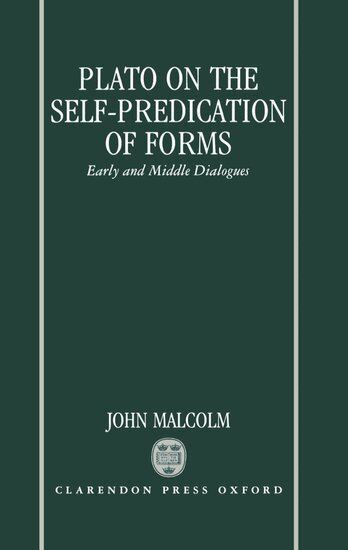
    Plato on the Self-Predication of Forms

    Early and Middle Dialogues

    AvJohn Malcolm

    Inbunden, Engelska, 1991

    2 926 kr

    Beställningsvara. Skickas inom 7-10 vardagar. Fri frakt över 249 kr.

    Beskrivning

    Much of the recent literature published on Plato's metaphysics has involved the Third Man Argument found in his dialogue Parmenides. This argument depends upon construing Forms both as universals and as paradigm examples, and thus as being subject to self-predication.Professor Malcolm first presents a new and radical interpretation of Plato's earlier dialogues. He argues that the few cases of self-predication contained therein are acceptable simply as statements concerning universals (for example, `beauty is beautiful'), and that therefore Plato is not vulnerable in these cases to the Third Man Argument.In considering the middle dialogues, Professor Malcolm takes a conservative stance, rejecting influential current doctrines which portray the Forms as being not self-predicative. He shows that the middle dialogues do indeed take Forms to be both universals and paradigms, and thus to exemplify themselves. The author goes on to consider why Plato should have been unsuccessful in avoiding self-predication. He shows that Plato's concern to explain how the truths of mathematics can indeed be true played an important role in his postulation of the Form as an Ideal Individual. The author concludes with the claim that reflection on the ambiguity of such notions as the `Standard Yard' may help us to appreciate why Plato failed to distinguish Forms as universals from Forms as paradigm cases.

    Produktinformation

    • Utgivningsdatum:1991-06-27
    • Mått:144 x 224 x 19 mm
    • Vikt:442 g
    • Format:Inbunden
    • Språk:Engelska
    • Antal sidor:238
    • Förlag:Clarendon Press
    • ISBN:9780198239062

    Utforska kategorier

    • Filosofiska discipliner inom Filosofi och religion

    Recensioner i media

    `He [Malcolm] gives a good account of competing interpretations, and a very defensible view of why it was that Plato was led to write as he did.'Heythrop Journal

    Innehållsförteckning

    • The extent of self-predication in the earlier dialogues; self-predication in the "Hippias Major" and the "Protagoras"; the "third man"; the middle-dialogue forms are universals; the rejection of the doctrine that the form is not an F Thing; the form as an F Thing non-univocally with the F Particulars; the form as an F Thing univocally with the F Particulars; logico-linguistic error as the genesis of the paradigm case; three more likely sources for the paradigm case; the failure to distinguish the universal from the paradigm case.