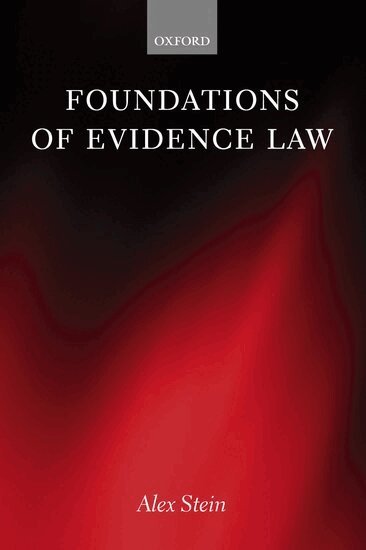
Inbunden, Engelska, 2005
Foundations of Evidence Law
Av Alex Stein
2248 kr
Beställningsvara. Skickas inom 5-8 vardagar. Fri frakt över 249 kr.
Beskrivning
This book examines systematically the underlying theory of evidence in Anglo-American legal systems and identifies the defining characteristics of adjudicative fact-finding. Stein develops a detailed innovative theory which sets aside the traditional vision of evidence law as facilitating the discovery of the truth. Combining probability theory, epistemology, economic analysis, and moral philosophy; he argues instead that the fundamental purpose of evidence law is to apportion the risk of error in conditions of uncertainty. Stein begins by identifying the domain of evidence law.He then describes the basic traits of adjudicative fact-finding and explores the epistemological foundations of the concept. This discussion identifies the problem of probabilistic deduction that accompanies generalizations to which fact-finders resort. This problem engenders paradoxes which Stein proposes to resolve by distinguishing between probability and weight. Stein advances the principle of maximal individualization that does not allow factfinders to make a finding against a person when the evidence they use is not susceptible to individualized testing.He argues that this principle has broad application, but may still be overridden by social utility. This analysis identifies allocation of the risk of error as requiring regulation by evidence law. Advocating a principled allocation of the risk of error, Stein denounces free proof for allowing individual judges to apportion this risk as they deem fit.He criticizes the UK's recent shift to a discretionary regime on similar grounds. Stein develops three fundamental principles for allocating the risk of error: the cost-efficiency principle which applies across the board; the equality principle which applies in civil litigation; and the equal best principle which applies in criminal trials. The cost-efficiency principle demands that fact-finders minimize the total cost of errors and error-avoidance.Under the equality principle, fact-finding procedures and decisions must not produce an unequal apportionment of the risk of error between the claimant and the defendant. This risk should be apportioned equally between the parties. The equal best principle sets forth two conditions for justifiably convicting and punishing a defendant. The state must do its best to protect the defendant from the risk of erroneous conviction and must not provide better protection to other individuals. Regulating both the admissibility of evidence and its sufficiency, these principles explain and justify many existing evidentiary rules. Alex Stein is Professor of Law at the Benjamin N.Cardozo School of Law,New York.
Produktinformation
- Utgivningsdatum: 2005-08-25
- Mått: 162 x 242 x 19 mm
- Vikt: 545 g
- Format: Inbunden
- Språk: Engelska
- Antal sidor: 264
- Förlag: OUP OXFORD
- ISBN: 9780198257363
Utforska kategorier
Betyg & recensioner
0 recensioner
Inga recensioner tillgängliga.