Inbunden, Engelska, 1996
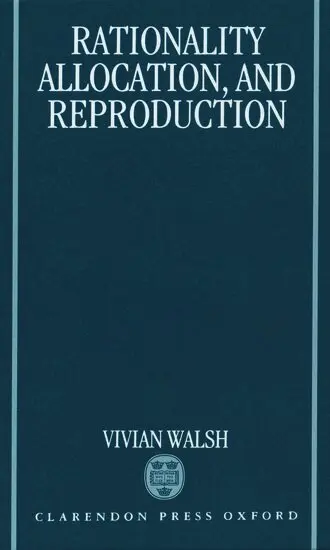
Rationality, Allocation, and Reproduction
Av Vivian Walsh
3838 kr
Beställningsvara. Skickas inom 5-8 vardagar. Fri frakt över 249 kr.
Beskrivning
When the term `rational' is used in formal economic theory, a strict definition is implicit. This strict definition cannot accommodate the complexities of our everyday ideas of what is rational. The concept of rationality that is embedded in our language is not a morally neutral one. It has always been believed possible to argue rationally about the worthiness of goals, the legitimacy of claim to rights, the existence of obligations or duties. Outside the discussions of the social sciences, argument concerning the rationality of a choice or action is never a purely technical, value-free discourse.This book is devoted to an examination of the limitations of the various formulations and interpretations of the concept of rationality which has been developed by economic theorists. It presents a series of challenges to the formal (axiomatic) concept of rationality. This conecept has spread from economics and decision theory through the social sciences and policy studies. It forms the implicit foundation for the pronouncement of policy-makers, whose recommendations can seriously affect the society and environment in which we live.The book begins with the claim of neoclassical economics that a rational agent maximizes utility. Next it considers the later, more austere construction of rationality where a rational agent was simply one whose choices or actions were consistent. The discussion then turns to who, dissatisfied with this bare notion of consistency, claimed that a rational agent was one whose choices or actions were directed towards maximization of the agent's self-interested aims - a view they attributed (misleadingly?) to Adam Smith. Once the character of the individual agent has been established, neoclassical theory has always regarded the analysis of allocation among these agents as its supreme task. This is the subject of chapters 6 and 7.Vivian Walsh examines the philosophical implications of the replacement of the ordinary concept of rationality by the formal concepts constructed to fit the requirements of general equilibrium theory, decision theory, and game theory. He argues that the current intellectual climate, which has moved away from formalism, necessitates the reexamination of the concepts of rationality which scholars and policy-makers, many of whom were not economists, were ready to adopt directly or indirectly from economic theory in the recent past.The final two chapters are intended to contrast sharply with the rest of the book. They offer a readable and minimally technical account of the much smaller role played by the concept of rational choice in the work of a present-day school which derives from the eighteenth- and nineteenth-century classical economists.
Produktinformation
- Utgivningsdatum: 1996-07-25
- Mått: 144 x 225 x 22 mm
- Vikt: 499 g
- Format: Inbunden
- Språk: Engelska
- Antal sidor: 314
- Förlag: Clarendon Press
- ISBN: 9780198287728
Utforska kategorier
Betyg & recensioner
0 recensioner
Inga recensioner tillgängliga.