• Fri frakt över 249 kr
  • •
  • Snabba leveranser
  • •
  • Billiga böcker
Kundservice

Du är på sajten för privatpersoner.

Företag, bibliotek eller offentlig verksamhet?

Du handlar på classic.bokus.com, där alla dina funktioner finns intakta.
Till classic.bokus.com
Bokus logotyp. Gå till startsidan.
  • Erbjudanden
  • Nyheter
  • Student
  • Topplistor
  • Barn & ungdom
  • Bokus Play
  • E-böcker
  • Pocketböcker
  • Spel & pussel

10% rabatt på allt med kod: NYSTART10 →

Sidfot

Mina sidor

    Hjälp

    • Kundservice
    • Vanliga frågor och svar
    • Frakt och leverans
    • Retur vid ångerrätt
    • Reklamera vara
    • Betalning
    • Köpvillkor
    • Allmänna villkor
    • Information om webbplatsens tillgänglighet

    Om Bokus

    • Om oss
    • Pressrum
    • För studenter
    • För företag
    • För bibliotek och offentlig verksamhet
    • För leverantörer
    • Hållbarhet

    Populärt

    • Aktuella erbjudanden
    • Presentkort
    • Studentlitteratur
    • Nya böcker
    • Topplistor
    • Signerade böcker
    • Engelska böcker

    Inspiration

    • Boktips
    • BookTok
    • Populära bokserier
    • Barnbokskaraktärer
    • Populära författare
    Logotyp för Bokus
    Följ oss på Facebook (extern länk)Följ oss på Instagram (extern länk)Följ oss på YouTube (extern länk)Följ oss på TikTok (extern länk)
    bokus @ CookiesAnpassa cookiesIntegritetspolicyKöpvillkor
    Till Citymail hemsida (extern länk)Till Budbee hemsida (extern länk)Till Postnord hemsida (extern länk)Till Schenker hemsida (extern länk)Till Early Bird hemsida (extern länk)Till Walleys hemsida (extern länk)
    1. Ekonomi och Ledarskap
    2. Nationalekonomi
    3. Ekonomisk politik

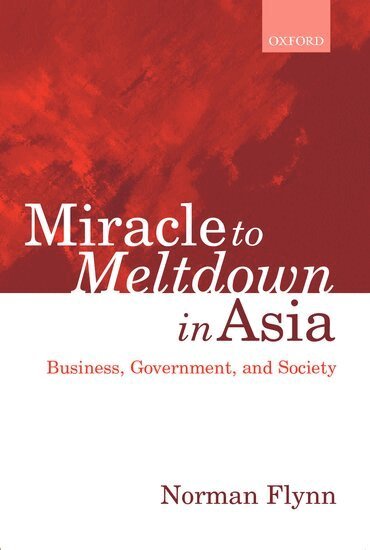
    Miracle to Meltdown in Asia

    Business, Government and Society

    AvNorman Flynn

    Inbunden, Engelska, 1999

    3 896 kr

    Beställningsvara. Skickas inom 3-6 vardagar. Fri frakt över 249 kr.

    Beskrivning

    The crisis in Asia has caused economic hardship and brought an end to the 'economic miracle' of fast economic growth in the region. This book asks whether the 1997/8 crisis marks a break with the past and signals an end to 'Asian' ways of running economies. During the period of rapid growth there were strong connections between governments and business in the region. 'Cronyism', or close connections between family, business, and government, was exposed when the stock markets and currencies dived. Pressure from overseas investors and international organizations has produced reforms in the region. The book examines the social, economic, and political modes of governance in the region. It finds that there is a shifting balance between rule by the market, rule by connections, and rule by force. In the sphere of economic management, it shows that the period of the 'developmental state' in Japan and Korea has come to an end, but that it has not yet been replaced by a liberal market. Elsewhere the close connections between governments and business have been weakened but not yet broken. There are still special 'Asian' characteristics in economic management and in politics. The forces of 'Globalization' are strong, but they are confronted with political and economic cultures that are not rooted in liberal market ethics.

    Produktinformation

    • Utgivningsdatum:1999-10-14
    • Mått:160 x 241 x 18 mm
    • Vikt:411 g
    • Format:Inbunden
    • Språk:Engelska
    • Antal sidor:180
    • Förlag:OUP OXFORD
    • ISBN:9780198295525

    Utforska kategorier

    • Ekonomisk politik inom Ekonomi och Ledarskap
    • Makroekonomi inom Ekonomi och Ledarskap
    • Företagsekonomi inom Ekonomi och Ledarskap

    Mer om författaren

    Norman Flynn is currently Research Fellow at the London School of Economics. He was formerly Professor of Public Management at the City University of Hong Kong. He has consulting experience in China, Hong Kong, Sweden, Denmark, Norway, Bosnia, Bolivia, and Slovenia.

    Innehållsförteckning

    • INTRODUCTION ; 1. LESSONS FROM THE ASIAN CRISIS ; What sort of 'miracles'? ; How did the 'meltdown' happen? ; Why did it happen? ; Responses ; Lessons ; 2. EXPRESSIVE RELATIONSHIPS AND NETWORKS ; Challenged assumptions ; Expressive and instrumental ties ; Mixed ties and networks ; Implications ; 3. THE ECONOMY AND THE STATE ; Intervention and the market ; The 'developmental state' ; 'Good governance' ; The development of the debate ; Networks and economic development ; The end of rule by connections? ; 4. THE FINAL VICTORY OF GLOBALIZATION? ; Homogenization ; The supranational institutions ; The global market ; Globalization as power struggle ; What is left for the state? ; Global governance for a global economy? ; 5. DEMOCRACY, THE ECONOMY, AND THE CRISIS ; Democracy and the crisis ; Democracy and the economy ; Asian democracy? ; 6. THE FAMILY, THE COMPANY, AND THE STATE ; Rights and obligations ; Politics and culture ; explanations of 'Asian' ways of welfare ; The crisis ; vulnerability of the self-reliant society in market downturns ; 7. MANAGING THE NETWORK STATE ; Differences among states ; Trends before the crisis ; The crisis and public management ; Convergence ; the end of rule by connections? ; CONCLUSIONS ; Economy ; Politics ; Labour and welfare ; Managing the state ; After rule by force and rule by connections? ; Stability ; Global market rules?