• Fri frakt över 249 kr
  • •
  • Snabba leveranser
  • •
  • Billiga böcker
Kundservice

Du är på sajten för privatpersoner.

Företag, bibliotek eller offentlig verksamhet?

Du handlar på classic.bokus.com, där alla dina funktioner finns intakta.
Till classic.bokus.com
Bokus logotyp. Gå till startsidan.
  • Erbjudanden
  • Nyheter
  • Student
  • Topplistor
  • Barn & ungdom
  • Bokus Play
  • E-böcker
  • Pocketböcker
  • Spel & pussel

10% rabatt på allt med kod: NYSTART10 →

Sidfot

Mina sidor

    Hjälp

    • Kundservice
    • Vanliga frågor och svar
    • Frakt och leverans
    • Retur vid ångerrätt
    • Reklamera vara
    • Betalning
    • Köpvillkor
    • Allmänna villkor
    • Information om webbplatsens tillgänglighet

    Om Bokus

    • Om oss
    • Pressrum
    • För studenter
    • För företag
    • För bibliotek och offentlig verksamhet
    • För leverantörer
    • Hållbarhet

    Populärt

    • Aktuella erbjudanden
    • Presentkort
    • Studentlitteratur
    • Nya böcker
    • Topplistor
    • Signerade böcker
    • Engelska böcker

    Inspiration

    • Boktips
    • BookTok
    • Populära bokserier
    • Barnbokskaraktärer
    • Populära författare
    Logotyp för Bokus
    Följ oss på Facebook (extern länk)Följ oss på Instagram (extern länk)Följ oss på YouTube (extern länk)Följ oss på TikTok (extern länk)
    bokus @ CookiesAnpassa cookiesIntegritetspolicyKöpvillkor
    Till Citymail hemsida (extern länk)Till Budbee hemsida (extern länk)Till Postnord hemsida (extern länk)Till Schenker hemsida (extern länk)Till Early Bird hemsida (extern länk)Till Walleys hemsida (extern länk)
    1. Djur och Natur
    2. Djurböcker
    3. Vilda djur
    4. Fågelböcker

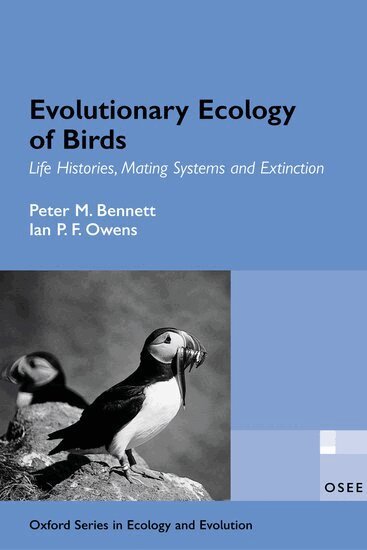
    Evolutionary Ecology of Birds

    AvBennett,Owens

    Häftad, Engelska, 2002

    Del i serien Oxford Series in Ecology and Evolution

    1 204 kr

    Beställningsvara. Skickas inom 5-8 vardagar. Fri frakt över 249 kr.

    Beskrivning

    Birds show bewildering diversity in their life histories, mating systems and risk of extinction. Why do albatrosses delay reproduction for the first 12 years of their life while zebra finches breed in their first year ? Why are fairy-wrens so sexually promiscuous while swans show lifelong monogamy? Why are over a quarter of parrot species threatened with global extinction while woodpeckers and cuckoos remain secure? Some of these topics, such as delayed onset of breeding in seabirds, are classic problems in evolutionary ecology, while others have arisen in the last decade, such as genetic mating systems and extinction. Birds offer a unique opportunity for investigating these questions because they are exceptionally well-studied in the wild. By employing phylogenetic comparative methods and a database of up to 3,000 species, the authors identify the ecological and evolutionary basis of many of these intriguing questions. They also highlight remaining puzzles and identify a series of challenges for future investigation. This is the most comprehensive reappraisal of avian diversity since David Lack's classic "Ecological Adaptations for Breeding in Birds". It is also the most extensive application of modern comparative methods yet undertaken. This novel approach demonstrates how an evolutionary perspective can reveal the general ecological processes that underpin contemporary avian diversity on a global scale.

    Produktinformation

    • Utgivningsdatum:2002-01-24
    • Mått:156 x 233 x 15 mm
    • Vikt:435 g
    • Format:Häftad
    • Språk:Engelska
    • Serie:Oxford Series in Ecology and Evolution
    • Antal sidor:296
    • Förlag:OUP OXFORD
    • ISBN:9780198510895

    Utforska kategorier

    • Fågelböcker inom Djur och Natur
    • Biovetenskap inom Naturvetenskap och teknik
    • Fåglar inom Naturvetenskap och teknik

    Recensioner i media

    The tradition embodies by Lack is enhanced here by the insights that new approaches can generate.

    Innehållsförteckning

    • 1. COMPARATIVE METHODS ; 2. DIVERSITY AMONG LIVING SPECIES ; 6. VARIATION IN MATING SYSTEMS AND SEXUAL DIMORPHISM ; 10. VARIATION IN EXTINCTION RISK AND SPECIES RICHNESS