Inbunden, Engelska, 2020
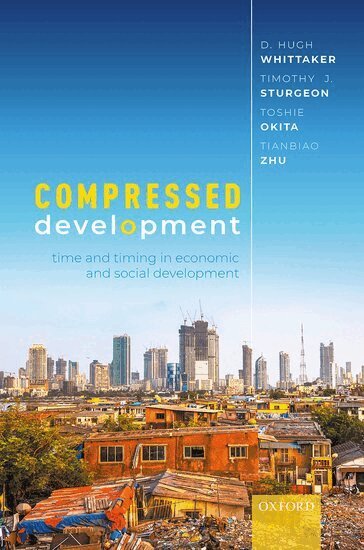
Compressed Development
Time and Timing in Economic and Social Development
Av D. Hugh Whittaker, Timothy Sturgeon, Toshie Okita, Tianbiao Zhu
1433 kr
Beställningsvara. Skickas inom 7-10 vardagar. Fri frakt över 249 kr.
Beskrivning
Produktinformation
- Utgivningsdatum: 2020-09-17
- Mått: 163 x 242 x 23 mm
- Vikt: 626 g
- Format: Inbunden
- Språk: Engelska
- Antal sidor: 296
- Förlag: OUP OXFORD
- ISBN: 9780198744948
Utforska kategorier
Mer om författaren
D. Hugh Whittaker is Professor in the Economy and Business of Japan, and Fellow of St Antony's College, University of Oxford. His research encompasses Japanese and comparative employment, innovation and technology management, small firms and entrepreneurship, and development.Timothy Sturgeon is Senior Researcher at the Industrial Performance Center, MIT. His research explores how evolving technologies and business models are altering linkages between industrialized and developing economies, with an emphasis on offshoring and outsourcing practices in the electronics, automotive, and services industries.Toshie Okita is Research and Teaching Associate at the Nissan Institute of Japanese Studies, University of Oxford. Her research focuses on international and comparative education, sociology of the family, socio-linguistics, youth transition, and social policy.Tianbiao Zhu is Professor, Deputy Chair for the Department of Sociology, and Executive Director for the Institute for Advanced Study in Humanities and Social Sciences at Zhejiang University. His research interests include international and comparative politics, international and comparative political economy, and the political economy of development.
Recensioner i media
"...the authors provide a compelling analysis of the ways in which the crisis of Fordism and the rise of the 'network model' of production is central to understand the industrial shaping of the current era of development. The authors are careful in pointing out how this crisis was not simply a crisis of competitiveness driven by the 'Japanese model' of lean production; it was also a social crisis for workers which undermined the social conditions for innovation and productivity across Western Capitalism. In fact, within Western firms, 'lean practices were often applied piecemeal. Reduced in-process inventory and increased monitoring raising productivity and quality were not coupled with employer commitment to job security - required to motivate buy-in from workers - as it was in Japan.
Betyg & recensioner
0 recensioner
Inga recensioner tillgängliga.