• Fri frakt över 249 kr
  • •
  • Snabba leveranser
  • •
  • Billiga böcker
Kundservice

Du är på sajten för privatpersoner.

Företag, bibliotek eller offentlig verksamhet?

Du handlar på classic.bokus.com, där alla dina funktioner finns intakta.
Till classic.bokus.com
Bokus logotyp. Gå till startsidan.
  • Erbjudanden
  • Student
  • Topplistor
  • Barn & ungdom
  • Bokus Play
  • E-böcker
  • Ljudböcker
  • Pocketböcker
  • Spel och pussel

5% studentrabatt – använd koden KURSBOK27 →

Sidfot

Mina sidor

    Hjälp

    • Kundservice
    • Vanliga frågor och svar
    • Frakt och leverans
    • Retur vid ångerrätt
    • Reklamera vara
    • Betalning
    • Köpvillkor
    • Allmänna villkor
    • Information om webbplatsens tillgänglighet

    Om Bokus

    • Om oss
    • Pressrum
    • För studenter
    • För företag
    • För bibliotek och offentlig verksamhet
    • För leverantörer
    • Hållbarhet

    Populärt

    • Aktuella erbjudanden
    • Presentkort
    • Studentlitteratur
    • Nya böcker
    • Topplistor
    • Signerade böcker
    • Engelska böcker

    Inspiration

    • Boktips
    • BookTok
    • Barnbokskaraktärer
    • Populära författare
    Logotyp för Bokus
    Följ oss på Facebook (extern länk)Följ oss på Instagram (extern länk)Följ oss på YouTube (extern länk)Följ oss på TikTok (extern länk)
    bokus @ CookiesAnpassa cookiesIntegritetspolicyKöpvillkor
    Till Citymail hemsida (extern länk)Till Budbee hemsida (extern länk)Till Postnord hemsida (extern länk)Till Schenker hemsida (extern länk)Till Early Bird hemsida (extern länk)Till Walleys hemsida (extern länk)
    1. Språk och ordböcker
    2. Språkvetenskap och lingvistik

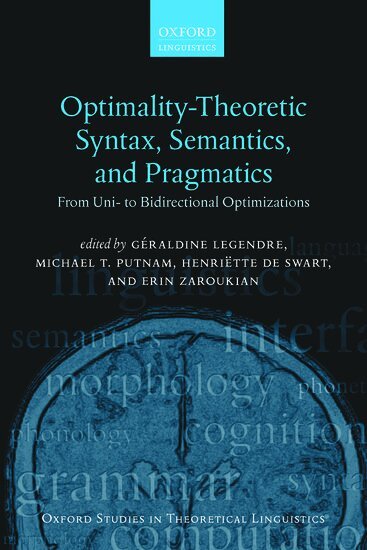
    Optimality Theoretic Syntax, Semantics, and Pragmatics

    From Uni- to Bidirectional Optimization

    AvGéraldine Legendre,Michael T. Putnam

    Inbunden, Engelska, 2016

    Del 61 i serien Oxford Studies in Theoretical Linguistics

    2 113 kr

    Beställningsvara. Skickas inom 3-6 vardagar. Fri frakt över 249 kr.

    Beskrivning

    This book investigates the morphosyntactic, semantic, and pragmatic properties of language, and the interactions between them, from the perspective of Optimality Theory. It integrates optimization processes into the formal and functional study of grammar, interpreting optimization as the result of conflicting, violable ranked constraints.Unlike previous work on the topic, this book also takes into account the question of directionality of grammar. A model of grammar in which optimization processes interact bidirectionally allows both language generation-the process of selecting the optimal form of a given meaning-and language interpretation-the process of optimal interpretation of a given form-to be taken into account. Chapters in this volume explore the consequences of both symmetric (unidirectional) and asymmetric (bidirectional) versions of Optimality Theory, investigating the syntax-semantics interface, first language acquisition, and sequential bilingual grammars. The volume presents cutting edge research in Optimality-Theoretic syntax and semantics, as well as demonstrating how optimization processes as modelled in this formalism serve as a viable approach for linguists and scholars in related fields.

    Produktinformation

    • Utgivningsdatum:2016-03-24
    • Mått:162 x 240 x 26 mm
    • Vikt:706 g
    • Format:Inbunden
    • Språk:Engelska
    • Serie:Oxford Studies in Theoretical Linguistics
    • Antal sidor:384
    • Förlag:OUP OXFORD
    • ISBN:9780198757115

    Utforska kategorier

    • Språkvetenskap och lingvistik inom Språk och ordböcker
    • Kognitiv psykologi inom Psykologi och pedagogik

    Mer om författaren

    Géraldine Legendre is Professor of Linguistics and Cognitive Science at Johns Hopkins University. She co-developed, with Paul Smolensky, the soft constraint-based precursor to Optimality Theory and has played a major role in the development of OT in syntax since the early 1990s, focussing particularly on comparative studies of phenomena in syntax and at the syntax-semantics interface and on the modelling of early child syntax and code-switching. She is co-author of The Harmonic Mind (with Paul Smolensky; MIT Press, 2006) and co-editor of Optimality-Theoretic Syntax (with Jane Grimshaw and Sten Vikner; MIT Press, 2001).Michael T. Putnam is Associate Professor of German and Linguistics at Penn State University. His work focuses on gaining a better understanding of the cognitive architecture underlying the language faculty at the intersection of culture, grammar, and performance biases, and he has published widely on comparative Germanic linguistics, the morphosyntax-semantics interface, and bilingualism. He is the author of The Structural Design of Language (with Thomas S. Stroik; CUP, 2013) and editor of Studies on German-Language Islands (Benjamins, 2011).Erin Zaroukian is a postdoctoral fellow in the Human Research and Engineering Directorate of the US Army Research Laboratory, where her primary research is in human-computer collaboration, including assessing the comprehension of controlled natural languages and establishing principles for their design and development. Her PhD work focused on formal semantics of approximation and hedging, which she continued, with an experimental focus, as a postdoctoral researcher in the Laboratoire de Sciences Cognitives et Psycholinguistique (École Normale Supérieure, PSL Research University, CNRS).Henriëtte de Swart is Professor of French Linguistics and Semantics at Utrecht University. Her research is concerned with cross-linguistic variation at the syntax-semantics-pragmatic interface, looking specifically at tense and aspect, negation, indefinites, genericity, and bare nominals. Her publications include Introduction to Natural Language Semantics (University of Chicago Press, 1998), The Semantics of Incorporation (with Donka Farkas; CSLI, 2003), and Conflicts in Interpretation (with Petra Hendriks, Helen de Hoop, and Irene Krämer; Equinox, 2010).

    Innehållsförteckning

    • PART I: ISSUES IN OPTIMALITY-THEORETIC SYNTAX; PART II: ISSUES IN OPTIMALITY-THEORETIC SEMANTICS AND PRAGMATICS