• Fri frakt över 249 kr
  • •
  • Snabba leveranser
  • •
  • Billiga böcker
Kundservice

Du är på sajten för privatpersoner.

Företag, bibliotek eller offentlig verksamhet?

Du handlar på classic.bokus.com, där alla dina funktioner finns intakta.
Till classic.bokus.com
Bokus logotyp. Gå till startsidan.
  • Erbjudanden
  • Nyheter
  • Student
  • Topplistor
  • Barn & ungdom
  • Bokus Play
  • E-böcker
  • Pocketböcker
  • Spel & pussel

10% rabatt på allt med kod NYSTART10 →

Sidfot

Mina sidor

    Hjälp

    • Kundservice
    • Vanliga frågor och svar
    • Frakt och leverans
    • Retur vid ångerrätt
    • Reklamera vara
    • Betalning
    • Köpvillkor
    • Allmänna villkor
    • Information om webbplatsens tillgänglighet

    Om Bokus

    • Om oss
    • Pressrum
    • För studenter
    • För företag
    • För bibliotek och offentlig verksamhet
    • För leverantörer
    • Hållbarhet

    Populärt

    • Aktuella erbjudanden
    • Presentkort
    • Studentlitteratur
    • Nya böcker
    • Topplistor
    • Signerade böcker
    • Engelska böcker

    Inspiration

    • Boktips
    • BookTok
    • Populära bokserier
    • Barnbokskaraktärer
    • Populära författare
    Logotyp för Bokus
    Följ oss på Facebook (extern länk)Följ oss på Instagram (extern länk)Följ oss på YouTube (extern länk)Följ oss på TikTok (extern länk)
    bokus @ CookiesAnpassa cookiesIntegritetspolicyKöpvillkor
    Till Citymail hemsida (extern länk)Till Budbee hemsida (extern länk)Till Postnord hemsida (extern länk)Till Schenker hemsida (extern länk)Till Early Bird hemsida (extern länk)Till Walleys hemsida (extern länk)
    1. Djur och Natur
    2. Naturböcker
    3. Växtböcker

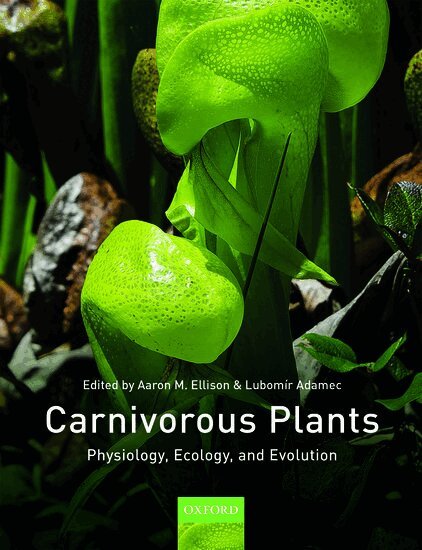
    Carnivorous Plants

    Physiology, ecology, and evolution

    AvAaron Ellison,Lubomír Adamec

    Inbunden, Engelska, 2017

    2 251 kr

    Beställningsvara. Skickas inom 7-10 vardagar. Fri frakt över 249 kr.

    Beskrivning

    Carnivorous plants have fascinated botanists, evolutionary biologists, ecologists, physiologists, developmental biologists, anatomists, horticulturalists, and the general public for centuries. Charles Darwin was the first scientist to demonstrate experimentally that some plants could actually attract, kill, digest, and absorb nutrients from insect prey; his book Insectivorous Plants (1875) remains a widely-cited classic. Since then, many movies and plays, short stories, novels, coffee-table picture books, and popular books on the cultivation of carnivorous plants have been produced. However, all of these widely read products depend on accurate scientific information, and most of them have repeated and recycled data from just three comprehensive, but now long out of date, scientific monographs. The field has evolved and changed dramatically in the nearly 30 years since the last of these books was published, and thousands of scientific papers on carnivorous plants have appeared in the academic journal literature. In response, Ellison and Adamec have assembled the world's leading experts to provide a truly modern synthesis. They examine every aspect of physiology, biochemistry, genomics, ecology, and evolution of these remarkable plants, culminating in a description of the serious threats they now face from over-collection, poaching, habitat loss, and climatic change which directly threaten their habitats and continued persistence in them.

    Produktinformation

    • Utgivningsdatum:2017-12-21
    • Mått:196 x 252 x 29 mm
    • Vikt:1 380 g
    • Format:Inbunden
    • Språk:Engelska
    • Antal sidor:548
    • Förlag:OUP OXFORD
    • ISBN:9780198779841

    Utforska kategorier

    • Växtböcker inom Djur och Natur
    • Botanik inom Naturvetenskap och teknik

    Mer om författaren

    Aaron M. Ellison is the Senior Research Fellow in Ecology at Harvard University, and a semi-professional photographer and writer. He studies the disintegration and reassembly of ecosystems following natural and anthropogenic disturbances; thinks about the relationship between the Dao and the intermediate disturbance hypothesis and reflects on the critical and reactionary stance of Ecology relative to Modernism.Lubomír Adamec is the Senior Research Scientist in the Section of Plant Ecology of the Institute of Botany CAS at Trebon, Czech Republic, where he has been working since 1986. Since graduating in plant physiology from the Charles University in Prague, Czechoslovakia, he has been studying the ecophysiology of aquatic and wetland plants, especially carnivorous ones: mineral nutrition, photosynthesis, growth traits, Utricularia trap ecophysiology, and biophysics. He is the curator of the world's largest collection of aquatic carnivorous plants, currently including more than 80 species or populations, which is used extensively for research and plant conservation.

    Recensioner i media

    As a review of the most up to date research on carnivorous plants, this is ideal for senior undergraduate or graduate students, academics, and those with a keen interest in carnivorous plants...It rewards the careful and thorough reader who is passionate about botany.

    Innehållsförteckning

    • Part I: Overview 1: Aaron M. Ellison and Lubomír Adamec: Introduction 2: J. Stephen Brewer and Jan Schlauer: Biogeography and habitats of carnivorous plants 3: Andreas Fleischmann, Jan Schlauer, Stephen A. Smith, and Thomas J. Givnish: Evolution of carnivory in angiosperms Part II: Systematics and evolution of carnivorous plants 4: Andreas Fleischmann, Adam T. Cross, Robert Gibson, Paulo M. Gonella, and Kingsley W. Dixon: Systematics and evolution of Droseraceae 5: Charles Clarke, Jan Schlauer, Jonathan Moran, and Alastair Robinson: Systematics and evolution of Nepenthes 6: Andreas Fleischmann and Aymeric Roccia: Systematics and evolution of Lentibulariaceae: I. Pinguicula 7: Andreas Fleischmann: Systematics and evolution of Lentibulariaceae: II. Genlisea 8: Richard W. Jobson, Paulo C. Baleeiro, and Cástor Guisande: Systematics and evolution of Lentibulariaceae: III. Utricularia 9: Robert F.C. Naczi: Systematics and evolution of Sarraceniaceae 10: Adam T. Cross, Maria Paniw, André Vito Scatigna, Nick Kalfas, Bruce Anderson, Thomas J. Givnish, and Andreas Fleischmann: Systematics and evolution of small genera of carnivorous plants 11: Tanya Renner, Tianying Lan, Kimberly M. Farr, Enrique Ibarra-Laclette, Luis Herrera- Esrella, Stephan C. Schuster, Mitsuyasu Hasebe, Kenji Fukushima, and Victor A. Albert: Carnivorous plant genomes Part III: Physiology, form, and function 12: John D. Horner, Bartosz J. Plachno, Ulrike Bauer, and Bruno Di Giusto: Attraction of prey 13: Bartosz J. Plachno and Lyudmila E. Muravnik: Functional anatomy of carnivorous traps 14: Simon Poppinga, Ulrike Bauer, Thomas Speck, and Alexander G. Volkov: Motile traps 15: Ulrike Bauer, Reinhard Jetter, and Simon Poppinga: Non-motile traps 16: Ildikó Matu%siková, Andrej Pavlovic, and Tanya Renner: Biochemistry of prey digestion and nutrient absorption 17: Lubomír Adamec and Andrej Pavlovic: Mineral nutrition of terrestrial carnivorous plants 18: Thomas J. Givnish, K. William Sparks, Steven J. Hunter, and Andrej Pavlovic: Why are plants carnivorous? Cost/benefit analysis, whole-plant growth, and the context- specific advantages of botanical carnivory 19: Lubomír Adamec: Ecophysiology of aquatic carnivorous plants 20: Laurent Legendre and Douglas W. Darnowski: Biotechnology with carnivorous plants Part IV: Ecology 21: Douglas W. Darnowski, Ulrike Bauer, Marcos Méndez, John D. Horner, and Bartosz J. Plachno: Prey selection and specialization by carnivorous plants 22: Adam T. Cross, Arthur R. Davis, Andreas Fleischmann, John D. Horner, Andreas Jürgens, David J. Merritt, Gillian L. Murza, and Shane R. Turner: Reproductive biology and prey-pollinator conflicts 23: Leonora S. Bittleston: Commensals of Nepenthes pitchers 24: Thomas E. Miller, William E. Bradshaw, and Christina M. Holzapfel: Pitcher-plant communities as model systems for addressing fundamental questions in ecology and evolution 25: Dagmara Sirová, Jirí Bárta, Jakub Borovec, and Jaroslav Vrba: The Utricularia-associated microbiome: composition, function, and ecology 26: Jonathan A. Moran, Bruce Anderson, Lijin Chin, Melinda Greenwood, and Charles Clarke: Nutritional mutualisms of Nepenthes and Roridula Part V: The future of carnivorous plants 27: Charles Clarke, Adam Ross, and Barry Rice: Conservation of carnivorous plants 28: Matthew C. Fitzpatrick and Aaron M. Ellison: Estimating the exposure of carnivorous plants to rapid climatic change 29: Aaron M. Ellison and Lubomír Adamec: The future of research with carnivorous plants