Inbunden, Engelska, 2027
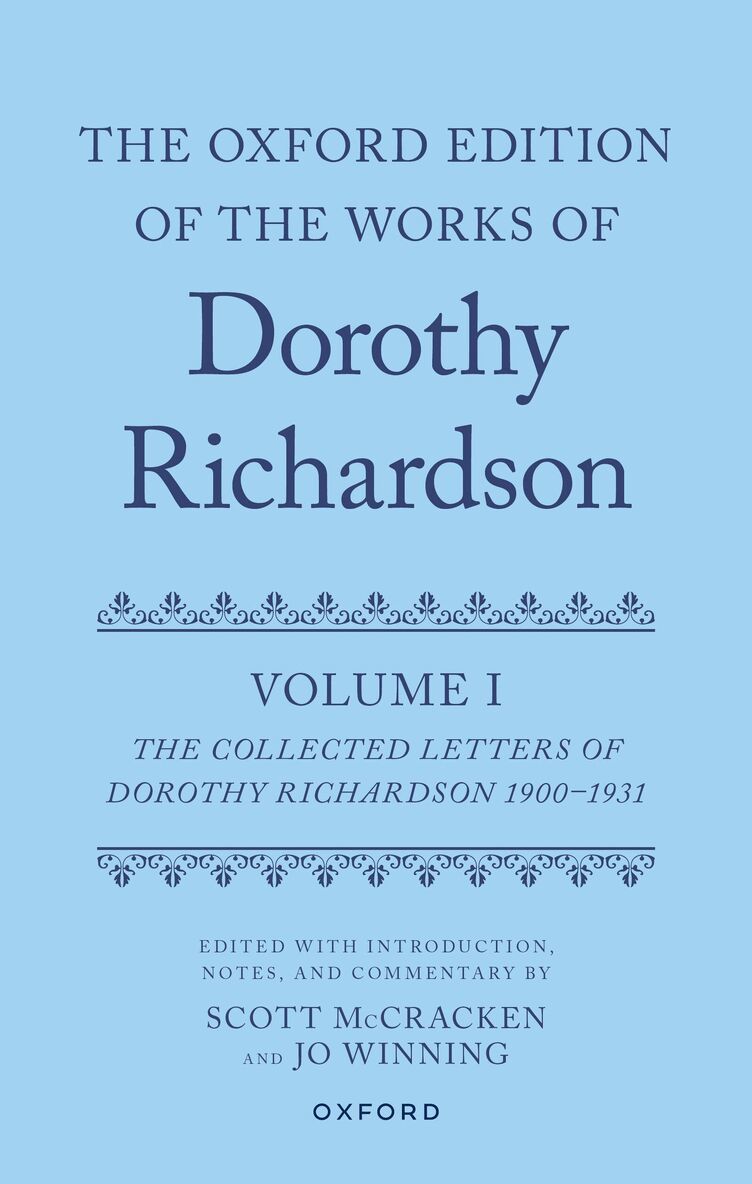
The Oxford Edition of the Works of Dorothy Richardson, Volume I
Av Scott McCracken, Jo Winning
4131 kr
Kommande
Beskrivning
Dorothy Richardson was a major figure in twentieth-century literature. Her long, thirteen-volume work, Pilgrimage, is a landmark of European modernism. The Oxford Edition of the Works of Dorothy Richardson is the first authoritative version of her work. It includes a six-volume edition of Pilgrimage, a volume of her shorter fiction and poetry, a volume of her non-fiction, and three volumes of her collected letters. The edition includes a full scholarly apparatus in a form that is accessible to scholars, students, and the general reader.Dorothy Richardson's letters are a remarkable record of the life of the first writer about whom the description 'stream of consciousness' was used. Her networks included early twentieth-century writers, publishers, booksellers, and artists such as: André Gide, H.D., George Moore, John Cowper Powys, George Bernard Shaw, H. G. Wells, Hugh Walpole, Bryher (Annie Winifred Ellerman), Edward Garnett, John Middleton Murray, Alfred Knopf, May Sinclair, D. H. Lawrence, and Violet Hunt, Nina Hamnett, Adrian Allinson, and Jacob Epstein. A matchless record of the first half of the twentieth century, they document her life, thought, and fiction, revealing a complex meshwork of communication, relationships, and cultural production. Sometimes intimate, sometimes defensive, sometimes pure performance, her letters exhibit her skills as a writer: changing voice depending on her subject and her correspondent; reworking a vivid scene to different friends; using epistolary form as a space in which to experiment or be playful; mixing details of everyday life with observations about philosophy and art in ways that make them literary works in their own right.Known and admired by writers throughout the twentieth century, like many women modernists, Richardson had to wait until secondwave feminism in the 1970s for proper critical recognition. Since then her reputation has gradually been re-established. The Oxford edition of her work is the culmination of several decades of scholarship and restores her to her rightful place in literary history.Volume I presents the collected letters, 1900-1931.
Produktinformation
- Utgivningsdatum: 2027-03-25
- Mått: 138 x 216 x undefined mm
- Format: Inbunden
- Språk: Engelska
- Serie: Oxford Edition Of The Works Of Dorothy Richardson
- Antal sidor: 736
- Förlag: OUP OXFORD
- ISBN: 9780198783039
Utforska kategorier
Betyg & recensioner
0 recensioner
Inga recensioner tillgängliga.