Häftad, Engelska, 1998
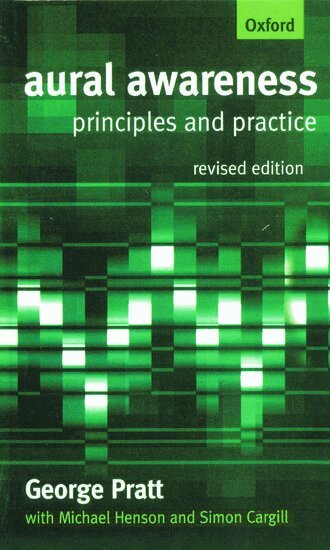
Aural Awareness
Av George Pratt, Michael Henson, Simon Cargill
1526 kr
Skickas torsdag 29/10. Fri frakt över 249 kr.
Beskrivning
Traditional aural training is heavily biased towards the perception and identification of pitch and rhythm. But George Pratt argues in this book that in these days of CDs and cassette recorders much of this area of the subject can best be worked on alone. He demonstrates how, by tailoring tasks to individual needs, every student can make some encouraging progess in these aspects of music. But this also makes time available for developing the perception of other musical elements just as significant yet often neglected because of their more abstract and qualitative nature--elements such as timbre, texture and density; compass, range, and tessitura; dynamics and articulation; ordering music in structures and placing it in space. The chapters on these areas break new ground. They demonstrate how these `elements', once perceived and analysed, are incorporated into the skills which musicians need--to notate sound quality accurately, to read or `image' the implications of notation beyond though including pitch and rhythm; to play and sing by ear; to improvise and to memorize, not only 'right notes' but the subtle qualities and nuances which bind them into coherent music. This book was first published by Open University Press, and at that stage was primarily addressed to groups of music students and their teachers, in universities, colleges, conservatoires, and sixth forms. But, by a happy accident of timing, George Pratt was then invited to be a member of the National Curriculum Music Working Group, and many of the ideas here, in particular the identification and codification of musical 'elements', were fed into their thinking. The present book has been substantially revised to take account of what are now the statutory requirements of the National Curriculum in Music. Much of the material in it is either already accessible for pupils in the earlier years at school or is easily adapted by imaginative teachers. In addition, every section leads towards open-ended `do-it-yourself' exercises and experiments which can be used by individuals. This follows the pattern established in Professor Pratt's The Dynamics of Harmony: Principles and Practice (OUP, 1996), and is designed to encourage open-ended exploration generated by musicians's individual needs and enthusiasms. This freedom to adapt exercises includes using them in any musical context. Timbre is as important to a rock group as to a classical orchestra playing on period instruments; performing by ear and from memory are as essential for handing down the un-notated music of some non-Western traditions as for a concert soloist; everyone who owns a CD can enhance their enjoyment of it by recognising the artistry and technical skills which have created it. So the book encourages self-reliance and the confidence to begin to discover for oneself music of any age, of any culture.
Produktinformation
- Utgivningsdatum: 1998-05-21
- Mått: 138 x 217 x 10 mm
- Vikt: 227 g
- Format: Häftad
- Språk: Engelska
- Antal sidor: 164
- Förlag: OUP OXFORD
- ISBN: 9780198790211
Utforska kategorier
Betyg & recensioner
0 recensioner
Inga recensioner tillgängliga.