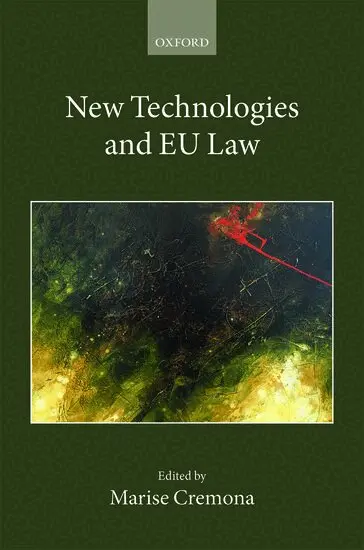
Inbunden, Engelska, 2017
New Technologies and EU Law
Del 2 i serien Collected Courses of the Academy of European Law
1901 kr
Beställningsvara. Skickas inom 3-6 vardagar. Fri frakt över 249 kr.
Beskrivning
Produktinformation
- Utgivningsdatum: 2017-06-15
- Mått: 176 x 240 x 22 mm
- Vikt: 592 g
- Format: Inbunden
- Språk: Engelska
- Serie: Collected Courses of the Academy of European Law
- Antal sidor: 282
- Förlag: OUP OXFORD
- ISBN: 9780198807216
Utforska kategorier
Mer om författaren
Marise Cremona is Professor of European Law at the European University Institute, Florence. Between November 2009 and June 2012 she was Head of the Department of Law at the EUI and between June 2012 and August 2013 she was President ad interim of the EUI. She is a co-Director of the Academy of European Law and general co-editor of The Collected Courses of the Academy of European Law, Oxford University Press. She has published extensively on the external relations law of the European Union, including Developments in EU External Relations Law (Oxford University Press, 2008); EU Foreign Relations Law - Constitutional Fundamentals, edited with B de Witte (Hart Publishing, 2008); The European Court of Justice and External Relations Law - Constitutional Challenges, edited with A Thies (Hart Publishing 2014) and Private Law in the External Relations of the EU (Oxford University Press 2016).
Recensioner i media
New technologies are important for market integration, fundamental rights and for security. The book is therefore not only of interest for lawyers specifically dealing with individual aspects of new technologies, but also of those dealing with horizontal aspects of EU law ... The book is an admirable read for academics and (mostly postgraduate) students interested in legal responses to various risks posed by new technologies. The book challenges them to explore other aspects of new technologies affecting EU law and the related institutional alternatives.
Betyg & recensioner
0 recensioner
Inga recensioner tillgängliga.