• Fri frakt över 249 kr
  • •
  • Snabba leveranser
  • •
  • Billiga böcker
Kundservice

Du är på sajten för privatpersoner.

Företag, bibliotek eller offentlig verksamhet?

Du handlar på classic.bokus.com, där alla dina funktioner finns intakta.
Till classic.bokus.com
Bokus logotyp. Gå till startsidan.
  • Erbjudanden
  • Nyheter
  • Student
  • Topplistor
  • Barn & ungdom
  • Bokus Play
  • E-böcker
  • Pocketböcker
  • Spel & pussel

10% rabatt på allt med kod: NYSTART10 →

Sidfot

Mina sidor

    Hjälp

    • Kundservice
    • Vanliga frågor och svar
    • Frakt och leverans
    • Retur vid ångerrätt
    • Reklamera vara
    • Betalning
    • Köpvillkor
    • Allmänna villkor
    • Information om webbplatsens tillgänglighet

    Om Bokus

    • Om oss
    • Pressrum
    • För studenter
    • För företag
    • För bibliotek och offentlig verksamhet
    • För leverantörer
    • Hållbarhet

    Populärt

    • Aktuella erbjudanden
    • Presentkort
    • Studentlitteratur
    • Nya böcker
    • Topplistor
    • Signerade böcker
    • Engelska böcker

    Inspiration

    • Boktips
    • BookTok
    • Populära bokserier
    • Barnbokskaraktärer
    • Populära författare
    Logotyp för Bokus
    Följ oss på Facebook (extern länk)Följ oss på Instagram (extern länk)Följ oss på YouTube (extern länk)Följ oss på TikTok (extern länk)
    bokus @ CookiesAnpassa cookiesIntegritetspolicyKöpvillkor
    Till Citymail hemsida (extern länk)Till Budbee hemsida (extern länk)Till Postnord hemsida (extern länk)Till Schenker hemsida (extern länk)Till Early Bird hemsida (extern länk)Till Walleys hemsida (extern länk)
    1. Skönlitteratur
    2. Litteraturvetenskap
    3. Litteraturvetenskap

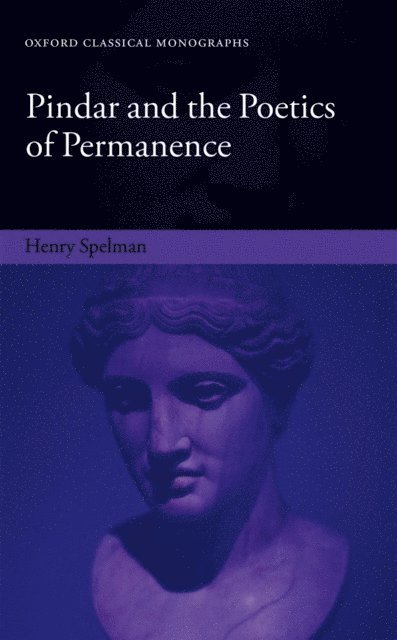
    Pindar and the Poetics of Permanence

    AvHenry Spelman

    Inbunden, Engelska, 2018

    Del i serien Oxford Classical Monographs

    2 517 kr

    Beställningsvara. Skickas inom 5-8 vardagar. Fri frakt över 249 kr.

    Fler format och utgåvor

    E-bok

    1 474 kr

    E-bok

    1 470 kr

    Beskrivning

    Recent scholarship on early Greek lyric has been primarily concerned with the immediate contexts of its first performance. This volume instead turns its attention to the rhetoric and realities of poetic permanence. Taking Pindar and archaic Greek literary culture as its focus, it offers a new reading of Pindar's victory odes which explores not only how they were received by those who first experienced them, but also what they can mean to later audiences. Part One of the discussion investigates Pindar's relationship to both of these audiences, demonstrating how his epinicia address the listeners present at their premiere performance and also a broader secondary audience across space and time. It argues that a full appreciation of these texts involves taking both perspectives into account. Part Two describes how Pindar engages with a wide variety of other poetry, particularly earlier lyric, in order to situate his work both within an immanent poetic history and a contemporary poetic culture. It shows how Pindar's vision of the world shaped the meaning of his work and illuminates the context within which he anticipated its permanence. The book offers new insights into the texts themselves and invites us to rethink early Greek poetic culture through a combination of historical and literary perspectives.

    Produktinformation

    • Utgivningsdatum:2018-05-17
    • Mått:147 x 223 x 27 mm
    • Vikt:594 g
    • Format:Inbunden
    • Språk:Engelska
    • Serie:Oxford Classical Monographs
    • Antal sidor:376
    • Förlag:OUP OXFORD
    • ISBN:9780198821274

    Utforska kategorier

    • Litteraturvetenskap inom Skönlitteratur
    • Dramatik inom Skönlitteratur
    • Poesi inom Skönlitteratur

    Mer om författaren

    Henry Spelman was raised in Philadelphia and received his doctorate from the University of Oxford in 2015. He is the author of numerous articles on early Greek poetry and currently holds the WHD Rouse Junior Research Fellowship at Christ's College, Cambridge.

    Recensioner i media

    Spelman's thought-provoking book, with a wide variety of literary evidence and the brand new perspectives he offers, is a useful work that accomplishes its aleged purpose. I therefore recommend it to all interested readers.

    Innehållsförteckning

    • Frontmatter Note on Translations and Conventions List of Abbreviations Precis Part One: Pindar's Audiences Introduction to Part One I: Secondary Audiences I.1: Knowledge of first performance I.2: Knowledge of external realities I.2.A: Public matters I.2.B: Individual circumstances I.2.C: Mythology I.3: Difficult pleasures I.4: Orality and writing II: Vital Light in Isthmian 4 III: Event and Artefact: From Performance to Permanence III.1: Isthmian 2.43 8 III.2: Olympian 10.91 6 III.3: Bacchylides 13.220 31 III.4: Pindar fr. 52o III.5: Nemean 3.76 84 III.6: Bacchylides 3.90 8 III.7: Conclusions IV: The Poetics of Permanence IV.1: Time travel and tradition: Pythian 1 IV.2: The victor's perspective: Nemean 4 IV.3: Epinician lessons: Pythian 6 IV.4: Epic analogues: Pythian 3 IV.5: Epigrammatic interactions: Nemean 5 IV.6: Interwoven perspectives: Nemean 7 and Paean 6 V: Genre and Tradition V.1: Genre V.1.A: Occasions and audiences in cultic poetry V.1.B: Permanence outside epinician V.1.B.i: Paean 7b V.1.B.ii: Dithyramb 2 (fr. 70b) V.1.C: Conclusions: rhetoric and reality V.2: Tradition V.2.A: Alcman and Stesichorus V.2.B: Alcaeus and Sappho V.2.C: Ibycus and Anacreon V.2.D: Common considerations V.2.E: Conclusions: development and continuity V.3: Coda Part Two: Pindar and the Traditions of Lyric Introduction to Part Two VI: The Epinician Past VI.1: Epinician origins in history: athletics, Ibycus, Simonides VI.2: Epinician origins in epinician: from revel to literature VI.2.A: Nemean 8 VI.2.B: Olympian 10 VI.3: The flowers of new poems: Olympian 9 VII: The Epinician Present VII.1: Generic references VII.2: The poet's career VII.3: Patrons and communities VII.4: Other eulogists VII.5: Epinician revels VII.6: Nemean 6 VII.7: Conclusions VIII: The Lyric Past VIII.1: Lyric history VIII.2: Generic enrichment VIII.2.A: Pythian 2 VIII.2.B: Pythian 1 VIII.2.C: Isthmian 2 VIII.3: Conclusions Epilogue Endmatter Bibliography 1. Texts 2. Works cited Index