• Fri frakt över 249 kr
  • •
  • Snabba leveranser
  • •
  • Billiga böcker
Kundservice

Du är på sajten för privatpersoner.

Företag, bibliotek eller offentlig verksamhet?

Du handlar på classic.bokus.com, där alla dina funktioner finns intakta.
Till classic.bokus.com
Bokus logotyp. Gå till startsidan.
  • Erbjudanden
  • Nyheter
  • Student
  • Topplistor
  • Barn & ungdom
  • Bokus Play
  • E-böcker
  • Pocketböcker
  • Spel & pussel

10% rabatt på allt med kod: NYSTART10 →

Sidfot

Mina sidor

    Hjälp

    • Kundservice
    • Vanliga frågor och svar
    • Frakt och leverans
    • Retur vid ångerrätt
    • Reklamera vara
    • Betalning
    • Köpvillkor
    • Allmänna villkor
    • Information om webbplatsens tillgänglighet

    Om Bokus

    • Om oss
    • Pressrum
    • För studenter
    • För företag
    • För bibliotek och offentlig verksamhet
    • För leverantörer
    • Hållbarhet

    Populärt

    • Aktuella erbjudanden
    • Presentkort
    • Studentlitteratur
    • Nya böcker
    • Topplistor
    • Signerade böcker
    • Engelska böcker

    Inspiration

    • Boktips
    • BookTok
    • Populära bokserier
    • Barnbokskaraktärer
    • Populära författare
    Logotyp för Bokus
    Följ oss på Facebook (extern länk)Följ oss på Instagram (extern länk)Följ oss på YouTube (extern länk)Följ oss på TikTok (extern länk)
    bokus @ CookiesAnpassa cookiesIntegritetspolicyKöpvillkor
    Till Citymail hemsida (extern länk)Till Budbee hemsida (extern länk)Till Postnord hemsida (extern länk)Till Schenker hemsida (extern länk)Till Early Bird hemsida (extern länk)Till Walleys hemsida (extern länk)
    1. Kultur
    2. Konstböcker
    3. Konsthistoria

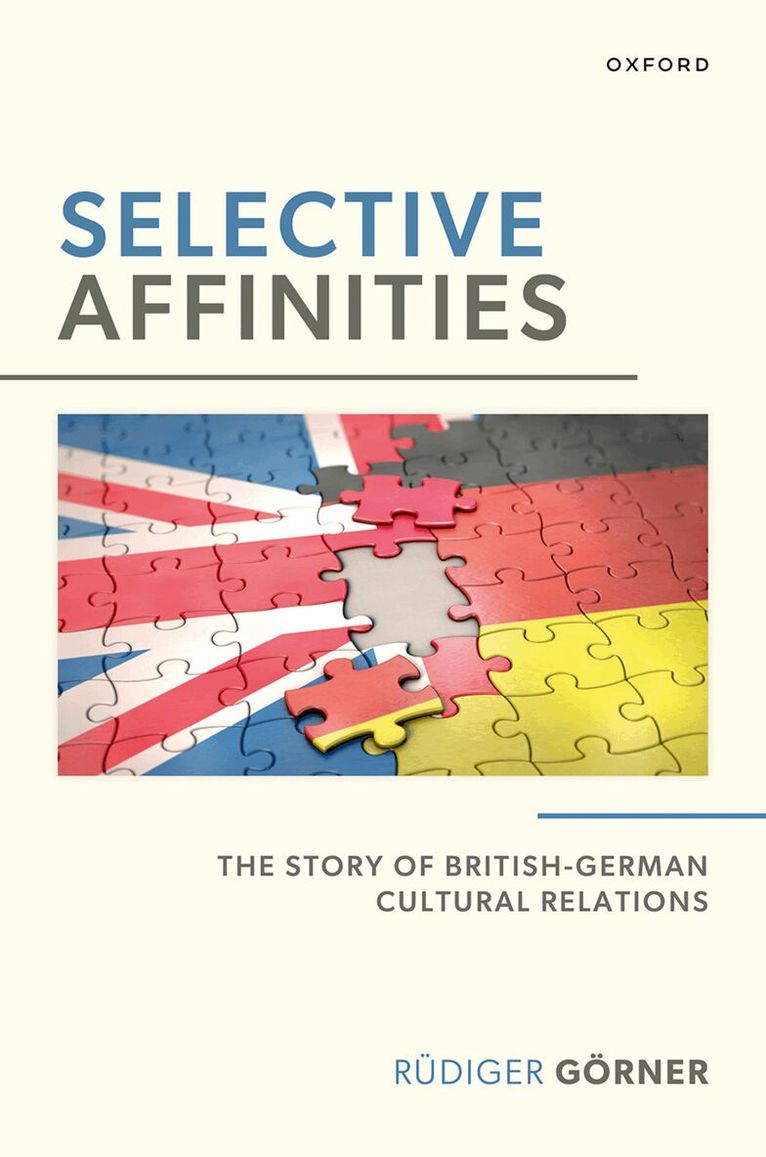
    Selective Affinities

    The Story of British-German Cultural Relations

    AvRüdiger Görner

    Inbunden, Engelska, 2026

    544 kr

    Kommande

    Beskrivning

    Selective Affinities offers in-depth insights into the formation, historical development, and present-day features of British-German cultural relations. Based on rarely considered source material, it tells the story of a uniquely rich relationship in cultural history and examines its synergies and controversies, its misunderstandings and the prejudices resulting from them. It discusses aspects of British Germanophobia and German Anglophilia with a particular focus on the nineteenth century, which influenced British-German relations into the twentieth century. The emphasis is on 'affinities' between British and Germanic culture throughout the last five centuries; at times they were too close for comfort but they were shaped by particular individuals who acted as 'transferants', or mediators, between both cultures. Accordingly, the work of artists, translators, and in some cases diplomats, takes centre stage, ranging from Hans Holbein the Younger, as the portraitist of the late Tudor period, to Michael Hamburger, the German-born exile poet and translator of Hölderlin and Celan. The role of German immigrants to Britain throughout the centuries but predominantly after 1933, is an integral part of the story; but so is the presence of English culture in Germany, first in the shape of the nineteenth-century traveller, or early tourist along the Rhine and Danube, and later, after 1919 and in particular after 1945, through the educational and organizational work of the British Occupation Forces. Ten years after the Brexit-referendum, Selective Affinities provides a balanced and analytical account of these strands in the cultural history of both countries with its fruitful ups and tragic downs that provide us with insightful pointers towards a continuation of these relations, once again in precarious times.

    Produktinformation

    • Utgivningsdatum:2026-11-19
    • Mått:156 x 234 x undefined mm
    • Format:Inbunden
    • Språk:Engelska
    • Antal sidor:560
    • Förlag:OUP OXFORD
    • ISBN:9780198824015

    Utforska kategorier

    • Konsthistoria inom Kultur
    • Litteraturvetenskap inom Skönlitteratur

    Mer om författaren

    Rüdiger Görner is Emeritus Centenary Professor of German with Comparative Literature at Queen Mary University of London and Founding Director of the Centre for Anglo-German Cultural Relations. Between 1999 and 2004, he was Director of the Institute of Germanic Studies where he founded the Ingeborg Bachmann Centre for Austrian Literature. He is member of the German Academy of Letters.

    Innehållsförteckning

    • A Personal Introduction Part I. Laying the Foundations 1: Towards a Definition of British-German Reciprocity, or Imaging the Other 2: Institutionalizing Cultural Relations? 3: Curious Beginnings 4: National Mythologies, Landscaping Nature (with Notes on the 'Englische Garten', the Square, and the Allotment) 5: In Praise of Translation Part II. Specifics 6: Some Musical Exchanges with the 'Land without Music' 7: Physics, Astronomy, and other Mutual Pursuits: From Newton to Herschel with Lichtenberg as Illuminator 8: The Enlightened Traveller 9: Brief Dramatic Interludes around 1800 10: British-German Romanticism and its European Implications 11: An Early Anticlimax: Heinrich Heine's English Fragments Part III. Victorian Highlights 12: German Shakespearianism: A Tale for All Seasons, followed by a comment on British Goetheanism 13: Victorian Engagement with the Land of Poets and Thinkers Part IV. Ruptures 14: Envy, Rivalry, Menaces: The Road to (Inevitable?) Disaster 15: 'On or about December 1910': Modernism as Anglo-German Difference 16: Entrenchments and a Role for Poetry in the Age of War Part V. Trauma and Transition 17: Anglo-German Roarings in the 1920s, a few Literary Echoes, and the Example of Hamburg 18: Harry Graf Kessler, and other Anglo-German Go-Betweens in the 1920s 19: Anglo-German Dubieties in the 1930s 20: Austrian and German Exiles in Britain: Cultural Fertilization by Default Part VI. "In my end is my beginning" 21: Emerging from the Ruins: Laying Foundations for Cultural Life after 1945 22: Renewed Mutuality? Anglo-German Perceptions in the (immediate) Post-War Period 23: German Popular Culture: Made in Britain? 24: The British-German Legacy in the Age of Brexit, or a Chance for a Breturn? Inconclusive Conclusions Bibliography