• Fri frakt över 249 kr
  • •
  • Snabba leveranser
  • •
  • Billiga böcker
Kundservice

Du är på sajten för privatpersoner.

Företag, bibliotek eller offentlig verksamhet?

Du handlar på classic.bokus.com, där alla dina funktioner finns intakta.
Till classic.bokus.com
Bokus logotyp. Gå till startsidan.
  • Erbjudanden
  • Nyheter
  • Student
  • Topplistor
  • Barn & ungdom
  • Bokus Play
  • E-böcker
  • Pocketböcker
  • Spel & pussel

10% rabatt på allt med kod NYSTART10 →

Sidfot

Mina sidor

    Hjälp

    • Kundservice
    • Vanliga frågor och svar
    • Frakt och leverans
    • Retur vid ångerrätt
    • Reklamera vara
    • Betalning
    • Köpvillkor
    • Allmänna villkor
    • Information om webbplatsens tillgänglighet

    Om Bokus

    • Om oss
    • Pressrum
    • För studenter
    • För företag
    • För bibliotek och offentlig verksamhet
    • För leverantörer
    • Hållbarhet

    Populärt

    • Aktuella erbjudanden
    • Presentkort
    • Studentlitteratur
    • Nya böcker
    • Topplistor
    • Signerade böcker
    • Engelska böcker

    Inspiration

    • Boktips
    • BookTok
    • Populära bokserier
    • Barnbokskaraktärer
    • Populära författare
    Logotyp för Bokus
    Följ oss på Facebook (extern länk)Följ oss på Instagram (extern länk)Följ oss på YouTube (extern länk)Följ oss på TikTok (extern länk)
    bokus @ CookiesAnpassa cookiesIntegritetspolicyKöpvillkor
    Till Citymail hemsida (extern länk)Till Budbee hemsida (extern länk)Till Postnord hemsida (extern länk)Till Schenker hemsida (extern länk)Till Early Bird hemsida (extern länk)Till Walleys hemsida (extern länk)
    1. Naturvetenskap och teknik
    2. Matematik och naturvetenskap
    3. Naturvetenskap:allmänt
    4. Populärvetenskap

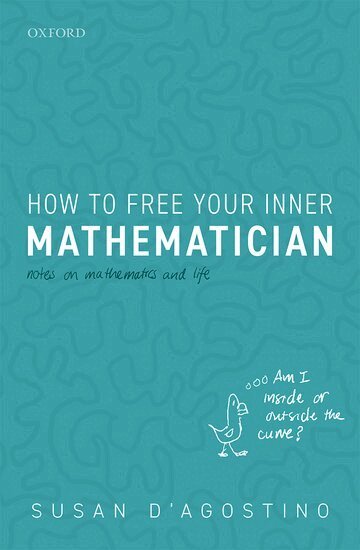
    How to Free Your Inner Mathematician

    Notes on Mathematics and Life

    AvSusan D'Agostino

    Inbunden, Engelska, 2020

    513 kr

    Beställningsvara. Skickas inom 7-10 vardagar. Fri frakt över 249 kr.

    Fler format och utgåvor

    E-bok

    347 kr

    E-bok

    347 kr

    Beskrivning

    How to Free Your Inner Mathematician: Notes on Mathematics and Life offers readers guidance in managing the fear, freedom, frustration, and joy that often accompany calls to think mathematically. With practical insight and years of award-winning mathematics teaching experience, D'Agostino offers more than 300 hand-drawn sketches alongside accessible descriptions of fractals, symmetry, fuzzy logic, knot theory, Penrose patterns, infinity, the Twin Prime Conjecture, Arrow's Impossibility Theorem, Fermat's Last Theorem, and other intriguing mathematical topics. Readers are encouraged to embrace change, proceed at their own pace, mix up their routines, resist comparison, have faith, fail more often, look for beauty, exercise their imaginations, and define success for themselves. Mathematics students and enthusiasts will learn advice for fostering courage on their journey regardless of age or mathematical background. How to Free Your Inner Mathematician delivers not only engaging mathematical content but provides reassurance that mathematical success has more to do with curiosity and drive than innate aptitude.

    Produktinformation

    • Utgivningsdatum:2020-03-26
    • Mått:136 x 202 x 23 mm
    • Vikt:534 g
    • Format:Inbunden
    • Språk:Engelska
    • Antal sidor:368
    • Förlag:OUP OXFORD
    • ISBN:9780198843597
    • Utmärkelser:Winner, 2023 Euler Book Prize, Mathematical Association of America

    Utforska kategorier

    • Populärvetenskap inom Naturvetenskap och teknik
    • Matematikens filosofi inom Naturvetenskap och teknik

    Mer om författaren

    Susan D'Agostino is a mathematician and writer whose essays have been published in Quanta Magazine, Scientific American, Financial Times, Nature, Undark, Times Higher Education, Chronicle of Higher Education, Math Horizons, Mathematics Teacher, and others. She earned her PhD in Mathematics from Dartmouth College, Master of Arts in Teaching Mathematics from Smith College, and BA in Anthropology from Bard College. She is a Council for the Advancement of Science Writing Taylor/Blakeslee Fellow at Johns Hopkins University. Her website is www.susandagostino.com and her Twitter handle is @susan_dagostino.

    Recensioner i media

    This is a popular book for those who want to learn about mathematics and mathematical thinking but have no mathematical background...Detailed solutions to the problems are provided

    Innehållsförteckning

    • 1: Mix up your routine, as cicadas with prime number cycles 2: Grow in accessible directions, like Voronoi diagrams 3: Rely on your reasoning abilities, because folded paper may reach the moon 4: Define success for yourself, given Arrow's Impossibility Theorem 5: Reach for the stars, just like Katherine Johnson 6: Find the right match, as with binary numbers and computers 7: Act natural, because of Benford's Law 8: Resist comparison, because of chaos theory 9: Look all around, as Archimedes did in life 10: Walk through the problem, as on the Konigsborg bridges 11: Untangle problems, with knot theory 12: Consider all options, as the shortest path between two points is not always straight 13: Look for beauty, because of Fibonacci numbers 14: Divide and conquer, just like Riemann sums in calculus 15: Embrace change, considering non-Euclidean geometry 16: Pursue an easier approach, considering the Pigeonhole Principle 17: Make an educated guess, like Kepler with his Sphere-packing Conjecture 18: Proceed at your own pace, because of terminal velocity 19: Pay attention to details, as Earth is an oblate spheroid 20: Join the community, with Hilbert's 23 problems 21: Search for like-minded math friends, because of the Twin Prime Conjecture 22: Abandon perfectionism, because of the Hairy Ball Theorem 23: Enjoy the pursuit, as Andrew Wiles did with Fermat's Last Theorem 24: Design your own pattern, because of the Penrose Patterns 25: Keep it simple whenever possible, since 26: Change your perspective, with Viviani's Theorem 27: Explore, on a Mobius strip 28: Be contradictory, because of the infinitude of primes 29: Cooperate when possible, because of game theory 30: Consider the less-travelled path, because of the Jordan Curve Theorem 31: Investigate, because of the golden rectangle 32: Be okay with small steps, as the harmonic series grows without bound 33: Work efficiently, like bacteriophages with icosahedral symmetry 34: Find the right balance, as in coding theory 35: Draw a picture, as in proofs without words 36: Incorporate nuance, because of fuzzy logic 37: Be grateful when solutions exist, because of Brouwer's Fixed Point Theorem 38: Update your understanding, with Bayesian statistics 39: Keep an open mind, because imaginary numbers exist 40: Appreciate the process, by taking a random walk 41: Fail more often, just like Albert Einstein did with 42: Get disoriented, on a Klein bottle 43: Go outside your realm of experience, on a hypercube 44: Follow your curiosity, along a space-filling curve 45: Exercise your imagination, with fractional dimensions 46: Proceed with care, because some infinities are larger than others