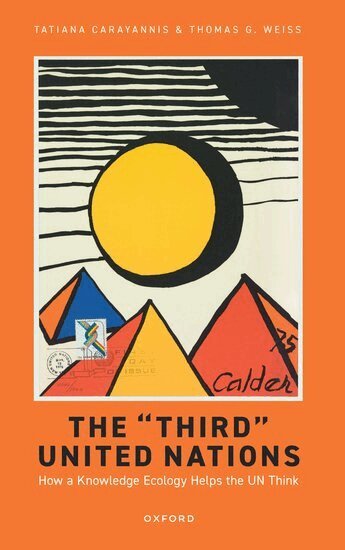
The 'Third' United Nations
How a Knowledge Ecology Helps the UN Think
AvTatiana Carayannis,Thomas G. Weiss
400 kr
Skickas . Fri frakt över 249 kr.
Du är på sajten för privatpersoner.
AvTatiana Carayannis,Thomas G. Weiss
400 kr
Skickas . Fri frakt över 249 kr.
Tatiana Carayannis is Director of the Social Science Research Council's Conflict Prevention and Peace Forum (CPPF) and Understanding Violent Conflict (UVC) program. She also leads the Council's China-Africa Knowledge Project and has a visiting appointment at the London School of Economics and Political Science's Africa Centre, where she also serves as a Research Director for the Centre for Public Authority and International Development (CPAID). Her publications include UN Voices: The Struggle for Development and Social Justice? (with T G Weiss, L Emmerij, and R Jolly, Indiana University Press, 2005), and Understanding the Central African Republic (with Louisa Lombard, Zed Book, 2015).Thomas G. Weiss is Presidential Professor of Political Science and Director Emeritus of the Ralph Bunche Institute for International Studies at The City University of New York's Graduate Center; he is also Co-Chair, Cultural Heritage at Risk Project, J. Paul Getty Trust; Distinguished Fellow, Global Governance, The Chicago Council on Global Affairs; and Eminent Scholar, Kyung Hee University, Korea. His most recent single-authored publications include Would the World Be Better without the UN? (Polity Press, 2018), What's Wrong with the United Nations and How to Fix It (Polity Press, 2016); and Humanitarian Intervention: Ideas in Action (Polity Press, 2016).
In this impressive book, the authors Tatiana Carayannis and Thomas G. Weiss remind us that the UN system cannot survive without the input and ideas of an array of independent thinkers and players and actors, including research centers, human rights experts, economists, consultants, digital networks, and specialists of all sorts who daily help the UN carry out its Charter obligations. Indeed, in many ways, the unheralded 'Third UN' serves as one of the great strengths of the world's most indispensable security body.
Du är på sajten för privatpersoner.
AvTatiana Carayannis,Thomas G. Weiss
400 kr
Skickas . Fri frakt över 249 kr.
Tatiana Carayannis is Director of the Social Science Research Council's Conflict Prevention and Peace Forum (CPPF) and Understanding Violent Conflict (UVC) program. She also leads the Council's China-Africa Knowledge Project and has a visiting appointment at the London School of Economics and Political Science's Africa Centre, where she also serves as a Research Director for the Centre for Public Authority and International Development (CPAID). Her publications include UN Voices: The Struggle for Development and Social Justice? (with T G Weiss, L Emmerij, and R Jolly, Indiana University Press, 2005), and Understanding the Central African Republic (with Louisa Lombard, Zed Book, 2015).Thomas G. Weiss is Presidential Professor of Political Science and Director Emeritus of the Ralph Bunche Institute for International Studies at The City University of New York's Graduate Center; he is also Co-Chair, Cultural Heritage at Risk Project, J. Paul Getty Trust; Distinguished Fellow, Global Governance, The Chicago Council on Global Affairs; and Eminent Scholar, Kyung Hee University, Korea. His most recent single-authored publications include Would the World Be Better without the UN? (Polity Press, 2018), What's Wrong with the United Nations and How to Fix It (Polity Press, 2016); and Humanitarian Intervention: Ideas in Action (Polity Press, 2016).
In this impressive book, the authors Tatiana Carayannis and Thomas G. Weiss remind us that the UN system cannot survive without the input and ideas of an array of independent thinkers and players and actors, including research centers, human rights experts, economists, consultants, digital networks, and specialists of all sorts who daily help the UN carry out its Charter obligations. Indeed, in many ways, the unheralded 'Third UN' serves as one of the great strengths of the world's most indispensable security body.