• Fri frakt över 249 kr
  • •
  • Snabba leveranser
  • •
  • Billiga böcker
Kundservice

Du är på sajten för privatpersoner.

Företag, bibliotek eller offentlig verksamhet?

Du handlar på classic.bokus.com, där alla dina funktioner finns intakta.
Till classic.bokus.com
Bokus logotyp. Gå till startsidan.
  • Erbjudanden
  • Nyheter
  • Student
  • Topplistor
  • Barn & ungdom
  • Bokus Play
  • E-böcker
  • Pocketböcker
  • Spel & pussel

10% studentrabatt med kod TERM26

Sidfot

Mina sidor

    Hjälp

    • Kundservice
    • Vanliga frågor och svar
    • Frakt och leverans
    • Retur vid ångerrätt
    • Reklamera vara
    • Betalning
    • Köpvillkor
    • Allmänna villkor
    • Information om webbplatsens tillgänglighet

    Om Bokus

    • Om oss
    • Pressrum
    • För studenter
    • För företag
    • För bibliotek och offentlig verksamhet
    • För leverantörer
    • Hållbarhet

    Populärt

    • Aktuella erbjudanden
    • Presentkort
    • Studentlitteratur
    • Nya böcker
    • Topplistor
    • Signerade böcker
    • Engelska böcker

    Inspiration

    • Boktips
    • BookTok
    • Populära bokserier
    • Barnbokskaraktärer
    • Populära författare
    Logotyp för Bokus
    Följ oss på Facebook (extern länk)Följ oss på Instagram (extern länk)Följ oss på YouTube (extern länk)Följ oss på TikTok (extern länk)
    bokus @ CookiesAnpassa cookiesIntegritetspolicyKöpvillkor
    Till Citymail hemsida (extern länk)Till Budbee hemsida (extern länk)Till Postnord hemsida (extern länk)Till Schenker hemsida (extern länk)Till Early Bird hemsida (extern länk)Till Walleys hemsida (extern länk)
    1. Historia och arkeologi
    2. Historia
    3. Historia: särskilda händelser och ämnen
    4. Kolonialism och imperialism

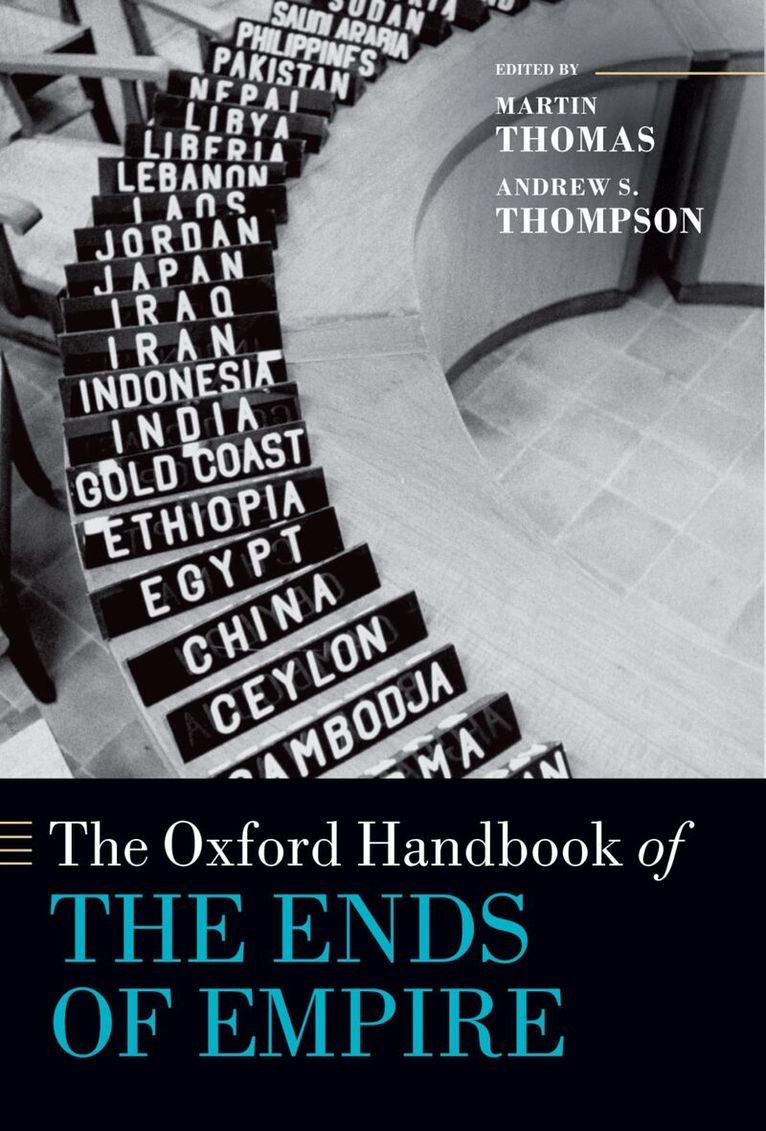
    The Oxford Handbook of the Ends of Empire

    AvMartin Thomas,Andrew Thompson

    Häftad, Engelska, 2023

    722 kr

    Beställningsvara. Skickas inom 5-8 vardagar. Fri frakt över 249 kr.

    Beskrivning

    The Oxford Handbook of the Ends of Empire offers the most comprehensive treatment of the causes, course, and consequences of the ends of empire in the twentieth century. The volume's contributors convey the global reach of decolonization, with chapters analysing the empires of Western Europe, Eastern Europe, China and Japan. The Handbook combines broad, regional treatments of decolonization with chapter contributions constructed around particular themes or social issues. It considers how the history of decolonization is being rethought as a result of the rise of the 'new' imperial history, and its emphasis on race, gender, and culture, as well as the more recent growth of interest in histories of globalization, transnational history, and histories of migration and diaspora, humanitarianism and development, and human rights.The Handbook, in other words, seeks to identify the processes and commonalities of experience that make decolonization a unique historical phenomenon with a lasting resonance. In light of decades of historical and social scientific scholarship on modernization, dependency, neo-colonialism, 'failed state' architectures and post-colonial conflict, the obvious question that begs itself is 'when did empires actually end?' In seeking to unravel this most basic dilemma the Handbook explores the relationship between the study of decolonization and the study of globalization. It connects histories of the late-colonial and post-colonial worlds, and considers the legacies of empire in European and formerly colonised societies.

    Produktinformation

    • Utgivningsdatum:2023-12-11
    • Mått:180 x 244 x 64 mm
    • Vikt:1 407 g
    • Format:Häftad
    • Språk:Engelska
    • Antal sidor:800
    • Förlag:OUP OXFORD
    • ISBN:9780198900948

    Utforska kategorier

    • Kolonialism och imperialism inom Historia och arkeologi
    • Allmän historia och världshistoria inom Historia och arkeologi
    • Nationell befrielse och självständighet inom Historia och arkeologi

    Mer om författaren

    Martin Thomas is Professor of Imperial History and Director of the Centre for Histories of Violence and Conflict at the University of Exeter. A specialist in the politics of contested decolonization, his most recent publications are Violence and Colonial Order: Police, Workers and Protest in the European Colonial Empires, 1918-1940 (2012), Fight or Flight: Britain, France, and their Roads from Empire (2014), and, with co-author Richard Toye, Arguing about Empire: Imperial Rhetoric in Britain and France (2017). He is an Independent Social Research Foundation Fellow and coordinator of a Leverhulme Trust research network, Understanding Insurgencies: Resonances from the Colonial Past.Andrew Thompson's previous publications include The Empire Strikes Back? The Impact of Imperialism on Britain from the Mid-Nineteenth Century (2005), Empire and Globalisation. Networks of People, Goods and Capital in the British World, c.1850-1914 (2010), and an edited collection, Britain's Experience of Empire in the Twentieth Century (2011). He is currently Professor of Global and Imperial History at the University of Oxford and Co-Director of the Oxford Centre for Global History. He is a Professorial Fellow of Nuffield College. He serves on the editorial boards of South African Historical Journal and Twentieth Century British History.

    Recensioner i media

    There are several overarching themes to the work: historicising decolonisation, unpicking the deeply complex relationship between decolonisation and globalisation - decolonisation was both a globalised and a globalising force, especially in the context of the Cold War - and shedding light upon the integral role played by asymmetric violence in decolonisation processes. This wide-ranging approach leads the reader on an odyssey through political thought, guerrilla warfare, architecture, cinema, and memory, to name but a few; bringing many diverse threads of research into a satisfyingly comprehensive volume

    Innehållsförteckning

    • Acknowledgements Introduction: Rethinking decolonization: A New Research Agenda for the 21st Century Robert Gerwarth: 1918 and the End of Europe's Land Empires Ryan Gingeras: An Empire Unredeemed: Tracing the Ottoman State's Path towards Collapse Part I: National Perspectives 1: Sarah E. Stockwell: Britain 2: Emmanuelle Saada: France: the longue durée of French Decolonization 3: Andreas Eckert: Germany 4: Nicola Labanca: Exceptional Italy? The Many Ends of the Italian Colonial Empire 5: Matthew G. Stanard: Après nous, le déluge: Belgium, Decolonization, and the Congo 6: Norrie MacQueen: Portugal 7: Alexey Miller: The Collapse of the Romanov Empire 8: Marc-William Palen: Empire by Imitation? US Economic Imperialism within a British World System 9: Louise Conrad Young: Rethinking Empire: Lessons from Imperial and Post Imperial Japan 10: Tehyun Ma: China Part II: Regional Perspectives 11: Joya Chatterji: Decolonization in South Asia: The Long View 12: Christopher Goscha: Global Wars and Decolonization in East and South East Asia, 1927-1954 13: Sylvie Thénault: The End of Empire in the Maghreb: The Common Heritage and Distinct Destinies of Morocco, Algeria, and Tunisia 14: Frederick Cooper: Decolonization in Tropical Africa 15: Spencer Mawby: The Caribbean 16: James Mark and Quinn Slobodian: Eastern Europe 17: Robert S. G. Fletcher: Decolonization and the Arid World 18: Marieke Bloembergen: The Open Ends of the Dutch Empire and the Indonesian Past: Sites, Scholarly Networks, and Moral Geographies of Greater India across Decolonization Part III: Thematic Perspectives 19: Brad Simpson: Self-determination and Decolonization 20: Christopher J. Lee: Anti-colonialism 21: Andrew Thompson: Unravelling the Relationships between Humanitarianism, Human Rights, and Decolonization: Time for a Radical Rethink? 22: Piero Gleijeses: Decolonization and Cold War 23: Martin Thomas: Violence, Insurgency, and Ends of Empire 24: Barbara Bush: Nationalism, Development, and Welfare Colonialism: Gender and the Dynamics of Decolonization 25: Miguel Bandeira Jerónimo: Repressive Developmentalism: Idioms, Repertoires, and Trajectories in Late Colonialism 26: David Motadel: Islamic Revolutionaries and the End of Empire 27: Panikos Panayi: Refugees and the End of Empire Part IV: Legacies and Memories 28: Elizabeth Buettner: Postcolonial Migrations to Europe 29: Joseph Morgan Hodge: Beyond Dependency: North-South Relationships in the Age of Development 30: Nicholas J. White: Imperial Business Interests, Decolonization and Post- Colonial Diversification 31: Paul Cooke: Film and the End of Empire: Deconstructing and Reconstructing Colonial Pasts and their Legacy in World Cinemas 32: Michael J. Parsons: Remnants of Empire 33: Charles Forsdick: Literature and Decolonization 34: Robert Aldrich: Apologies, Restitutions and Compensation: Making Reparations for Colonialism