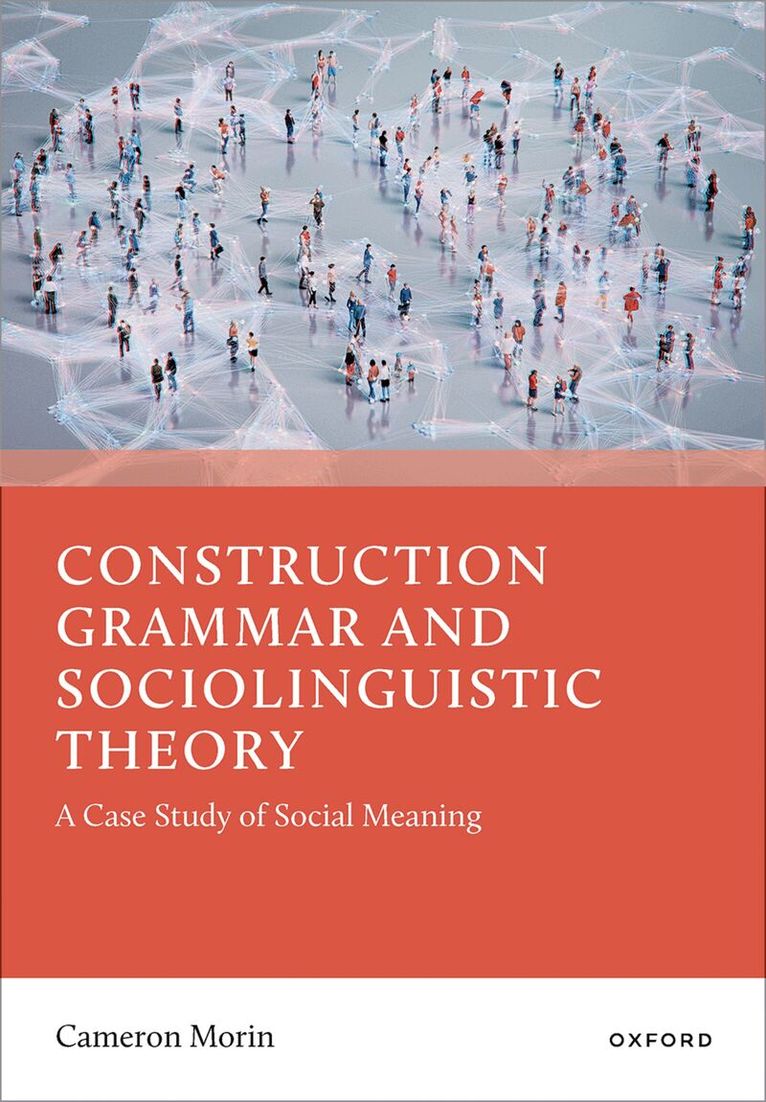
Inbunden, Engelska, 2027
Construction Grammar and Sociolinguistic Theory
1623 kr
Kommande
Beskrivning
This book brings two of the most influential frameworks in contemporary linguistics into systematic dialogue. Construction Grammar offers a powerful, non-modular cognitive model of language as a network of form-function pairings; variationist sociolinguistics offers an equally powerful account of language as a socially stratified, inherently variable system. Cameron Morin argues that the former is substantially enriched, both descriptively and theoretically, by the explicit modelling of 'social meaning' in constructions. At its core is a multidimensional model of constructional meaning that distinguishes semantic, pragmatic, and social dimensions, with social meaning further subdivided into interactional meaning (register, style, genre) and sociocultural meaning (identity, dialect, language variety). The model is tested in a triangulated empirical case study of double modal constructions (e.g. might could, will can) in dialects of British and American English, combining corpus-based computational sociolinguistics on large geolocated social media datasets with experimental fieldwork in Scotland, Northumberland, Northern Ireland, and Southeast England. The model is then deployed theoretically to resolve two long-standing metatheoretical puzzles: the tension between isomorphism and optionality in language, informed by the revised Principle of No Equivalence; and the constructionhood of phonemes and phonotactic patterns. A final computational study, using agent-based modelling, shows that the gradient social meaning of constructions and its stratification across speech communities can be predicted from a minimal set of usage-based principles: usage affecting grammar, salience, and co-adaptation. The book provides the foundations for an integrated sociocognitive theory of the linguistic system, and opens a number of avenues for future research at the intersection of cognitive linguistics and sociolinguistics.
Produktinformation
- Utgivningsdatum: 2027-01-31
- Mått: 156 x 234 x undefined mm
- Format: Inbunden
- Språk: Engelska
- Antal sidor: 320
- Förlag: OUP OXFORD
- ISBN: 9780198962311
Utforska kategorier
Betyg & recensioner
0 recensioner
Inga recensioner tillgängliga.