Cameron Morin – författare
Visar alla böcker från författaren . Handla med fri frakt och snabb leverans.
5 produkter
5 produkter
Inbunden, Engelska, 2027
1 576 kr
Kommande
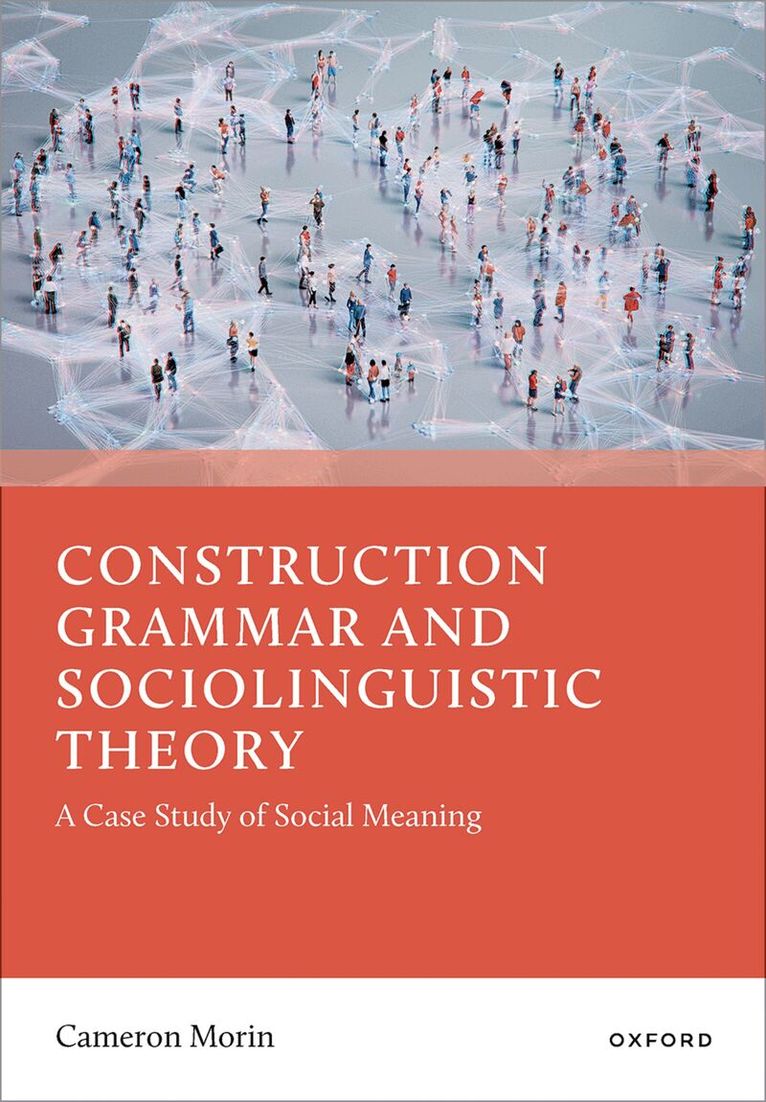
This book brings two of the most influential frameworks in contemporary linguistics into systematic dialogue. Construction Grammar offers a powerful, non-modular cognitive model of language as a network of form-function pairings; variationist sociolinguistics offers an equally powerful account of language as a socially stratified, inherently variable system. Cameron Morin argues that the former is substantially enriched, both descriptively and theoretically, by the explicit modelling of 'social meaning' in constructions. At its core is a multidimensional model of constructional meaning that distinguishes semantic, pragmatic, and social dimensions, with social meaning further subdivided into interactional meaning (register, style, genre) and sociocultural meaning (identity, dialect, language variety). The model is tested in a triangulated empirical case study of double modal constructions (e.g. might could, will can) in dialects of British and American English, combining corpus-based computational sociolinguistics on large geolocated social media datasets with experimental fieldwork in Scotland, Northumberland, Northern Ireland, and Southeast England. The model is then deployed theoretically to resolve two long-standing metatheoretical puzzles: the tension between isomorphism and optionality in language, informed by the revised Principle of No Equivalence; and the constructionhood of phonemes and phonotactic patterns. A final computational study, using agent-based modelling, shows that the gradient social meaning of constructions and its stratification across speech communities can be predicted from a minimal set of usage-based principles: usage affecting grammar, salience, and co-adaptation. The book provides the foundations for an integrated sociocognitive theory of the linguistic system, and opens a number of avenues for future research at the intersection of cognitive linguistics and sociolinguistics.
E-bok
Engelska, 2025268 kr
Läs direkt efter köp
Inbunden, Engelska, 2025
695 kr
Skickas inom 7-10 vardagar
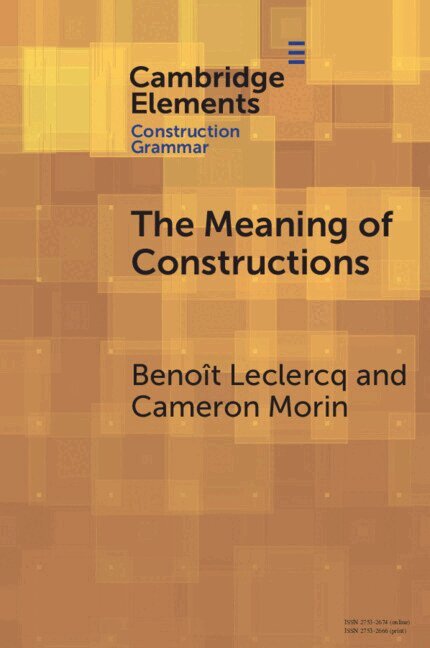
This Element offers a primer for the study of meaning in a Construction Grammar approach. It reviews the main principles of meaning shared across constructionist frameworks, including its ubiquity in grammatical structure, its usage-based formation, and its nature as the output of cognitive representations. It also reviews the importance given to meaning in construction-based explanations of sentence composition, innovative language use, and language change. Paradoxically, the Element shows that there is no systematic framework delineating the rich structure of constructional meaning, which has led to theoretical disagreements and inconsistencies. It therefore proposes an operational model of meaning for practitioners of Construction Grammar. It details the characteristics of a complex interface of semantic, pragmatic, and social meaning, and shows how this framework sheds light on recent theoretical issues. The Element concludes by considering ways in which this framework can be used for future descriptive and theoretical research questions.
E-bok
PDF, Engelska, 2025277 kr
Läs direkt efter köp
Häftad, Engelska, 2025
232 kr
Skickas inom 7-10 vardagar
This Element offers a primer for the study of meaning in a Construction Grammar approach. It reviews the main principles of meaning shared across constructionist frameworks, including its ubiquity in grammatical structure, its usage-based formation, and its nature as the output of cognitive representations. It also reviews the importance given to meaning in construction-based explanations of sentence composition, innovative language use, and language change. Paradoxically, the Element shows that there is no systematic framework delineating the rich structure of constructional meaning, which has led to theoretical disagreements and inconsistencies. It therefore proposes an operational model of meaning for practitioners of Construction Grammar. It details the characteristics of a complex interface of semantic, pragmatic, and social meaning, and shows how this framework sheds light on recent theoretical issues. The Element concludes by considering ways in which this framework can be used for future descriptive and theoretical research questions.