Benoît Leclercq - Böcker
Visar alla böcker från författaren Benoît Leclercq. Handla med fri frakt och snabb leverans.
4 produkter
4 produkter
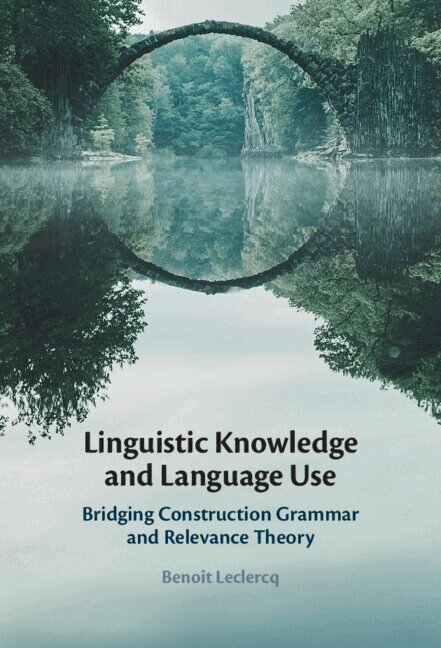
Linguistic Knowledge and Language Use
Bridging Construction Grammar and Relevance Theory
Inbunden, Engelska, 2023
1 295 kr
Skickas inom 7-10 vardagar
One of the key challenges in linguistics is to account for the link between linguistic knowledge and our use of language in a way that is both descriptively accurate and cognitively plausible. This pioneering book addresses these challenges by combining insights from Construction Grammar and Relevance Theory, two influential approaches which until now have been considered incompatible. After a clear and detailed presentation of both theories, the author demonstrates that their integration is possible, and explains why this integration is necessary, in order to understand exactly how meaning comes about. A new theoretical model is offered that provides ground-breaking insights into the semantics-pragmatic interface, and addresses a variety of topics including the nature of lexical and grammatical concepts, procedural meaning, coercion and idiom processing. This title is part of the Flip it Open Programme and may also be available Open Access. Check our website Cambridge Core for details.
Linguistic Knowledge and Language Use
Bridging Construction Grammar and Relevance Theory
Häftad, Engelska, 2026
319 kr
Skickas inom 7-10 vardagar
One of the key challenges in linguistics is to account for the link between linguistic knowledge and our use of language in a way that is both descriptively accurate and cognitively plausible. This pioneering book addresses these challenges by combining insights from Construction Grammar and Relevance Theory, two influential approaches which until now have been considered incompatible. After a clear and detailed presentation of both theories, the author demonstrates that their integration is possible, and explains why this integration is necessary, in order to understand exactly how meaning comes about. A new theoretical model is offered that provides ground-breaking insights into the semantics-pragmatic interface, and addresses a variety of topics including the nature of lexical and grammatical concepts, procedural meaning, coercion and idiom processing. This title is part of the Flip it Open Programme and may also be available Open Access. Check our website Cambridge Core for details.
705 kr
Skickas inom 7-10 vardagar
This Element offers a primer for the study of meaning in a Construction Grammar approach. It reviews the main principles of meaning shared across constructionist frameworks, including its ubiquity in grammatical structure, its usage-based formation, and its nature as the output of cognitive representations. It also reviews the importance given to meaning in construction-based explanations of sentence composition, innovative language use, and language change. Paradoxically, the Element shows that there is no systematic framework delineating the rich structure of constructional meaning, which has led to theoretical disagreements and inconsistencies. It therefore proposes an operational model of meaning for practitioners of Construction Grammar. It details the characteristics of a complex interface of semantic, pragmatic, and social meaning, and shows how this framework sheds light on recent theoretical issues. The Element concludes by considering ways in which this framework can be used for future descriptive and theoretical research questions.
228 kr
Skickas inom 7-10 vardagar
This Element offers a primer for the study of meaning in a Construction Grammar approach. It reviews the main principles of meaning shared across constructionist frameworks, including its ubiquity in grammatical structure, its usage-based formation, and its nature as the output of cognitive representations. It also reviews the importance given to meaning in construction-based explanations of sentence composition, innovative language use, and language change. Paradoxically, the Element shows that there is no systematic framework delineating the rich structure of constructional meaning, which has led to theoretical disagreements and inconsistencies. It therefore proposes an operational model of meaning for practitioners of Construction Grammar. It details the characteristics of a complex interface of semantic, pragmatic, and social meaning, and shows how this framework sheds light on recent theoretical issues. The Element concludes by considering ways in which this framework can be used for future descriptive and theoretical research questions.