• Fri frakt över 249 kr
  • •
  • Snabba leveranser
  • •
  • Billiga böcker
Kundservice

Du är på sajten för privatpersoner.

Företag, bibliotek eller offentlig verksamhet?

Du handlar på classic.bokus.com, där alla dina funktioner finns intakta.
Till classic.bokus.com
Bokus logotyp. Gå till startsidan.
  • Erbjudanden
  • Nyheter
  • Student
  • Topplistor
  • Barn & ungdom
  • Bokus Play
  • E-böcker
  • Pocketböcker
  • Spel & pussel

10% rabatt på allt med kod: NYSTART10 →

Sidfot

Mina sidor

    Hjälp

    • Kundservice
    • Vanliga frågor och svar
    • Frakt och leverans
    • Retur vid ångerrätt
    • Reklamera vara
    • Betalning
    • Köpvillkor
    • Allmänna villkor
    • Information om webbplatsens tillgänglighet

    Om Bokus

    • Om oss
    • Pressrum
    • För studenter
    • För företag
    • För bibliotek och offentlig verksamhet
    • För leverantörer
    • Hållbarhet

    Populärt

    • Aktuella erbjudanden
    • Presentkort
    • Studentlitteratur
    • Nya böcker
    • Topplistor
    • Signerade böcker
    • Engelska böcker

    Inspiration

    • Boktips
    • BookTok
    • Populära bokserier
    • Barnbokskaraktärer
    • Populära författare
    Logotyp för Bokus
    Följ oss på Facebook (extern länk)Följ oss på Instagram (extern länk)Följ oss på YouTube (extern länk)Följ oss på TikTok (extern länk)
    bokus @ CookiesAnpassa cookiesIntegritetspolicyKöpvillkor
    Till Citymail hemsida (extern länk)Till Budbee hemsida (extern länk)Till Postnord hemsida (extern länk)Till Schenker hemsida (extern länk)Till Early Bird hemsida (extern länk)Till Walleys hemsida (extern länk)
    1. Ekonomi och Ledarskap
    2. Nationalekonomi
    3. Internationell ekonomi

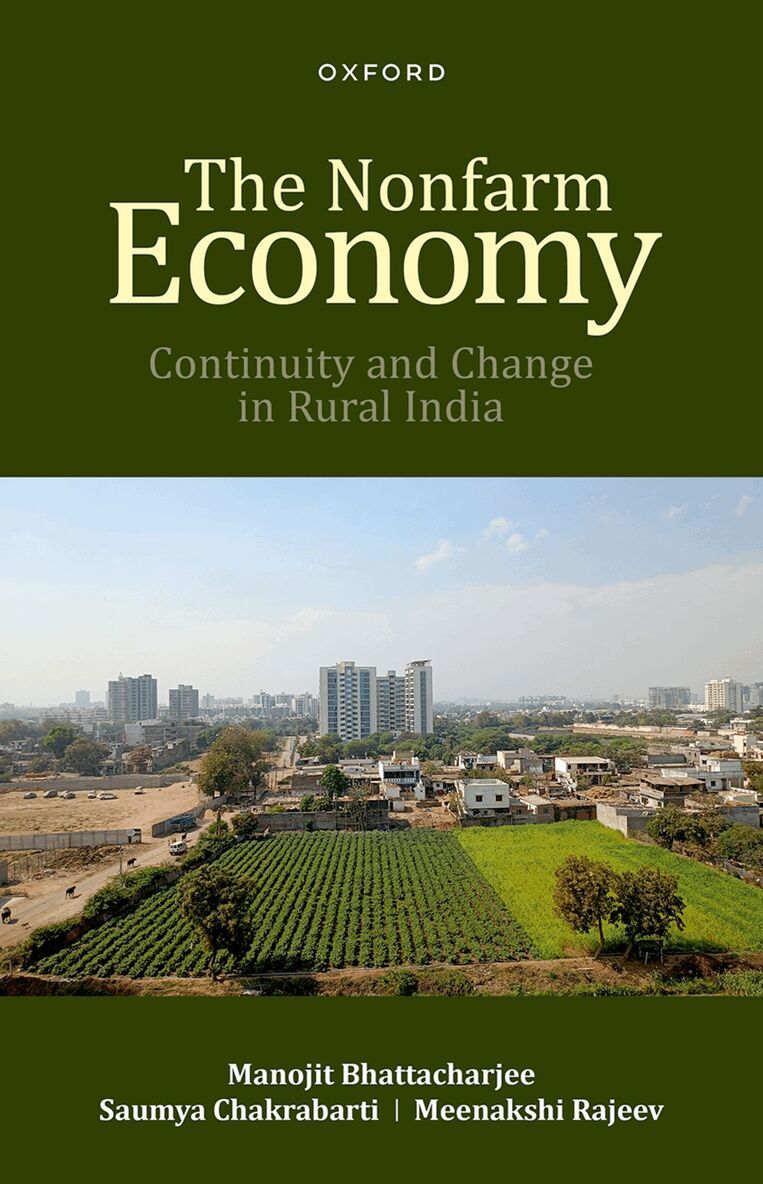
    The Nonfarm Economy

    Continuity and Change in Rural India

    AvManojit Bhattacharjee,Saumya Chakrabarti

    Inbunden, Engelska, 2026

    1 447 kr

    Beställningsvara. Skickas inom 7-10 vardagar. Fri frakt över 249 kr.

    Beskrivning

    The dominant discourse views the Indian economy's transformation over several decades as a progression towards a grand, unified, and dynamic market economy. Critiquing this discourse, The Nonfarm Economy illustrates the prevalence and intensification of 'structural dualism'. Using both theoretical and empirical perspectives, Bhattacharjee, Chakrabarti, and Rajeev analyse the origins of this persistence and the deepening of a dualistic developmental pattern. By studying the Indian rural economy and parts of the rural Global South, they demonstrate how the contemporary capital-centric growth process itself has induced the intensification of dualism, alongside factors such as population growth and land fragmentation. Only a limited segment of the impoverished population can integrate with the expanding circuits of capital using their skills, resources, and networks; a large mass of people is thus pushed towards dispossession and exclusion. The book further examines the effects of the COVID-19 pandemic on this development pattern, demonstrating how it has intensified the phenomenon of structural dualism. Contrary to the current prescriptions fixated on formal sector growth and policies extending government support, the authors posit a labour-focused (cluster-based) development model and offer constructive policy recommendations for achieving inclusive growth.

    Produktinformation

    • Utgivningsdatum:2026-04-26
    • Mått:140 x 20 x 216 mm
    • Vikt:445 g
    • Format:Inbunden
    • Språk:Engelska
    • Antal sidor:276
    • Förlag:OUP OXFORD
    • ISBN:9780198972020

    Utforska kategorier

    • Internationell ekonomi inom Ekonomi och Ledarskap
    • Ekonomiska system inom Ekonomi och Ledarskap
    • Miljöekonomi inom Ekonomi och Ledarskap

    Mer om författaren

    Manojit Bhattacharjee is an Assistant Professor at the Mahatma Gandhi Government Arts College, Mahe. With a PhD from the Institute for Social and Economic Change, Bangalore, he has previously taught at St. Joseph's College (Autonomous), Bangalore, and Jain University. His research focuses on the household credit market, insurance, and the farm and nonfarm sectors. He has authored numerous publications in journals and edited books, including the Journal of Asian Economics, Applied Economics Perspectives and Policy, Margin: The Journal of Applied Economic Research, Economic and Political Weekly, and others.Saumya Chakrabarti is a Professor of Economics and the Head of the Department of Economics and Politics at Visva-Bharati (University), Santiniketan. He has taught at St. Xavier's College, Kolkata; University of Calcutta; and Presidency University, Kolkata. Professor Chakrabarti has been a Visiting Fellow at Brown University, USA, and an Honorary Director at the Agro-Economic Research Centre (Government of India), Santiniketan. He has published in journals such as the Cambridge Journal of Economics, Review of Radical Political Economics, Economic and Labour Relations Review, Economic and Political Weekly, Indian Journal of Agricultural Economics, and Indian Journal of Labour Economics, and has written books published by Prentice Hall and Oxford University Press. He has travelled across several countries of the Global South and North and regularly contributes to popular journals and vernacular dailies.Meenakshi Rajeev is a Professor of Economics at the Department of Humanities and Social Sciences, Indian Institute of Technology, Jammu, and HAG Professor at the Centre for Economic Studies and Policy, Institute for Social and Economic Change, Bangalore. She graduated from IIT Kanpur in Statistics and holds a PhD in Economics from the Indian Statistical Institute (ISI), Kolkata. With over 100 publications in reputed journals and books, and as working papers, she has taught at the University of California (San Diego), Kassel University, and Central Michigan University. Her research focuses on game theoretic applications, banking and credit markets, farm and nonfarm sectors, and industrial economics. Professor Rajeev has served on several government committees and conducted research projects for the World Bank, Asian Development Bank, and the Governments of India and Karnataka. Recently, she has been a member of the task force that helped formulate Karnataka's research and development (R&D) policy.

    Recensioner i media

    This extraordinary book illuminates in a coherent manner, imaginatively combining data with formal modelling, that dark corner of development economics called the 'nonfarm' informal economy. Although India is the primary focus, many developing countries and regions across the globe find their place in the comparative analysis. It is an extremely valuable addition to the development literature and should be on the essential reading list of students, researchers and practitioners concerned with development studies and problems.

    Innehållsförteckning

    • 1: Introduction 2: Capitalist Growth and the Proliferation of Dualism: A Theoretical Framework 3: The Changing Nature of the Global Rural Economy 4: Rural Economies of the Developing World: Micro Perspectives 5: The Rural Nonfarm Sector in India: Imprints of Deepening Dualism 6: The State of the Agricultural Sector and Its Implications for the Rural Nonfarm Economy 7: The COVID-19 Pandemic and Its Impact on the Rural Economy 8: Conclusions and Policy Suggestions