• Fri frakt över 249 kr
  • •
  • Snabba leveranser
  • •
  • Billiga böcker
Kundservice

Du är på sajten för privatpersoner.

Företag, bibliotek eller offentlig verksamhet?

Du handlar på classic.bokus.com, där alla dina funktioner finns intakta.
Till classic.bokus.com
Bokus logotyp. Gå till startsidan.
  • Erbjudanden
  • Student
  • Topplistor
  • Barn & ungdom
  • Bokus Play
  • E-böcker
  • Ljudböcker
  • Pocketböcker
  • Spel och pussel

Skapa nya rutiner – hälsoböcker upp till 50% →

Sidfot

Mina sidor

    Hjälp

    • Kundservice
    • Vanliga frågor och svar
    • Frakt och leverans
    • Retur vid ångerrätt
    • Reklamera vara
    • Betalning
    • Köpvillkor
    • Allmänna villkor
    • Information om webbplatsens tillgänglighet

    Om Bokus

    • Om oss
    • Pressrum
    • För studenter
    • För företag
    • För bibliotek och offentlig verksamhet
    • För leverantörer
    • Hållbarhet

    Populärt

    • Aktuella erbjudanden
    • Presentkort
    • Studentlitteratur
    • Nya böcker
    • Topplistor
    • Signerade böcker
    • Engelska böcker

    Inspiration

    • Boktips
    • BookTok
    • Barnbokskaraktärer
    • Populära författare
    Logotyp för Bokus
    Följ oss på Facebook (extern länk)Följ oss på Instagram (extern länk)Följ oss på YouTube (extern länk)Följ oss på TikTok (extern länk)
    bokus @ CookiesAnpassa cookiesIntegritetspolicyKöpvillkor
    Till Citymail hemsida (extern länk)Till Budbee hemsida (extern länk)Till Postnord hemsida (extern länk)Till Schenker hemsida (extern länk)Till Early Bird hemsida (extern länk)Till Walleys hemsida (extern länk)
    1. Ekonomi och Ledarskap
    2. Nationalekonomi
    3. Miljöekonomi

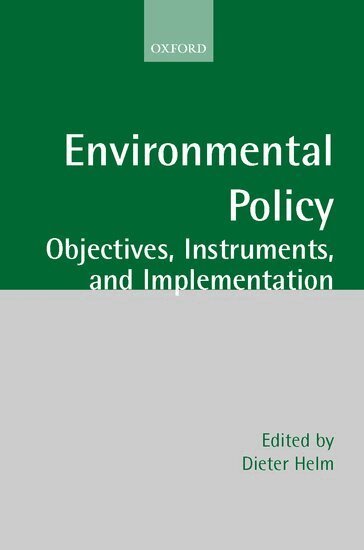
    Environmental Policy

    Objectives, Instruments, and Implementation

    AvDieter Helm

    Häftad, Engelska, 2000

    867 kr

    Beställningsvara. Skickas inom 5-8 vardagar. Fri frakt över 249 kr.

    Beskrivning

    The twentieth century witnessed unparalleled economic growth among developed countries, largely based upon the exploitation of fossil fuels, and unparalleled population growth in developing countries. These broad trends in turn did massive damage to the environment. Biodiversity has suffered its biggest reverse since the last great extinctions in geological time, and the burning of fossil fuels has begun to change our climate. But it was only at the end of the century that environmental concerns were transformed from a narrow sectional interest, moving to the centre-stage of government, and on to the main agendas of companies. Once a minority interest, the environment now commands the attention of ministers, chief executives, and consumers in the supermarket. Party manifestos proclaim the greenness of politicians, companies produce environmental reports, and shoppers opt for organic food and avoid genetically modified products. This volume focuses on the practical design of economic instruments for environmental policy. It is divided into three parts: the overarching policy context; the choice of policy instruments; and applications to the main sectors of the economy.

    Produktinformation

    • Utgivningsdatum:2000-11-30
    • Mått:156 x 235 x 18 mm
    • Vikt:522 g
    • Format:Häftad
    • Språk:Engelska
    • Antal sidor:342
    • Förlag:OUP OXFORD
    • ISBN:9780199241361

    Utforska kategorier

    • Miljöekonomi inom Ekonomi och Ledarskap
    • Miljövetenskap och miljöpolitik inom Naturvetenskap och teknik

    Mer om författaren

    Dieter Helm is a member of the DTIs Energy Advisory Panel and chairman of the DETRs Academic Panel. He is an Associate Editor of the Oxford Review of Economic Policy and editor of The Utilities Journal. He has advised government and industry in the UK, USA, New Zealand, Japan, the Czech Republic, Hungary, Ireland, Argentina, Germany, and France.

    Innehållsförteckning

    • Part 1 Principles: Dieter Helm, objectives, instruments, and institutions; David Pearce, costbenefit analysis; stephen smith, environmental and public finance aspects of the taxation of energy; Giles Atkinson, sustainable development and policy; Anthony Heyes, making things stick - enforcement and compliance. Part 2 Policy; Scott Barrett, political economy of the Kyoto Protocol; David Macdonald, bartering biodiversity - what are the options?. Part 3 Sectors: Simon Cowan, water pollution and abstraction and economic instruments; Ian Hodge, agri-environmental policy - a UK perspective; Chris Nash, transport and the environment; Jane Powell and Inger Brisson, landfill levy.