• Fri frakt över 249 kr
  • •
  • Snabba leveranser
  • •
  • Billiga böcker
Kundservice

Du är på sajten för privatpersoner.

Företag, bibliotek eller offentlig verksamhet?

Du handlar på classic.bokus.com, där alla dina funktioner finns intakta.
Till classic.bokus.com
Bokus logotyp. Gå till startsidan.
  • Erbjudanden
  • Nyheter
  • Student
  • Topplistor
  • Barn & ungdom
  • Bokus Play
  • E-böcker
  • Pocketböcker
  • Spel & pussel

10% rabatt på allt med kod: NYSTART10 →

Sidfot

Mina sidor

    Hjälp

    • Kundservice
    • Vanliga frågor och svar
    • Frakt och leverans
    • Retur vid ångerrätt
    • Reklamera vara
    • Betalning
    • Köpvillkor
    • Allmänna villkor
    • Information om webbplatsens tillgänglighet

    Om Bokus

    • Om oss
    • Pressrum
    • För studenter
    • För företag
    • För bibliotek och offentlig verksamhet
    • För leverantörer
    • Hållbarhet

    Populärt

    • Aktuella erbjudanden
    • Presentkort
    • Studentlitteratur
    • Nya böcker
    • Topplistor
    • Signerade böcker
    • Engelska böcker

    Inspiration

    • Boktips
    • BookTok
    • Populära bokserier
    • Barnbokskaraktärer
    • Populära författare
    Logotyp för Bokus
    Följ oss på Facebook (extern länk)Följ oss på Instagram (extern länk)Följ oss på YouTube (extern länk)Följ oss på TikTok (extern länk)
    bokus @ CookiesAnpassa cookiesIntegritetspolicyKöpvillkor
    Till Citymail hemsida (extern länk)Till Budbee hemsida (extern länk)Till Postnord hemsida (extern länk)Till Schenker hemsida (extern länk)Till Early Bird hemsida (extern länk)Till Walleys hemsida (extern länk)
    1. Filosofi och religion
    2. Filosofi
    3. Filosofiska discipliner

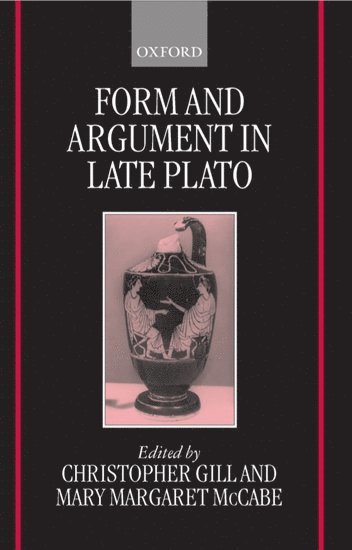
    Form and Argument in Late Plato

    AvGill,McCabe

    Häftad, Engelska, 2000

    1 099 kr

    Beställningsvara. Skickas inom 5-8 vardagar. Fri frakt över 249 kr.

    Beskrivning

    Why did Plato put his philosophical arguments into dialogues, rather than presenting them in a plain and readily understandable fashion? In writing rich tales of philosophical encounters, does Plato desert clarity in favour of seducing his readers with fine words, or is there a philosophical reason behind the form of his argument? While recent work has focused on the literary brilliance of the early dialogues, the late dialogues present a particular problem: they lack the vivid literary character of Plato's earlier works, and the dialogue structure seems to be a mere formality. Is there a philosophical reason why Plato's late works are in the form of dialogues? In this volume, a group of internationally prominent scholars address that question. Their answers are fresh, varied, and powerfully argued. This volume offers both a series of first-class essays on major late Platonic dialogues and a discussion which has important implications for the study of philosophical method and the relation between philosophy and literature. It shows that the literary form and modes of dialectic of the late dialogues are richly rewarding to study, and that doing so is of deep importance for Plato's philosophical project.

    Produktinformation

    • Utgivningsdatum:2000-09-07
    • Mått:137 x 215 x 20 mm
    • Vikt:426 g
    • Format:Häftad
    • Språk:Engelska
    • Antal sidor:358
    • Förlag:Clarendon Press
    • ISBN:9780199241422

    Utforska kategorier

    • Filosofiska discipliner inom Filosofi och religion
    • Språkvetenskap och lingvistik inom Språk och ordböcker
    • Litteraturvetenskap inom Skönlitteratur

    Mer om författaren

    Christopher Gill is Professor of Ancient Thought at the University of Exeter. He is the editor of The Person and the Human Mind: Issues in Ancient and Modern Philosophy (OUP, 1990) and the author of Personality in Greek Epic, Tragedy, and Philosophy: The Self in Dialogue (OUP, 1996). Mary Margaret McCabe is Professor of Philosophy at King's College London. She is the author of Plato on Punishment (Berkeley, 1981), and Plato's Individuals (Princeton, 1994).

    Recensioner i media

    The contents of this volume are likely to provide much material for future discussions of late Plato. Bryn Mawr Classical Review