• Fri frakt över 249 kr
  • •
  • Snabba leveranser
  • •
  • Billiga böcker
Kundservice

Du är på sajten för privatpersoner.

Företag, bibliotek eller offentlig verksamhet?

Du handlar på classic.bokus.com, där alla dina funktioner finns intakta.
Till classic.bokus.com
Bokus logotyp. Gå till startsidan.
  • Erbjudanden
  • Student
  • Topplistor
  • Barn & ungdom
  • Bokus Play
  • E-böcker
  • Ljudböcker
  • Pocketböcker
  • Spel & pussel

Upp till 25% på utvalda nyheter →

Sidfot

Mina sidor

    Hjälp

    • Kundservice
    • Vanliga frågor och svar
    • Frakt och leverans
    • Retur vid ångerrätt
    • Reklamera vara
    • Betalning
    • Köpvillkor
    • Allmänna villkor
    • Information om webbplatsens tillgänglighet

    Om Bokus

    • Om oss
    • Pressrum
    • För studenter
    • För företag
    • För bibliotek och offentlig verksamhet
    • För leverantörer
    • Hållbarhet

    Populärt

    • Aktuella erbjudanden
    • Presentkort
    • Studentlitteratur
    • Nya böcker
    • Topplistor
    • Signerade böcker
    • Engelska böcker

    Inspiration

    • Boktips
    • BookTok
    • Populära bokserier
    • Barnbokskaraktärer
    • Populära författare
    Logotyp för Bokus
    Följ oss på Facebook (extern länk)Följ oss på Instagram (extern länk)Följ oss på YouTube (extern länk)Följ oss på TikTok (extern länk)
    bokus @ CookiesAnpassa cookiesIntegritetspolicyKöpvillkor
    Till Citymail hemsida (extern länk)Till Budbee hemsida (extern länk)Till Postnord hemsida (extern länk)Till Schenker hemsida (extern länk)Till Early Bird hemsida (extern länk)Till Walleys hemsida (extern länk)
    1. Filosofi och religion
    2. Filosofi
    3. Filosofiska discipliner

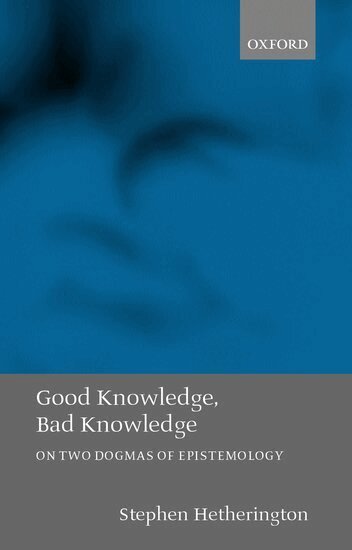
    Good Knowledge, Bad Knowledge

    On Two Dogmas of Epistemology

    AvStephen Hetherington

    Inbunden, Engelska, 2001

    1 027 kr

    Beställningsvara. Skickas inom 5-8 vardagar. Fri frakt över 249 kr.

    Beskrivning

    What is knowledge? How hard is it for a person to have knowledge? Good Knowledge, Bad Knowledge confronts contemporary philosophical attempts to answer those classic questions, by identifying and arguing against two fundamental epistemological presumptions. Can there be both better and worse knowledge of some fact? Can you improve your knowledge of a particular fact? Can there be especially bad knowledge of a specific fact? Epistemologists routinely answer these questions with a resounding 'No'. But Stephen Hetherington argues that those standard answers are mistaken. The result is a theory of knowledge that is unique in conceiving of knowledge in a non-absolutist way. The theory offers new solutions to many traditional epistemological puzzles, including various kinds of scepticism, the Gettier challenge, and the problem of the criterion. It also offers a fresh way of using G. E. Moore's anti-sceptical gambit, along with reinterpretations of the epistemic roles of fallibility, luck, relevance, and dogmatism. And what can we know about knowledge? The role of intuition in shaping epistemological thought about knowledge is critically examined. Anyone working on epistemology will enjoy this original and challenging work.

    Produktinformation

    • Utgivningsdatum:2001-10-18
    • Mått:145 x 224 x 17 mm
    • Vikt:378 g
    • Format:Inbunden
    • Språk:Engelska
    • Antal sidor:220
    • Förlag:OUP OXFORD
    • ISBN:9780199247349

    Utforska kategorier

    • Filosofiska discipliner inom Filosofi och religion

    Mer om författaren

    Stephen Hetherington is Associate Professor of Philosophy at the University of New South Wales, Australia.

    Recensioner i media

    'Good Knowledge, Bad Knowledge is an interesting and provocative book, defending novel views about a wide range of issues in contemporary epistemology. It is written in a clear and straightforward manner, and is devoid of unnecessary technicalities. Hetherington is always clear about what he is arguing for and candid about what he thinks he has established and what he has not. I found it to be an enjoyable book to read.'

    Innehållsförteckning

    • 1. Epistemic absolutism ; 2. Scepticism ; 3. Gettier cases ; 4. Minimal knowledge ; 5. The spectrum of knowledge ; 6. Knowledge about knowledge ; References, Index