• Fri frakt över 249 kr
  • •
  • Snabba leveranser
  • •
  • Billiga böcker
Kundservice

Du är på sajten för privatpersoner.

Företag, bibliotek eller offentlig verksamhet?

Du handlar på classic.bokus.com, där alla dina funktioner finns intakta.
Till classic.bokus.com
Bokus logotyp. Gå till startsidan.
  • Erbjudanden
  • Student
  • Topplistor
  • Barn & ungdom
  • Bokus Play
  • E-böcker
  • Ljudböcker
  • Pocketböcker
  • Spel och pussel

Pocketfynda! Hundratals böcker för 49 kr/st →

Sidfot

Mina sidor

    Hjälp

    • Kundservice
    • Vanliga frågor och svar
    • Frakt och leverans
    • Retur vid ångerrätt
    • Reklamera vara
    • Betalning
    • Köpvillkor
    • Allmänna villkor
    • Information om webbplatsens tillgänglighet

    Om Bokus

    • Om oss
    • Pressrum
    • För studenter
    • För företag
    • För bibliotek och offentlig verksamhet
    • För leverantörer
    • Hållbarhet

    Populärt

    • Aktuella erbjudanden
    • Presentkort
    • Studentlitteratur
    • Nya böcker
    • Topplistor
    • Signerade böcker
    • Engelska böcker

    Inspiration

    • Boktips
    • BookTok
    • Barnbokskaraktärer
    • Populära författare
    Logotyp för Bokus
    Följ oss på Facebook (extern länk)Följ oss på Instagram (extern länk)Följ oss på YouTube (extern länk)Följ oss på TikTok (extern länk)
    bokus @ CookiesAnpassa cookiesIntegritetspolicyKöpvillkor
    Till Citymail hemsida (extern länk)Till Budbee hemsida (extern länk)Till Postnord hemsida (extern länk)Till Schenker hemsida (extern länk)Till Early Bird hemsida (extern länk)Till Walleys hemsida (extern länk)
    1. Ekonomi och Ledarskap
    2. Nationalekonomi
    3. Makroekonomi

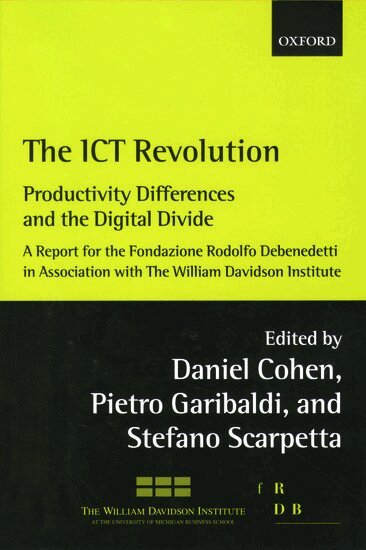
    The ICT Revolution

    Productivity Differences and the Digital Divide

    AvCohen,Garibaldi

    Häftad, Engelska, 2004

    778 kr

    Beställningsvara. Skickas inom 5-8 vardagar. Fri frakt över 249 kr.

    Beskrivning

    The view that the Internet and the information and communication technology (ICT) revolution would deliver a frictionless economy without recessions is, at least for the time being, dead. This book takes stock of the ICT revolution, going well below the surface to ask and answer a few key questions: Did the ICT revolution contribute to the recent divergence in the growth record? And if this is the case, how and why were some countries better equipped to exploit the potential of ICT? The naïve approach to the Internet views e-commerce as a means to achieve a perfect world of competition. By making information cheap and readily available, it should allow the affluent consumer to raise competitive pressure on firms, help the firms themselves to put competitive pressure on their own suppliers, and so on. For the poor countries, the story goes, the Internet should lower the barriers to entry to rich countries' markets, and foster their inclusion in world markets. However, the theory of economic geography does not support the idea that geography becomes irrelevant as the cost of distance is reduced. Instead, when investigating the impact of the first communication revolution in the nineteenth century, we observe quite the opposite trend. Rather than fostering the forces of "dispersion" across the location of economic activity, railways, the telegraph, and the telephone have produced instead an extraordinary concentration of economic activities: the forces of "concentration" have been much more powerful than the forces of dispersion. Understanding the new forces of agglomeration and the forces of dispersion in the new Internet economy is one of the major themes of this book.Drawing on a wide range of data, it assembles the work of two teams of leading economists in the ICT field. Part 1, the work of the first team, focuses on the role that the ICT revolution played in advanced countries to grow output and productivity at macro, industry, and firm levels. Part 2, the work of the second team, assesses whether or not the digital economy will indeed result in a more competitive and more equal world.

    Produktinformation

    • Utgivningsdatum:2004-01-01
    • Mått:156 x 233 x 16 mm
    • Vikt:421 g
    • Format:Häftad
    • Språk:Engelska
    • Antal sidor:290
    • Förlag:OUP OXFORD
    • ISBN:9780199270118

    Utforska kategorier

    • Makroekonomi inom Ekonomi och Ledarskap
    • Media och underhållning inom Ekonomi och Ledarskap
    • Affärsförhandlingar inom Ekonomi och Ledarskap

    Mer om författaren

    Daniel Cohen is a Research fellow and former co-director of the International macroeconomy programme at the CEPR, and Research fellow at CEPREMAP, Paris. He has been a Consultant at the World Bank (1984-1994) and the IMF (2001 and 2002), and was a Visiting fellow at Harvard University in 1981-82 and 1983-84.Pietro Garibaldi is the Head of Labour Studies at the Fondazione Rdolfo Debenedetti, Research fellow in the Labour Economics programme at the CEPR, Research Fellow at the IZA in Bonn, Research fellow at Igier, Milan, and Consultant on Labour Issues for the Italian Ministry of the Economy and Finance. He has been a Consultant at the World Bank (1999; 2002) and the IMF (2000; 2001), and was an Economist at the IMF from 1996 to 1999.Stefano Scarpetta is the Labor Market Adviser at the World Bank, responsible for leading research, policy, and operational support activities in a variety of areas including the setting of a common framework for studying labor market systems, the impact of labor and product market regulations on economic performance and the effectiveness of labor market policies. Prior to joining the World Bank, he was in charge of the OECD Growth project, and prior to this of the OECD Jobs Strategy project.

    Innehållsförteckning

    • PART I: THE SPREAD OF ICT AND PRODUCTIVITY GROWTH: IS EUROPE REALLY LAGGING BEHIND IN THE NEW ECONOMY?; PART II: INTERNET: THE ELUSIVE QUEST FOR A FRICTIONLESS ECONOMY; CONCLUSION