• Fri frakt över 249 kr
  • •
  • Snabba leveranser
  • •
  • Billiga böcker
Kundservice

Du är på sajten för privatpersoner.

Företag, bibliotek eller offentlig verksamhet?

Du handlar på classic.bokus.com, där alla dina funktioner finns intakta.
Till classic.bokus.com
Bokus logotyp. Gå till startsidan.
  • Erbjudanden
  • Nyheter
  • Student
  • Topplistor
  • Barn & ungdom
  • Bokus Play
  • E-böcker
  • Pocketböcker
  • Spel & pussel

10% rabatt på allt med kod NYSTART10 →

Sidfot

Mina sidor

    Hjälp

    • Kundservice
    • Vanliga frågor och svar
    • Frakt och leverans
    • Retur vid ångerrätt
    • Reklamera vara
    • Betalning
    • Köpvillkor
    • Allmänna villkor
    • Information om webbplatsens tillgänglighet

    Om Bokus

    • Om oss
    • Pressrum
    • För studenter
    • För företag
    • För bibliotek och offentlig verksamhet
    • För leverantörer
    • Hållbarhet

    Populärt

    • Aktuella erbjudanden
    • Presentkort
    • Studentlitteratur
    • Nya böcker
    • Topplistor
    • Signerade böcker
    • Engelska böcker

    Inspiration

    • Boktips
    • BookTok
    • Populära bokserier
    • Barnbokskaraktärer
    • Populära författare
    Logotyp för Bokus
    Följ oss på Facebook (extern länk)Följ oss på Instagram (extern länk)Följ oss på YouTube (extern länk)Följ oss på TikTok (extern länk)
    bokus @ CookiesAnpassa cookiesIntegritetspolicyKöpvillkor
    Till Citymail hemsida (extern länk)Till Budbee hemsida (extern länk)Till Postnord hemsida (extern länk)Till Schenker hemsida (extern länk)Till Early Bird hemsida (extern länk)Till Walleys hemsida (extern länk)
    1. Språk och ordböcker
    2. Språkvetenskap och lingvistik

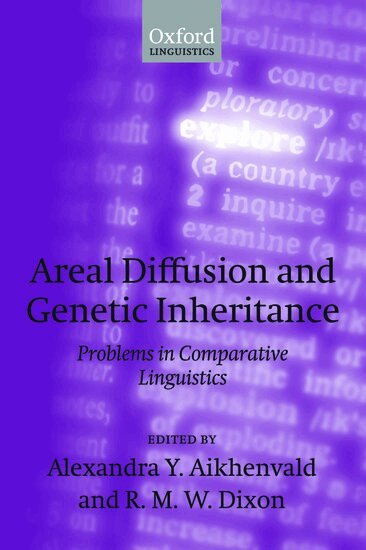
    Areal Diffusion and Genetic Inheritance

    Problems in Comparative Linguistics

    AvAlexandra Y. Aikhenvald,R. M. W. Dixon

    Häftad, Engelska, 2006

    Del i serien Explorations in Linguistic Typology

    1 234 kr

    Beställningsvara. Skickas inom 5-8 vardagar. Fri frakt över 249 kr.

    Beskrivning

    Two languages can resemble each other in the categories, constructions, and types of meaning they use; and in the forms they employ to express these. Such resemblances may be the consequence of universal characteristics of language, of chance or coincidence, of the borrowing by one language of another's words, or of the diffusion of grammatical, phonetic, and phonological characteristics that takes place when languages come into contact. Languages sometimes show likeness because they have borrowed not from each other but from a third language. Languages that come from the same ancestor may have similar grammatical categories and meanings expressed by similar forms: such languages are said to be genetically affiliated. This book considers how and why forms and meanings of different languages at different times may resemble one another. Its editors and authors aim (a) to explain and identify the relationship between areal diffusion and the genetic development of languages, and (b) to discover the means of distinguishing what may cause one language to share the characteristics of another. The introduction outlines the issues that underlie these aims, introduces the chapters which follow, and comments on recurrent conclusions by the contributors. The problems are formidable and the pitfalls numerous: for example, several of the authors draw attention to the inadequacy of the family tree diagram as the main metaphor for language relationship. The authors range over Ancient Anatolia, Modern Anatolia, Australia, Amazonia, Oceania, Southeast and East Asia, and Sub-Saharan Africa. The book includes an archaeologist's view on what material evidence offers to explain cultural and linguistic change, and a general discussion of which kinds of linguistic feature can and cannot be borrowed. The chapters are accessibly-written and illustrated by twenty maps. The book will interest all students of the causes and consequences of language change and evolution.

    Produktinformation

    • Utgivningsdatum:2006-03-02
    • Mått:156 x 234 x 26 mm
    • Vikt:711 g
    • Format:Häftad
    • Språk:Engelska
    • Serie:Explorations in Linguistic Typology
    • Antal sidor:470
    • Förlag:OUP OXFORD
    • ISBN:9780199283088

    Utforska kategorier

    • Språkvetenskap och lingvistik inom Språk och ordböcker

    Mer om författaren

    Alexandra Y. Aikhenvald is Professor and Associate Director of the Research Centre for Linguistic Typology at La Trobe University. She has worked on descriptive and historical aspects of Berber languages and has published, in Russian, a grammar of modern Hebrew (1990). She is a major authority on languages of the Arawak family, from northern Amazonia, and has written grammars of Bare (1995) (based on work with the last speaker who has since died) and Warekena (1998), plus A Grammar of Tariana, from Northwest Amazonia (CUP 2003), in addition to essays on various typological and areal features of South American languages. Her monographs, Classifiers: A Typology of Noun Categorization Devices (2000, paperback reissue 2003), Language Contact in Amazonia (2002) and Evidentiality (2004) are published by Oxford University Press. She is currently working on a reference grammar of Manambu, from the Sepik area of New Guinea.R. M. W. Dixon is Professor and Director of the Research Centre for Linguistic Typology at La Trobe University. He has published grammars of a number of Australian languages (including Dyirbal and Yidiñ), in addition to A Grammar of Boumaa Fijian (University of Chicago Press 1988), The Jarawara Language of Southern Amazonia (OUP 2004), and A Semantic Approach to English Grammar (OUP 2005). His works on typological theory include Where Have All the Adjectives Gone? and Other Essays in Semantics and Syntax (Mouton,1982) and Ergativity (CUP 1994). The Rise and Fall of Languages (CUP 1997) expounded a punctuated equilibrium model for language development: this is the basis for his detailed case study Australian Languages: Their Nature and Development (CUP 2002).

    Recensioner i media

    extremely rich, competent, and well-edited.

    Innehållsförteckning

    • 1. Introduction ; 2. Archaeology and the Historical Determinants of Punctuation in Language-Family Origins ; 3. An Indo-European Linguistic Area and its Characteristics: Ancient Anatolia. Areal Diffusion as a Challenge to the Comparative Method? ; 4. The Australian Linguistic Area ; 5. Descent and Diffusion: The Complexity of the Pilbara Situation ; 6. Contact-Induced Change in Oceanic Languages in North-West Melanesia ; 7. Areal Diffusion, Genetic Inheritance, and Problems of Subgrouping: A North Arawak Case Study ; 8. Linguistic Diffusion in Present-Day East Anatolia: From Top to Bottom ; 9. The Role of Migration and Language Contact in the Development of the Sino-Tibetan Language Family ; 10. On Genetic and Areal Linguistics in Mainland South-East Asia: Parallel Polyfunctionality of 'Acquire' ; 11. Genetic Versus Contact Relationship: Prosodic Diffusibility in South-East Asian Languages ; 12. Language Contact and Areal Diffusion in Sinitic Languages ; 13. Areal Diffusion Versus Genetic Inheritance: An African Perspective ; 14. Convergence and Divergence in the Development of African Lanaguages ; 15. What Language Features can be 'Borrowed'?