• Fri frakt över 249 kr
  • •
  • Snabba leveranser
  • •
  • Billiga böcker
Kundservice

Du är på sajten för privatpersoner.

Företag, bibliotek eller offentlig verksamhet?

Du handlar på classic.bokus.com, där alla dina funktioner finns intakta.
Till classic.bokus.com
Bokus logotyp. Gå till startsidan.
  • Erbjudanden
  • Nyheter
  • Student
  • Topplistor
  • Barn & ungdom
  • Bokus Play
  • E-böcker
  • Pocketböcker
  • Spel & pussel

10% rabatt på allt med kod NYSTART10 →

Sidfot

Mina sidor

    Hjälp

    • Kundservice
    • Vanliga frågor och svar
    • Frakt och leverans
    • Retur vid ångerrätt
    • Reklamera vara
    • Betalning
    • Köpvillkor
    • Allmänna villkor
    • Information om webbplatsens tillgänglighet

    Om Bokus

    • Om oss
    • Pressrum
    • För studenter
    • För företag
    • För bibliotek och offentlig verksamhet
    • För leverantörer
    • Hållbarhet

    Populärt

    • Aktuella erbjudanden
    • Presentkort
    • Studentlitteratur
    • Nya böcker
    • Topplistor
    • Signerade böcker
    • Engelska böcker

    Inspiration

    • Boktips
    • BookTok
    • Populära bokserier
    • Barnbokskaraktärer
    • Populära författare
    Logotyp för Bokus
    Följ oss på Facebook (extern länk)Följ oss på Instagram (extern länk)Följ oss på YouTube (extern länk)Följ oss på TikTok (extern länk)
    bokus @ CookiesAnpassa cookiesIntegritetspolicyKöpvillkor
    Till Citymail hemsida (extern länk)Till Budbee hemsida (extern länk)Till Postnord hemsida (extern länk)Till Schenker hemsida (extern länk)Till Early Bird hemsida (extern länk)Till Walleys hemsida (extern länk)
    1. Språk och ordböcker
    2. Språkvetenskap och lingvistik

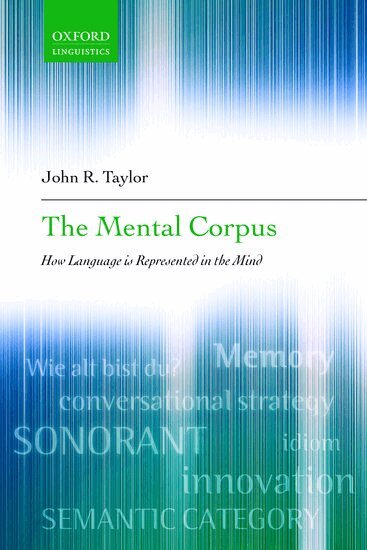
    The Mental Corpus

    How Language is Represented in the Mind

    AvJohn R. Taylor

    Häftad, Engelska, 2014

    615 kr

    Beställningsvara. Skickas inom 7-10 vardagar. Fri frakt över 249 kr.

    Fler format och utgåvor

    Inbunden

    2 171 kr

    Beskrivning

    This book presents a radical reconceptualization of the nature of linguistic knowledge. John Taylor challenges the conventional notion that a language can be understood in terms of the interaction of syntax with a lexicon, the second listing the words and the first the rules for combining them. He proposes instead that an individual's knowledge of a language can be thought of as a repository of memories of linguistic experience. Each encounter with the language, he argues, leaves a trace in our minds. We record the forms of utterances, the concepts and interpretations associated with them, and the contexts in which they were heard or seen. Features of incoming language - a word, a phrase, a meaning, a voice quality, an interactional situation - resonate with items already stored. Similarities between stored items give rise to generalizations of varying degrees of certainty and precision, which in turn are able to sanction new and innovative expressions. John Taylor writes with conviction, clarity, and wit, illustrating every stage of his argument with arresting examples. His account makes a profound and original contribution to understanding the nature of language and the operations of the mind and brain. His book will appeal in equal measure to linguists, philosophers, and cognitive scientists.

    Produktinformation

    • Utgivningsdatum:2014-11-27
    • Mått:157 x 235 x 18 mm
    • Vikt:500 g
    • Format:Häftad
    • Språk:Engelska
    • Antal sidor:330
    • Förlag:OUP OXFORD
    • ISBN:9780199290819

    Utforska kategorier

    • Språkvetenskap och lingvistik inom Språk och ordböcker
    • Psykologi inom Psykologi och pedagogik

    Mer om författaren

    John R. Taylor is the author of Linguistic Categorization (3rd edn 2003), Possessives in English (pbk edn 2003); and Cognitive Grammar (2002) all published by OUP.

    Recensioner i media

    [T]his book is a well-written, accessible, and often compelling account of a very exciting new view of language. Researchers and theoreticians in many areas of Applied Linguistics will find a wealth of ideas brought together in a stimulating and coherent (if occasionally under-specified) way, and students will benefit from the lively discussion and counterpoint Taylor offers of some of the key topics in this field.

    Innehållsförteckning

    • 1. Conceptualizing Language ; 2. The Dictionary and the Grammar Book: The generative model of linguistic knowledge ; 3. Three Words and Their Behaviour ; 4. Idioms ; 5. Speaking Idiomatically ; 6. Constructions ; 7. Frequency ; 8. Skewed Frequencies as a Design Feature of Language ; 9. Learning From Input ; 10. Polysemy ; 11. Creativity and Innovation ; 12. Blending ; 13. The Mental Corpus ; References ; Subject Index ; Index of Names