• Fri frakt över 249 kr
  • •
  • Snabba leveranser
  • •
  • Billiga böcker
Kundservice

Du är på sajten för privatpersoner.

Företag, bibliotek eller offentlig verksamhet?

Du handlar på classic.bokus.com, där alla dina funktioner finns intakta.
Till classic.bokus.com
Bokus logotyp. Gå till startsidan.
  • Erbjudanden
  • Nyheter
  • Student
  • Topplistor
  • Barn & ungdom
  • Bokus Play
  • E-böcker
  • Pocketböcker
  • Spel & pussel

10% rabatt på allt med kod NYSTART10 →

Sidfot

Mina sidor

    Hjälp

    • Kundservice
    • Vanliga frågor och svar
    • Frakt och leverans
    • Retur vid ångerrätt
    • Reklamera vara
    • Betalning
    • Köpvillkor
    • Allmänna villkor
    • Information om webbplatsens tillgänglighet

    Om Bokus

    • Om oss
    • Pressrum
    • För studenter
    • För företag
    • För bibliotek och offentlig verksamhet
    • För leverantörer
    • Hållbarhet

    Populärt

    • Aktuella erbjudanden
    • Presentkort
    • Studentlitteratur
    • Nya böcker
    • Topplistor
    • Signerade böcker
    • Engelska böcker

    Inspiration

    • Boktips
    • BookTok
    • Populära bokserier
    • Barnbokskaraktärer
    • Populära författare
    Logotyp för Bokus
    Följ oss på Facebook (extern länk)Följ oss på Instagram (extern länk)Följ oss på YouTube (extern länk)Följ oss på TikTok (extern länk)
    bokus @ CookiesAnpassa cookiesIntegritetspolicyKöpvillkor
    Till Citymail hemsida (extern länk)Till Budbee hemsida (extern länk)Till Postnord hemsida (extern länk)Till Schenker hemsida (extern länk)Till Early Bird hemsida (extern länk)Till Walleys hemsida (extern länk)
    1. Medicin
    2. Andra medicinska specialiteter
    3. Klinisk psykologi

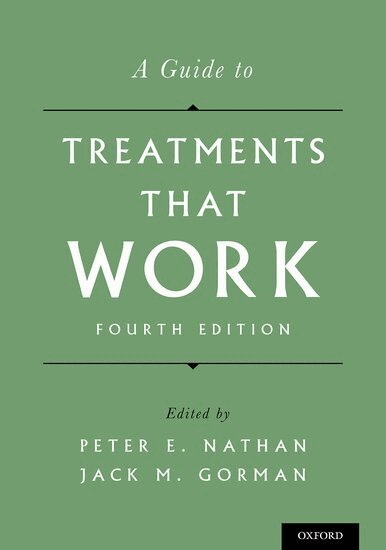
    A Guide to Treatments That Work

    AvPeter E. Nathan,Jack M. Gorman

    Inbunden, Engelska, 2015

    3 306 kr

    Beställningsvara. Skickas inom 5-8 vardagar. Fri frakt över 249 kr.

    Beskrivning

    Like its predecessors, this fourth edition of A Guide to Treatments That Work offers detailed chapters that review the latest research on pharmacological and psychosocial treatments that work for the full range of psychiatric and psychological disorders, written in most instances by clinical psychologists and psychiatrists who have been major contributors to that literature. Similarly, the standards by which the authors were asked to evaluate the methodological rigor of the research on treatments have also remained the same. Each chapter in A Guide to Treatments That Work follows the same general outline: a review of diagnostic cues to the disorder, a discussion of changes in the nomenclatures from DSM-IV to DSM-5, and then a systematic review of research, most of which has been reported within the last few years, that represents the evidence base for the treatments reviewed. In all, 26 of the volume's 28 chapters review the evidence base for 17 major syndromes. Featuring this coverage is a Summary of Treatments that Work, an extended matrix offering a ready reference by syndrome of the conclusions reached by the chapter authors on treatments that work reviewed in their chapters. New to this edition are two chapters at the beginning of the book. Chapter 1 details two perplexing issues raised by critics of DSM-5: the unrealized potential of neuroscience biomarkers to yield more accurate and reliable diagnoses and the lingering problem of conflicts of interest in pharmaceutical research. Chapter 2 contrasts Native American and western ways of identifying effective treatments for mental and physical disorders, concluding that "evidence-informed culture-based" interventions sometimes constitute best practices in Native communities. Two chapters detailing pharmacological treatments for pediatric bipolar disorder (Chapter 9) and pediatric depressive disorder (Chapter 12) have also been added. More than three quarters of the chapters are written by colleagues who also contributed to most or all of the previous editions. Hence, this new edition provides up-to-date information on the quality of research on treatment efficacy and effectiveness provided by individuals who know the research best.

    Produktinformation

    • Utgivningsdatum:2015-08-20
    • Mått:191 x 254 x 55 mm
    • Vikt:1 882 g
    • Format:Inbunden
    • Språk:Engelska
    • Antal sidor:988
    • Upplaga:4
    • Förlag:OUP USA
    • ISBN:9780199342211

    Utforska kategorier

    • Klinisk psykologi inom Medicin
    • Psykiatri inom Medicin
    • Arbetsterapi inom Medicin

    Mer om författaren

    Peter E. Nathan, PhD, received his PhD in Clinical Psychology from Washington University in 1962. After spending two years as a research fellow, he then joined the Harvard psychiatry service at Boston City Hospital. In 1969, he became a Professor of Psychology and Director of Clinical Training at Rutgers University, later serving as Henry and Anna Starr Professor and Director of the Rutgers Center of Alcohol Studies. In 1990 he accepted the position of Provost and Distinguished Professor of Psychology at the University of Iowa and became Emeritus in 2007.Jack M. Gorman, MD, received his medical degree from the College of Physicians and Surgeons of Columbia University in 1977 and did residency and fellowship training in the Columbia University Department of Psychiatry/New York Psychiatric Insitute program. He remained on the fac ulty of Columbia University's Department of Psychiatry for the next 25 years, eventually serving as Lieber Professor of Psychiatry. He then became the Esther and Joseph Klingenstein Professor and Chair of Psychiatry and Professor of Neuroscience at the Mount Sinai School of Medicine. He is currently CEO and Chief Scientific Officer, Franklin Behavioral Health Consultants.

    Recensioner i media

    It is remarkably thorough without being overwhelming. The information is readily accessible and is useful for clinicians who are referring to it briefly, or opening it to brush up on the literature in a given area. But this book's main strength is that the authors also are using an evidence-based approach to psychotherapy for many major psychiatric conditions, an area many clinicians unfortunately neglect in their treatment recommendations. This is a worthy effort and one book likely to be used over and over, not accumulating dust on a shelf.

    Innehållsförteckning

    • Preface ; Contents ; Contributors ; Summary of Treatments that Work ; 1. Challenges to Implementing Evidence-Based Treatments ; Jack M. Gorman & Peter E. Nathan ; 2. Evidence-Informed, Culture-Based Interventions and Best Practices in American Indian and Alaska Native Communities ; R. Dale Walker & Douglas A. Bigelow ; 3. Nonpharmacological Treatments for Childhood ADHD and their Combination with ; Medication ; Linda J. Pfiffner & Lauren M. Haack ; 4. Pharmacological Treatments for Attention-Deficit/Hyperactivity Disorder and ; Disruptive Behavior Disorders ; Erica Kass, Jonathan Posner, & Laurence L. Greenhill ; 5. Psychosocial Treatments for Conduct Disorder in Children and Adolescents ; Alan E. Kazdin ; 6. Pharmacological Treatments for Schizophrenia ; Athier Abbas & Jeffrey Lieberman ; 7. Cognitive and Social Cognitive Interventions for Schizophrenia ; Matthew M. Kurtz ; 8. Pharmacological Treatments for Bipolar Disorder ; Paul E. Keck, Jr., & Susan L. McElroy ; 9. Treatments for Pediatric Bipolar Disorder ; Pablo Goldberg, Prerna Martin, Carolina Bieracki, & Moira Rynn ; 10. Psychosocial Treatments for Bipolar Disorder ; Anjana Muralidharan, David J. Miklowitz, & W. Edward Craighead ; 11. Pharmacological Treatments for Unipolar Depression ; Stefania Prendes-Alvarez, Alan F. Schatzberg, & Charles B. Nemeroff ; 12. Treatments for Pediatric Depression ; Carolina Biernacki, Prerna Martin, Pablo Goldberg, & Moira Rynn ; 13. Psychosocial Treatments for Major Depressive Disorder ; W. Edward Craighead, Benjamin N. Johnson, Sean Carey, & Broadie ; W. Dunlop ; 14. Psychological Treatments for Panic Disorders, Phobias, and Social and Generalized ; Anxiety Disorders ; David H. Barlow, Laren R. Conklin, & Kate H. Bentley ; 15. Pharmacological Treatments for Panic Disorder, Generalized Anxiety Disorder, Specific ; Phobia, and Social Anxiety Disorder ; Ryan J. Kimmel, Peter P. Roy-Byrne, & Deborah S. Cowley ; 16. Combination Pharmacotherapy and Psychotherapy for the Treatment of Major ; Depressive and Anxiety Disorders ; Cindy J. Aaronson, Gary Katzman & Rachel L. Moster ; 17. Treatments for Obsessive-Compulsive Disorder ; Darin D. Dougherty, Scott L. Rauch, & Michael A. Jenike ; 18. Psychosocial Treatments for Posttraumatic Stress Disorder ; Lisa M. Najavits & Melissa L. Anderson ; 19. Pharmacological Treatment of Posttraumatic Stress Disorder ; Julia A. Golier, Andreas C. Michaelides, Maya Genovesi, Emily Chapman, & Rachel ; Yehuda ; 20. Treatments for Eating Disorders ; Kathleen M. Pike, Loren M. Gianini, Katharine L. Loeb, & Daniel Le Grange ; 21. Treatment of Sleep Disorders ; Deepa Burman, Daniel J. Buysse, & Charles F. Reynolds, III ; 22. Pharmacotherapy and Psychotherapy for Sexual Dysfunctions ; R. Taylor Segraves ; 23. Psychosocial Treatments for Substance Use Disorders ; Daniel M. Blonigen, John W. Finney, Paula L. Wilbourne, & Rudolf H. Moos ; 24. Psychopharmacological Treatments for Substance Use Disorders ; James R. McKay, Henry R. Kranzler, Kyle M. Kampman, Rebecca L. Ashare, & Robert A. Schnoll ; 25. Treatments for Gambling Disorder and Impulse Control Disorders ; Jon E. Grant, Brian L. Odlaug, & Marc N. Potenza ; 26. Treatments for Neurocognitive Disorders ; Pei Huey Nie & David L. Sultzer ; 27. Psychological Treatments for Personality Disorders ; Paul Crits-Christoph & Jacques P. Barber ; 28. Psychopharmacological Treatment of Personality Disorders ; M. Mercedes Perez-Rodriguez & Larry J. Siever